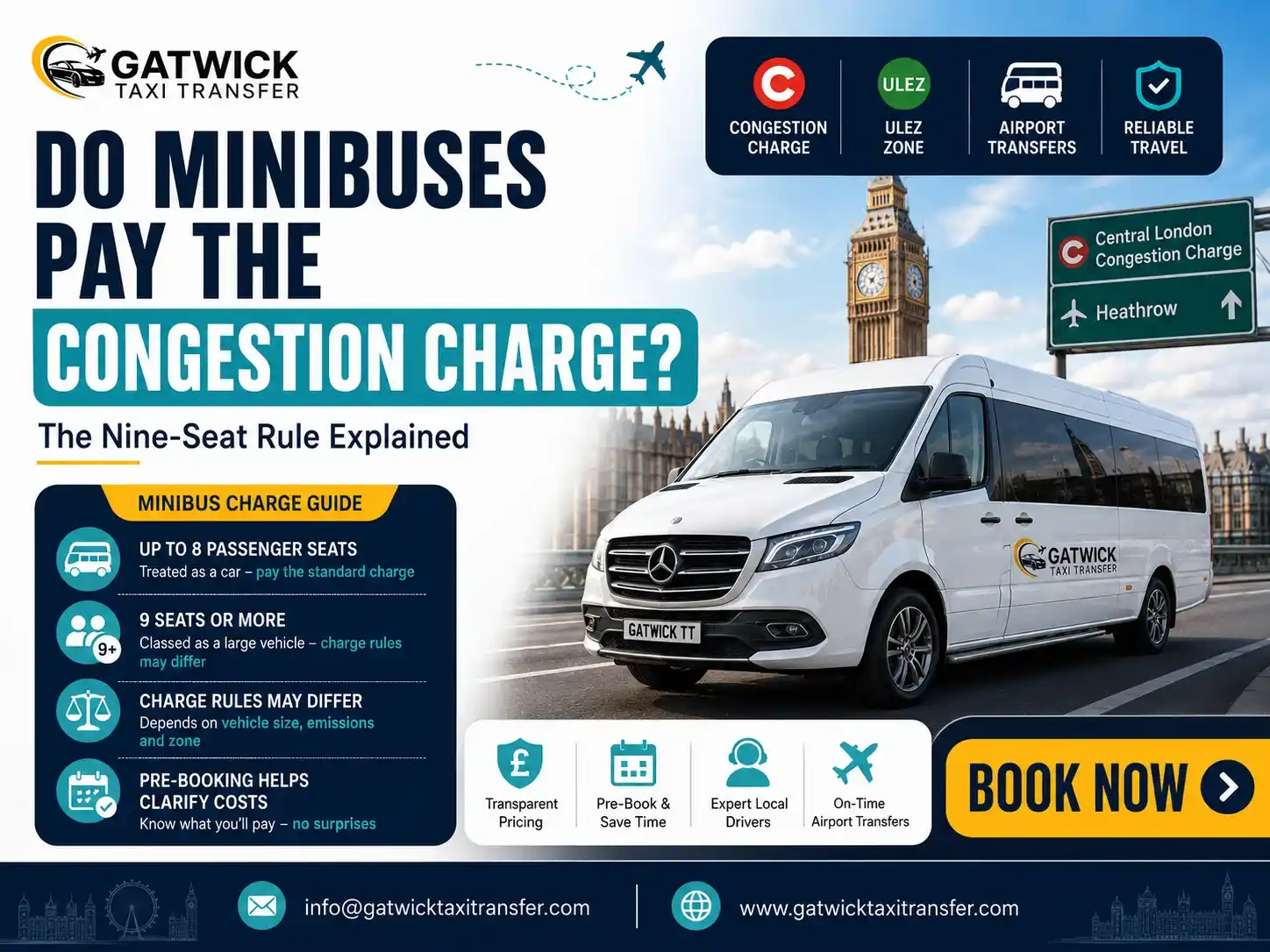
No, where the vehicle carries nine or more passengers. Transport for London grants those a full discount, which places an eighteen-pound cliff edge in a peculiar spot: an eight-seat vehicle pays in full while a ten-seat minibus pays nothing whatsoever. Almost nobody in the transfer trade explains this, and the clearest account of it online is a forum post from 2013 written by somebody who found out by accident. Every figure below comes from Transport for London rather than another operator's summary.
Nine seats is the line. At or above it the Congestion Charge disappears entirely. Below it, the full £18 applies.
The discount is not automatic. TfL registration is required unless the vehicle is DVLA-licensed as a bus. £10 a year per vehicle.
Ordinary minicabs pay in full. TfL states plainly they are not exempt. Licensed taxis are, and from ULEZ as well.
ULEZ is a separate thing. £12.50, all 32 boroughs, round the clock, and only for vehicles failing the emissions standard.
The Rule in One Table
Transport for London grants a full discount to vehicles carrying nine or more passengers. Everything else on this page follows from that single line.
| Vehicle | Seats | Charge |
|---|---|---|
| Saloon | 3 | £18 |
| Estate or MPV | 5–7 | £18 |
| Eight seater | 8 | £18 — one seat short |
| Ten seater | 10 | Nothing |
| Twelve seater | 12 | Nothing |
| Sixteen seater | 16 | Nothing |
The two shaded rows are two seats apart and eighteen pounds apart. Nobody need be sitting in those seats for the discount to apply; the vehicle simply has to have them.
Why so few people know this
It sits in TfL's discounts and exemptions pages rather than anywhere a passenger would look, and the transfer trade almost never mentions it. Search for it and the clearest explanation online is a forum thread from 2013, written by somebody who was upgraded from an eight-seater to a nine-seater and noticed the charge had vanished.
Operators that hold the discount know. Passengers comparing quotes generally do not, which means an £18 difference sits inside a comparison without either side mentioning it.
It is not automatic
Registration with TfL is required unless the vehicle is licensed with the DVLA in a bus taxation class. It costs £10 a year per vehicle and needs a V5C plus proof of the seat count.
So a firm running minibuses either did that paperwork or is paying £18 a day it need not. Worth asking, because it distinguishes a managed fleet from a collection of vehicles. Our minibus classes start at ten seats.
Two Charges, Constantly Confused
They cover different areas, run at different times, apply for different reasons and can both land on the same journey. Worth separating before anything else.
| Congestion Charge | ULEZ | |
|---|---|---|
| Daily cost | £18 | £12.50 |
| Area | Central zone only | Every borough, 32 of them, plus the City |
| Hours | Daytime, see below | 24 hours |
| Applies to | Every vehicle in the zone | Only non-compliant vehicles |
| Purpose | Reducing traffic volume | Reducing emissions |
| Both on one journey? | Yes — £30.50 combined | They are cumulative |
Row four is the distinction that matters most for a passenger. The Congestion Charge falls on everyone inside the zone regardless of what they drive. ULEZ falls only on vehicles that fail the emissions standard, so a compliant modern vehicle pays it never.
Why this matters for an airport journey
Gatwick sits outside London entirely, so any run into the capital crosses the ULEZ boundary. That sounds alarming and mostly is not: a properly maintained fleet is compliant and the charge simply does not arise.
The Congestion Charge is the one to watch, because it depends on where you are going rather than what you are travelling in. Fares by destination sit in our route-by-route breakdown.
Who Pays, and Who Does Not
Here is where the assumptions go wrong, and TfL's own wording is unusually direct about it.
Transport for London states that private hire vehicles are not exempt from the Congestion Charge. Licensed taxis are, for as long as the vehicle remains on the register.
| Vehicle | Pays? | Detail |
|---|---|---|
| Licensed taxi | No — and no ULEZ either | Exempt from both while on the TfL register |
| Private hire vehicle | Yes, in full | TfL states plainly they are not exempt |
| Wheelchair-accessible PHV | No | Exempt while fulfilling a booking |
| Nine or more seats | No | 100% discount, registration required |
| Electric car on Auto Pay | £13.50 | 25% off, only if registered |
| Electric car, not registered | Full £18 | The discount is not automatic |
| Blue Badge holder | No | 100% discount, up to two vehicles |
| Motorcycles | Exempt from CC | Still liable for ULEZ |
The first two lines together are the honest part of this page. A black cab crossing the zone pays nothing where we pay £18 on the same road at the same hour. And the exemption runs further than that: licensed taxis are exempt from ULEZ as well, so on a non-compliant vehicle the gap would be £30.50 rather than £18.
What that asymmetry is actually worth
Up to £30.50 on those two components, set against a metered fare that climbs while stationary versus a fixed price that does not. Which wins depends entirely on the hour and the traffic.
On a clear morning the exemption is a genuine advantage to a taxi. On a slow weekday afternoon into the zone, a meter can consume that £18 and considerably more while a fixed fare sits still. Our comparison of ranks and reservations sets out where each approach earns its place.
Ask Whether It Is Inside the Number — Before You Book
Eighteen pounds is a quarter of a saloon fare into the zone · Too large to discover at the destination
The Nine-Seat Cliff Edge
This is the rule almost nobody knows, and it produces a result that looks like a mistake until you see where the line sits.
Vehicles with nine or more seats receive a 100 per cent discount. So an eight-seat vehicle pays £18 into the zone and a ten-seat minibus pays nothing whatsoever.
| Vehicle | Seats | Fare | Charge | Total | Each |
|---|---|---|---|---|---|
| Saloon | 3 | £68 | £18 | £86 | £28.67 |
| MPV8 | 8 | £110 | £18 | £128 | £16.00 |
| 10 seater | 10 | £172 | £0 | £172 | £17.20 |
| 12 seater | 12 | £204 | £0 | £204 | £17.00 |
| 14 seater | 14 | £218 | £0 | £218 | £15.57 |
| 16 seater | 16 | £234 | £0 | £234 | £14.62 |
Read the two shaded pairs. An MPV8 carrying eight people pays £18 that a ten-seat minibus does not, and the entire difference sits in a pair of seats nobody may be sitting in.
What the charge is worth as a proportion
On a saloon into the zone, £18 is roughly a quarter of the fare. On an MPV8 it is about a sixth. On anything above eight seats it is nothing at all.
That makes the charge disproportionately expensive for small parties and irrelevant for large ones, and most surcharges do exactly the reverse. Capacities across each class sit on our fleet page.
The registration nobody mentions
The discount is not automatic. A vehicle must be registered with TfL unless it is DVLA-licensed in a bus taxation class, which costs £10 a year per vehicle and requires a V5C plus proof of the seat count. Charges in the context of a whole journey appear in our Gatwick transfer guide.
So an operator running minibuses either has done that paperwork or is paying £18 a day it did not need to. Worth asking, because it is the sort of detail that separates a managed fleet from a collection of vehicles. Our minibus page covers the classes we run.
What It Costs, and What Changed
Two dates in the last eight months moved figures that had been stable for years.
| Amount | When it applies | |
|---|---|---|
| Standard daily charge | £18 | Settled beforehand or same-day |
| Late payment | £21 | By midnight on the third day after |
| Electric car on Auto Pay | £13.50 | 25% discount, registration required |
| Penalty Charge Notice | £180 | If unpaid and cameras logged the trip |
| PCN paid promptly | £90 | Within 14 days |
| Nine or more seats | £0 | 100% discount, registered |
The rise on 2 January 2026
It moved up by three pounds, from fifteen to eighteen, having sat still for five years. Late payment moved from £17.50 to £21 at the same time.
That is a twenty per cent rise landing in one step after half a decade of stability, which is why quotes and guides written in 2025 are now understating it. Our route pricing was compiled after the change.
The end of the electric exemption
Until 25 December 2025 a battery electric or hydrogen vehicle entered the zone free under the Cleaner Vehicle Discount. That discount was discontinued on that date.
From 2 January 2026 a tiered replacement gives electric cars, private hire vehicles included, twenty-five per cent off — £13.50 rather than £18. The catch is that it applies only where the vehicle is registered on Auto Pay, and without that registration an electric vehicle pays exactly what a diesel one does.
When Does It Apply?
Here we are going to be straight with you about a discrepancy rather than pick whichever answer suits.
Transport for London's January 2026 notice to the trade gives the charging hours as 07:00 to 18:00 every day except Christmas Day. Earlier published guidance described shorter hours at weekends, typically noon to 18:00.
| Source | Hours given |
|---|---|
| TfL trade notice, January 2026 | 07:00–18:00, every day except Christmas Day |
| Earlier published guidance | 07:00–18:00 weekdays; 12:00–18:00 weekends |
We have not been able to reconcile the two, and rather than pick one we would rather say so. The more recent and more authoritative document is the trade notice, so that is what appears throughout this page, but check TfL's current page if your journey falls on a weekend morning.
One thing that is not in dispute
The charge is daily rather than per entry. Cross the zone once or six times on the same day and the amount is identical, which occasionally matters on a journey with several stops inside the boundary.
Does the Zone Cover Where You Are Going?
Frequently not, and "central London" is a much larger idea than the charging zone.
| Inside — charge applies | Outside — no charge |
|---|---|
| The West End and Soho | Kensington |
| King's Cross | Notting Hill |
| Buckingham Palace | Hammersmith |
| Covent Garden | Chelsea |
| The City | Paddington |
| Fitzrovia and Marylebone | Canary Wharf |
| Roughly Vauxhall to Clerkenwell | Clapham |
Two hotels a few miles apart can therefore carry different totals for the same journey length, and Paddington sitting outside while Marylebone sits inside catches people out regularly.
Where the boundary actually runs
The line follows the Inner Ring Road rather than anything a visitor would recognise on the ground. There are no barriers and nothing marking a crossing beyond signage that is easy to miss at speed.
Paddington sitting outside while Marylebone sits inside is the clearest illustration: the two are a short walk apart, one attracts £18 and the other attracts nothing. Nobody arriving from abroad could reasonably be expected to know that, which is why it belongs on the booking form rather than in the passenger's head.
This is one more reason handing over the complete address beats naming a town or district when a quote is being built. Where the postcode falls decides whether £18 enters the calculation at all, and our Gatwick transfers page quotes against a full postcode instead of a district.
Who Else Gets Out of Paying?
That list runs further than anyone assumes, and a few of its entries concern people rather than vehicles.
| Category | Relief | Condition |
|---|---|---|
| Nine or more seats | 100% | Registration required unless DVLA bus class |
| Blue Badge holders | 100% | Up to two vehicles |
| Residents inside the zone | 90% | Closed to new applicants since 2020 |
| Accredited breakdown vehicles | 100% | Recognised accreditation needed |
| Motor tricycles | 100% | Under 1m wide, 2m long |
| NHS patients | Reclaimable | Where too ill for public transport |
| Emergency and armed forces | Exempt | Typically no registration |
The sixth line is worth knowing and rarely publicised: patients deemed too unwell to travel by public transport can reclaim both this charge and ULEZ, arranged through the hospital rather than TfL.
The resident discount is closed
Ninety per cent off for people living inside the zone sounds generous and is, but it stopped accepting new applicants in 2020. Anyone moving into the area since then pays in full.
That matters for a transfer only in one situation: a passenger returning to a zone address may assume their own discount covers the vehicle carrying them. It does not, because the relief attaches to a registered vehicle rather than to a person.
Registration is the recurring theme
Nearly every entry above requires applying in advance and, for several, an annual fee of £10 per vehicle. None of it happens automatically because a vehicle qualifies.
So an operator either did the paperwork or is paying charges it need not. Our accessible vehicles page covers the class where this matters most.
How the Charge Changes a Comparison
Eighteen pounds is large enough to reverse the result of a price comparison, which makes it worth putting into the arithmetic rather than leaving beside it.
| Class | Fare | Charge | As a share |
|---|---|---|---|
| Saloon | £68 | £18 | 26 per cent |
| MPV8 | £110 | £18 | 16 per cent |
| 10 seater and above | £172+ | £0 | Nothing |
A quarter of a saloon fare is not a rounding item. It is the difference between two quotes that looked fifteen pounds apart before anybody mentioned it.
Against a ride-hailing app
Apps operating in the zone face the same charge and recover it the same way, so the comparison is not distorted by this particular item. What does distort it is dynamic pricing, which moves with demand while a fixed fare does not.
Our comparison against ride-hailing sets out where each comes out ahead.
Against rail
Trains obviously pay nothing, so on a solo journey into the zone the charge widens an already existing gap. For a group it barely registers, because the vehicle carrying nine or more pays no charge at all and the per-head figure was already the argument.
Where the crossover falls is set out in our rail comparison, which uses fares without the charge and therefore understates the road option slightly on zone destinations.
What Counts as ULEZ-Compliant?
Worth spelling out, because "non-compliant" is doing a lot of work in most explanations and it has a precise meaning you can check yourself.
| Fuel | Standard required | Roughly | Charge if not met |
|---|---|---|---|
| Petrol | Euro 4 or better | Registered after 2005 | £12.50 a day |
| Diesel | Euro 6 or better | Registered after September 2015 | £12.50 a day |
| Fully electric | Exempt | Any age | Nothing |
| Licensed taxi | Exempt | Subject to age limits | Nothing |
People come unstuck on the diesel line. A diesel registered in 2014 looks modern, drives well and is non-compliant, so it pays £12.50 every day it enters Greater London regardless of condition.
Why it rarely affects a licensed transfer
Private hire licensing already forces vehicles towards newer standards, and newly licensed vehicles in London face zero-emission-capable requirements on top. The result is that a properly licensed fleet is compliant almost by construction.
So on a booked transfer the ULEZ line is usually academic. Where it matters is a hire car or a private vehicle, and TfL runs a registration checker for exactly that purpose.
How the Charge Is Actually Paid
Not your problem on a booked transfer, and worth knowing anyway because it explains why the deadline matters more than the amount.
| Route | Best for | Note |
|---|---|---|
| Auto Pay | Anyone driving in regularly | Required for the electric discount |
| TfL website | One-off journeys | Advance or same day |
| Pay to Drive in London app | Both charges in one place | Congestion Charge and ULEZ together |
| Telephone | Where online is impractical | Call charges apply |
| Not paying | — | £180, halved to £90 within 14 days |
The first line matters for a reason beyond convenience. The 25 per cent electric discount exists only through Auto Pay, so an operator running electric vehicles without registering is paying £18 where £13.50 was available.
The deadline is the trap
Payment is due by midnight on the third day after travel, and the zone has no barriers to remind anybody. A driver who simply forgets receives a penalty rather than a bill.
On a fixed fare that administration sits with the operator, which is one of the quieter arguments for booking. Somebody who does this daily is unlikely to forget in a way that a visitor driving in once might. Our comparison of booking against arriving covers what else moves across when a fare is fixed.
The Charge Alongside Airport Levies
London has six airports and every one of them charges for the forecourt. Combined with the Congestion Charge, the total of things that can sit outside a quote adds up quickly.
| Airport | Drop-off | Plus Congestion Charge if in zone |
|---|---|---|
| Gatwick | £10 | £28 combined |
| Stansted | £10 | £28 combined |
| London City | £8 | £26 combined |
| Heathrow | £7 | £25 combined |
| Luton | £7 | £25 combined |
| Southend | £7 | £25 combined |
Twenty-eight pounds on a Gatwick run into the zone is the worst case, and on a £68 saloon fare that is over forty per cent sitting either inside the quoted figure or outside it.
One question covers both
Asking whether a quote includes the airport charge and any Congestion Charge takes a single sentence and settles the largest variable in the comparison. Full figures by airport sit in our survey of forecourt pricing.
A third item joined them on the same date. From 2 January 2026, twenty per cent VAT applies to ride-hailing fares in London, landing on the day the zone charge itself climbed. Two cost increases in twenty-four hours, and most guides written before then reflect neither.
What This Means Practically
Six things follow from everything above, and none of them requires understanding the scheme in detail.
| Action | Why | |
|---|---|---|
| 1 | Give the full destination postcode | It decides whether the charge applies at all |
| 2 | Ask whether the quote includes it | £18 is too large to discover later |
| 3 | Mention the travel time | Travel wholly outside the hours and nothing is due |
| 4 | For nine or more, ask about the discount | A registered minibus pays nothing |
| 5 | Ask about the forecourt levy too | The other charge, same question |
| 6 | Get the answer in writing | A verbal assurance settles no argument |
Points two and five together account for about £28 that can sit either inside a quoted figure or outside it. On a £68 saloon fare that is over forty per cent of the headline price, which is why they belong in the same question.
Timing occasionally helps
A journey wholly outside charging hours incurs nothing, so an evening arrival into a zone address after the charging period simply does not attract it. This is not something to plan a flight around, but it does explain why the same route can be quoted differently at different times.
It also cuts the other way on early departures. A collection before seven leaving a zone address is outside the hours; one at eight is not.

Is It Inside Your Fare?
It should be, and the question is worth asking directly rather than assuming either way.
An operator taking a booking knows the destination and the time before you travel, which means it can price the charge. There is no reason for it to appear afterwards.
| Approach | What it means for you |
|---|---|
| Absorbed into the fixed fare | The quoted figure is the figure |
| Itemised in the quote | Transparent, and comparable |
| Added at the destination | A £18 surprise on arrival |
| Not mentioned at all | Ask before booking |
The bottom two lines are why comparing two quotes on the headline alone produces the wrong answer. A figure £15 below another that adds the charge afterwards finishes £3 above it.
The same problem as the airport levy
This is structurally identical to the terminal forecourt charge, which is also either inside a fare or bolted on at the end. Two charges, same question, and both large enough to reverse a comparison.
Our guide to airport forecourt charges covers the other half of it. Between the two, roughly £28 can sit either inside a quoted fare or outside it.
Questions About the Charges
Related Guides
One Figure, Everything In — Nothing Added at the Kerb
Congestion Charge where it applies · Forecourt levy absorbed · Priced from your postcode · Fixed when you book