This is the top of the range, which changes the question you should be asking. With every smaller vehicle the fallback is simple — size up. Here there is nothing to size up to. Sixteen belted seats come with twelve suitcase spaces, so a group where everyone brings a hold bag is four cases beyond what fits, and the answer at that point is a trailer, a second vehicle or a coach. This guide covers what genuinely fits, what it costs to every UK airport and port, and how sixteen people should organise a booking so it holds together on the morning.
Sixteen seats, twelve cases. A ratio of 0.75. Everyone bringing a hold bag puts you four over, and there is no larger vehicle to move to.
Cheapest per person in the fleet when full: £14.62 to Gatwick, against £17.20 for a 10 seater and £13.75 for an MPV8 carrying eight.
The comparison that matters: not one minibus against one taxi. Sixteen people need four vehicles otherwise — roughly £380 against £234.
If it does not fit: a trailer for luggage volume, two vehicles for more than sixteen people, a coach beyond that. All three need arranging in advance.
Why Is Passenger Count the Wrong Starting Point?
Two groups, both sixteen people, both flying from Gatwick on the same morning. One fits this vehicle without difficulty. The other does not fit it at all.
| Group A | Group B | |
|---|---|---|
| Passengers | 16 | 16 |
| Large suitcases | 8 | 16 |
| Cabin bags | 8 | 12 |
| Pushchairs | None | 2 |
| Fits a 16 seater? | Comfortably | Four cases over, plus buggies |
| What it needs | One vehicle | Trailer, or a second vehicle |
Nothing separates those groups on a booking form that asks only for passenger numbers. Everything separates them on the driveway at five in the morning.
Which is why any useful group booking starts with two figures rather than one: how many people, and how much are they bringing. The second is harder to establish because it means asking sixteen individuals what they are packing, and it is the one that decides whether the vehicle works.
What Does a 16 Seater Genuinely Hold?
Sixteen belted passengers, twelve large suitcases and sixteen cabin cases — figures you can set against every other class on our fleet page. A large case here means the 75 to 80 cm hold bag weighing up to 23 kg that most people fly with — not the 65 to 70 cm medium case some capacity claims quietly assume.
Twelve cases against 16 seats gives a ratio of 0.75 bags per passenger, and reading that against the rest of the range is instructive because it is not the best figure available.
| Vehicle | Seats | Large cases | Ratio | Comment |
|---|---|---|---|---|
| MPV8 | 8 | 7 | 0.88 | Best balance in the range |
| 10 seater | 10 | 8 | 0.80 | Strong for its size |
| 12 seater | 12 | 8 | 0.67 | Weakest ratio; seats without boot |
| 14 seater | 14 | 12 | 0.86 | Where hold capacity jumps |
| 16 seater | 16 | 12 | 0.75 | Most seats, same boot as the 14 |
The step from fourteen seats to sixteen adds two passengers and four cabin positions. It adds nothing to the hold. That is worth knowing before assuming the largest vehicle automatically solves a luggage problem, because on hold capacity it solves nothing the 14 did not already.
Where the 16 earns its place is head count and flexibility. Fifteen or sixteen travellers have no alternative in a single vehicle. Fourteen travellers whose number might still move have a genuine reason to hold two spare belts.
What Happens When Sixteen Seats Are Not Enough?
Every other vehicle in this range has a fallback: take the next size up. This one does not, and that changes how the conversation should go.
Three routes remain, and which applies depends entirely on what ran out first.
| What ran out | The answer | Notice needed | Worth knowing |
|---|---|---|---|
| Luggage space, seats fine | Towed trailer | 48 hours minimum | Not every vehicle or driver is set up to tow |
| Seats, 17–30 passengers | Two vehicles running together | 1 week | Both drivers briefed on one plan and one contact |
| Seats, 30 or more | Coach | 1–2 weeks | Different licensing category; access restrictions apply |
| Oversized items only | Trailer | 48 hours | Skis, instruments, competition kit, bicycles |
The trailer route
Where the constraint is volume rather than seats, a trailer solves it without a second driver or a second fare structure. Five sets of golf clubs, a full ski party, sixteen cruise cases, a sports squad's competition equipment — all of these fit the pattern. It needs raising at the quote stage because towing capability is not universal across the fleet.
Two vehicles, one plan
Above sixteen passengers you are into a second vehicle regardless of luggage. The thing that makes this work is treating it as one booking with two vehicles rather than two separate bookings — same collection time, same terminal, both drivers briefed together, one named organiser holding both confirmations.
When a coach is genuinely the answer
Beyond about thirty passengers the minibus approach stops making sense. Coaches carry a different licensing category, have different access restrictions at some pickup addresses, and need considerably more notice. If your group is that size, say so at the first enquiry rather than working up through vehicle classes.
Why Do Some 16 Seaters Take More Luggage?
This is the detail that explains most of the disagreement between capacity claims, and almost nobody states it plainly: not every 16 seater has a boot.
Standard conversions carry luggage in overhead racks and whatever space remains behind the last row, which is why the published fleet specification matters more than the seat count. Executive specifications are built with a dedicated rear compartment sized for full hold cases. Same seat count, materially different luggage outcome — which is why one operator quotes eight cases and another sixteen without either of them inventing anything.
| Standard conversion | Executive specification | |
|---|---|---|
| Luggage storage | Overhead racks plus rear space | Dedicated boot for full-size cases |
| Suits | Day trips, short runs, light bags | Airport transfers, cruise, corporate |
| Seating | Durable cloth | Reclining, often leather |
| Climate | Air conditioning | Zoned climate control |
| Power and connectivity | Limited or none | USB points, Wi-Fi on some vehicles |
| Airport suitability | Only with light luggage | Built for it |
Our twelve-case figure describes a vehicle with a proper rear compartment. A standard conversion with overhead racks takes materially less than that in full-size cases, however many seats it has, because racks hold cabin bags rather than 23 kg hold luggage.
What Sizes Exist Above a 16 Seater?
Saying "a coach" is not much help when your group is nineteen. The ladder above this vehicle is more granular than most people expect, and knowing it prevents both over-booking and the assumption that two minibuses are the only option.
| Class | Capacity | Sensible for | Access note |
|---|---|---|---|
| 16 seater minibus | 16 | Up to 16 with 12 cases | Reaches most residential addresses |
| 19 seater minibus | 19 | 17–19 passengers | Still minibus-sized on the road |
| 22–25 seater mini coach | 22–25 | 20–25, or 16 with heavy luggage | Needs turning space; check narrow streets |
| 30–37 seater midi coach | 30–37 | Larger parties, school groups | Restricted on many residential roads |
| 49–55 seater coach | 49–55 | Full coach parties | Designated coach access only |
The row worth noticing is the mini coach. A group of sixteen whose luggage exceeds twelve cases does not necessarily need a trailer — a 22 or 25 seater carries the same people with considerably more hold space, and on some routes prices closer to a 16 seater than you would guess.
Access is the trade. Minibuses reach virtually any residential address. Mini coaches need turning room. Full coaches are restricted on narrow streets and at some hotel frontages entirely, which occasionally makes two minibuses the practical answer even where one coach would be cheaper.
How Much Is a 16 Seater to Each Airport?
What follows covers the vehicle entire, departing the middle of town, with the terminal levy swallowed into every figure. Divide by a full load and you arrive at the right-hand column.
| Airport | Miles | Forecourt | Vehicle | Each of 16 |
|---|---|---|---|---|
| London City LCY | ~11 mi | £8 | £177 | £11.06 |
| Heathrow LHR | ~16 mi | £7 | £189 | £11.81 |
| Luton LTN | ~37 mi | £7 | £230 | £14.38 |
| Gatwick LGW | ~40 mi | £10 | £234 | £14.62 |
| Stansted STN | ~45 mi | £10 | £241 | £15.06 |
| Southend SEN | ~45 mi | £8 | £287 | £17.94 |
The per-head figure is the point
At £14.62 each to Gatwick, a filled 16 seater is the lowest per-person cost of anything we operate — below the 10 seater at £17.20 and the 12 seater at £17.00, and within a pound of an MPV8 carrying eight.
That only holds when the vehicle is full. Twelve people in a 16 seater pay £19.50 each, which is worse than booking the 12. The economics reward filling the seats, not reserving them.
No weekend or seasonal loading
Worth stating because it is not universal. A common practice across minibus hire is a Saturday premium of 10 to 20 per cent, applied because demand concentrates there. We do not operate one. A Saturday collection is priced identically to a Tuesday collection on the same route, as is a 03:30 departure against a 15:30 one.
The reason to raise it is comparison. A quote that looks £30 lower on a Wednesday may not be lower on the Saturday you are actually travelling. Ask any operator whether the figure they have given you is day-specific before setting it against ours.
ULEZ and the Congestion Charge
Our minibuses meet the Ultra Low Emission Zone standard, so no ULEZ charge arises on any London journey. Where a route crosses the Congestion Charge zone during charging hours, that charge sits inside the quoted fare rather than appearing afterwards.
This matters more on group work than it sounds. A vehicle that is not ULEZ-compliant attracts a daily charge that has to be recovered from somewhere, and on a booking priced before the journey that recovery is rarely visible until the invoice.
Sixteen Travelling Together — One Vehicle, One Fixed Price
Sixteen belts · Levy inside the price · No charge for child seats · Someone qualified driving
Is One 16 Seater Cheaper Than Several Cars?
Substantially, and the comparison most people run is the wrong one. Nobody sets a minibus fare against a single taxi fare, because a single taxi was never going to carry sixteen people.
| Arrangement | Vehicles | Total | Each | Arrival times |
|---|---|---|---|---|
| One 16 seater | 1 | £234 | £14.62 | One |
| Two 8 seater MPVs | 2 | £220 | £13.75 | Two |
| Four MPV7s | 4 | £380 | £23.75 | Four |
| One 12 + one saloon | 2 | £273 | £17.06 | Two |
Four MPV7s cost £146 more than one minibus — 62 per cent above — and produce four separate journeys. That is the comparison worth making, and it is decisive.
The second row is the honest complication. Two MPV8s come to £220 — fourteen pounds less than the minibus, and they carry fourteen cases between them against the minibus's twelve. On pure arithmetic they win. What they cost you is a single arrival: two vehicles, two departure times, two drivers, and a group that reassembles at the terminal rather than arriving as one.
Which Terminal Does a Group of Sixteen Need?
Terminal errors cost the same in money whatever the vehicle. They cost far more in disruption when sixteen people are involved.
| Airport | Terminals | Second charge | Time lost |
|---|---|---|---|
| Gatwick | 2 — North, South | £10 | 15–20 min |
| Heathrow | 4 — T2, T3, T4, T5 | £7 | 10–30 min |
| Stansted | 1 | Not possible | — |
| Luton | 1 | Not possible | — |
| London City | 1 | Not possible | — |
A mile of separation sits between Gatwick's two buildings, each reached by its own spur, with a shuttle covering the gap in about 3 minutes at no cost. Heathrow spreads across 4 operating terminals: 2 and 3 clustered centrally, 4 and 5 each on a road of its own. Terminal 1 has not appeared on a boarding pass since 2015.
Those shuttles and terminal trains exist for pedestrians. Neither carries a 16 seater, which is obliged to leave the perimeter and come back in via another entrance. Your sixteen passengers could walk it in 5 minutes; their 12 cases and the vehicle carrying them cannot.
How Early Should Sixteen People Leave?
Add thirty minutes to whatever you would allow for a family of four, and the reason has nothing to do with the road.
Sixteen people unloading twelve cases, assembling at a kerb and moving into a terminal together simply takes longer than four people with two bags. That time falls between the vehicle stopping and the group reaching a check-in desk, and it is the step most commonly left out of the plan entirely.
| Step | Allow | Why it differs for sixteen |
|---|---|---|
| Airline recommended arrival | 2 hrs short-haul, 3 long-haul | Same for any group size |
| Group assembly at the terminal | +30 min | Unloading and gathering sixteen people |
| Journey time | Route dependent | Same as any vehicle |
| Loading at the pickup | +15 min | Twelve cases into a rear compartment |
| Peak-hour buffer | +20–30 min | Weekday mornings, Fridays, holidays |
Fifteen minutes of loading at the start and thirty of assembly at the end is three quarters of an hour that a solo traveller never encounters. Build it in and the morning is calm; leave it out and the road time has to absorb it, which it usually cannot.
How Do Sixteen People Manage an Arrival?
Arrivals need a plan agreed before you fly, because the coordination problem is genuinely harder on the way back.
After landing, sixteen people have to leave the aircraft, clear passport control, collect twelve cases from a belt, pass customs and then find each other. Those steps happen at sixteen different speeds. A driver holding a board is waiting on the slowest of them, not the fastest.
| Step | Why it matters at this group size | |
|---|---|---|
| 1 | Organiser switches phone on first | One person receives the driver's message, not sixteen |
| 2 | Check for the driver's message | Confirms the meeting point before anyone moves |
| 3 | Collect every bag before leaving reclaim | Returning for a missed case with sixteen waiting is costly |
| 4 | Assemble the full group | Agree this spot before you fly out |
| 5 | Organiser contacts the driver once | Not sixteen separate calls |
| 6 | Flag unusual delays at the belt | Lets the driver hold position rather than circle |
We follow the aircraft from wherever it departed, meaning a 90-minute delay moves the collection window while you are still airborne. The included allowance begins the moment wheels touch, absorbing border control and the 20 to 40 minutes a belt typically takes for 12 cases.
Split arrivals need declaring upfront. Holding one vehicle across a 90-minute spread between two landings bills as waiting for the full gap, and running 2 separate collections frequently costs less. Flights touching down inside 30 minutes of one another share a pickup without difficulty.
Who Should Run a Group Booking?
This is the smallest recommendation on the page and the one that prevents the most trouble.
Sixteen passengers each contacting the driver independently produces conflicting instructions, repeated questions and a driver who cannot tell which version is current. One person saying "we are twenty minutes from the lobby" while another says "we are ready now" is not a communication problem the driver can resolve.
| Responsibility | Why it sits with one person |
|---|---|
| The booking confirmation | One authoritative version of the arrangement |
| Driver communication | One thread, one current instruction |
| Flight number and terminal | Changes reach us through one route |
| Passenger count | Someone tracks who has dropped out or joined |
| Luggage list | The figure that decides the vehicle |
| Payment questions | Avoids duplicate or contradictory instructions |
Name that person when you book and give us their number as the contact. It costs nothing and it is the difference between a group that moves and a group that negotiates with itself at a kerb.
Who Travels in a 16 Seater?
Five group types dominate, and each runs into a different limit.
Extended families and multi-household groups
Three or four families travelling together. Almost always the group most likely to exceed twelve cases, because families carry more per head than anyone. Child seats are free but each one claims a belt, and pushchairs are the item most often left off the luggage count entirely.
Corporate delegations and conference groups
Hand baggage and laptop bags rather than hold cases, which puts the 16 belts under pressure and leaves the 12-case limit untouched. The ideal shape for this vehicle. A corporate account with monthly invoicing suits organisations running this regularly.
Wedding parties
The group whose number moves latest. Two spare belts on a fourteen-person party is the one legitimate reason to book the 16 over the 14 seater when both carry the same luggage.
Sports teams and clubs
Equipment rather than suitcases. Kit bags, balls, medical supplies and team stores accumulate faster than 16 passengers would suggest. List each type with rough dimensions instead of rolling them into a suitcase figure.
Tour, student and school groups
Fixed head counts that cannot flex. No one gets left on a pavement because the vehicle was 1 seat short, so book against the confirmed number rather than the hoped-for one. Enhanced DBS clearance covers every driver we dispatch, not merely those on youth work.
Why Do Cruise Groups Struggle With a 16 Seater?
Cruise passengers carry more than any other traveller type, and a group of sixteen is where that collides hardest with a twelve-case compartment.
Cruise packing behaves differently from flying. Longer itineraries, formal evening wear, and no airline weighing anything at check-in. Sixteen cruise passengers routinely arrive with sixteen substantial cases before cabin bags are counted — four beyond capacity, and that is before anyone mentions a wheelchair or a set of golf clubs.
| Port | Miles | Vehicle | Each of 16 |
|---|---|---|---|
| Tilbury Cruise Port | ~30 mi | £252 | £15 |
| Southampton Cruise Port | ~80 mi | £447 | £27 |
| Dover Cruise Port | ~80 mi | £458 | £28 |
| Portsmouth Cruise Port | ~75 mi | £481 | £30 |
| Harwich Cruise Port | ~90 mi | £573 | £35 |
Tell us it is a cruise transfer when you book. That single word carries more information about likely luggage than any figure you could give us, and it means we size the vehicle and any trailer to the bags rather than the bodies.
Embarkation timing is also stricter than a flight gate. Ships depart on schedule and being left on the quayside costs considerably more than rebooking a seat, which is the argument for one arrival rather than several. Full detail sits on our cruise port transfers page.
Where Do Groups Travel Beyond the Airport?
Arrivals into Gatwick continuing elsewhere, and longer runs where the per-head figure keeps falling.
| Route | Miles | Vehicle | Each of 16 |
|---|---|---|---|
| Gatwick → Croydon | ~25 mi | £172 | £10.75 |
| Gatwick → Brighton | ~30 mi | £189 | £11.81 |
| Gatwick → Central London | ~40 mi | £234 | £14.62 |
| Gatwick → Southampton | ~80 mi | £408 | £25.50 |
| Gatwick → Oxford | ~85 mi | £424 | £26.50 |
| Gatwick → Cambridge | ~90 mi | £440 | £27.50 |
Gatwick to Brighton at £11.81 a head is roughly what a single rail ticket costs on the same route, with the difference that nobody changes trains or carries a case through a station. Croydon at £10.75 is the cheapest per-person figure anywhere on this page.
| Airport | Miles | Vehicle | Each of 16 |
|---|---|---|---|
| Southampton SOU | ~80 mi | £424 | £26 |
| Birmingham BHX | ~120 mi | £596 | £37 |
| Bristol BRS | ~120 mi | £596 | £37 |
| Manchester MAN | ~200 mi | £905 | £56 |
Manchester at £56 each across roughly 200 miles works out near 28 pence per person per mile — below advance rail on most booking windows, and without sixteen people negotiating a station concourse with twelve cases. Long-distance transfers follow the same pricing logic.
What Is the Vehicle Like With Sixteen Aboard?
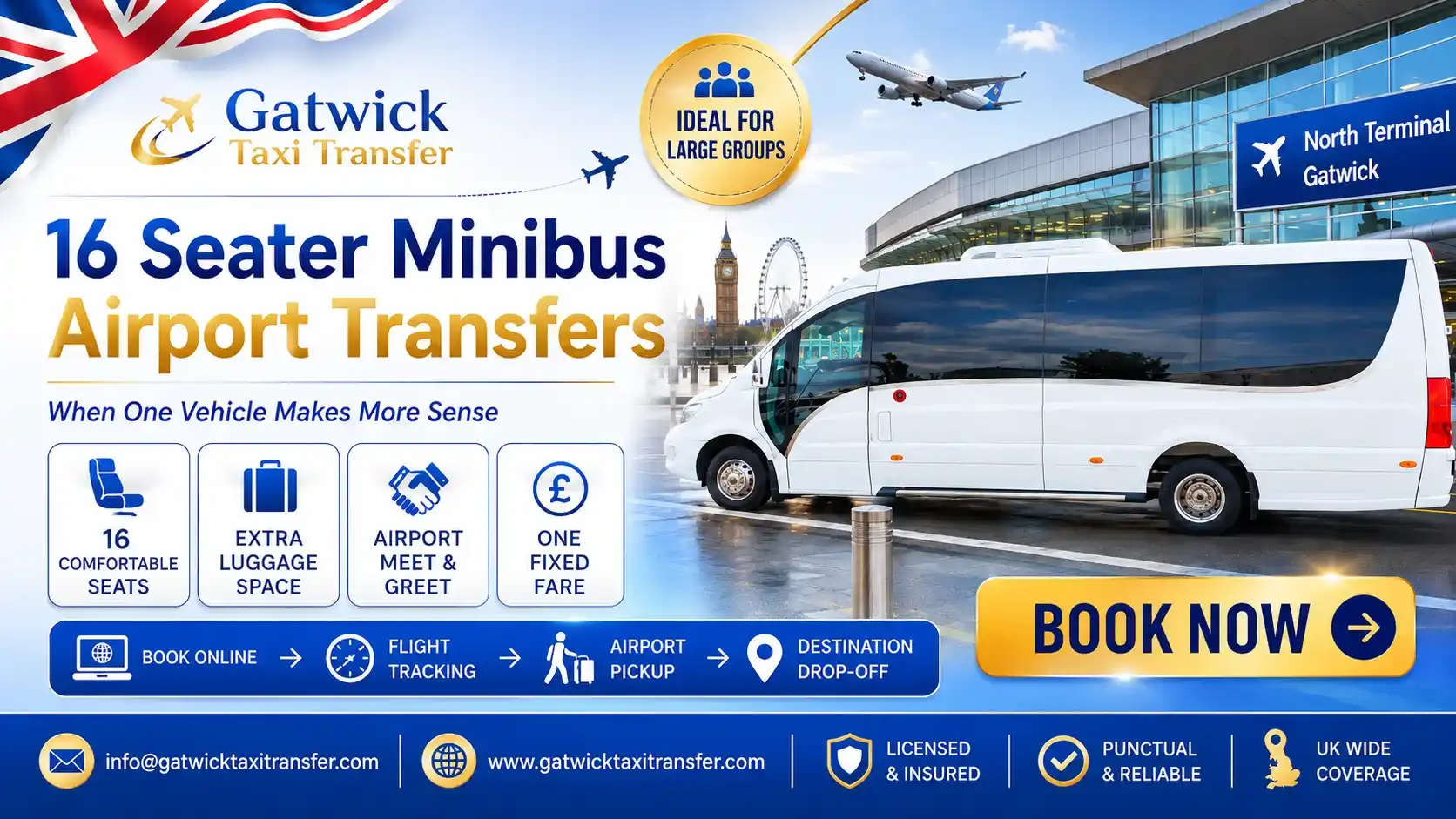
Sixteen people aboard changes the character of the same vehicle carrying half that, and the difference is worth appreciating before committing to a couple of hours in it.
Rows sit behind the cab either side of a walkway. Every one of the 16 places has a belt and standing is never permitted. Entry comes via a side opening with a raised threshold, unlike the shallow sill of a saloon. That geometry divides passengers: those with poor balance would rather have the car, while anyone whose back objects to stooping would rather have the minibus.
| Feature | Availability | Why it matters at 16 passengers |
|---|---|---|
| Belted seating throughout | Standard | All 16 positions; no standing on any journey |
| Climate control | Standard | 16 bodies generate real heat over 2 hours |
| Sealed rear compartment | Standard | 12 cases stay behind the last row, never loose |
| Central aisle | Standard | Someone can move without 6 people shuffling out |
| Wi-Fi | Partial fitment | Present on some vehicles only; raise it while quoting |
| Ramp access | Ordered ahead | Distinct category, not drawn from the general pool |
| Named marque | Cannot promise | Confirmation covers category and numbers carried |
That final row deserves saying plainly. A booking secures a vehicle class and its stated capacity, not a particular manufacturer, because fleet availability moves day to day. If a specific model genuinely matters — a measured boot opening, a particular access feature — raise it when you ask for the quote and we will tell you what can honestly be guaranteed.
The rear compartment is the part worth understanding properly. Luggage travels in a dedicated space behind the last row rather than piled among passengers, which is both a legal requirement and the reason 12 is a hard ceiling rather than a guideline. Once that space is full there is no overflow, and nothing rides loose in the cabin.
What Else Is a 16 Seater Booked For?
Something like one booking in five here has nothing to do with flying, and those are costed on a different basis entirely.
| Occasion | Shape of the booking | Priced as |
|---|---|---|
| Wedding guests | Ceremony to reception, repeated shuttles | Clock-based once idle |
| Company away day | Premises out to a venue, then home | Whole-day rate, idling included |
| Match days | Clubhouse to ground, equipment loaded | Both legs plus idle time |
| Races and festivals | Arrival to the minute, departure anyone's guess | Take the whole-day rate |
| Educational trips | Numbers locked, outbound and return | A pair of routed journeys |
| Touring itineraries | Driver shadows the party throughout | Clock-based only |
Everything hinges on whether the driver stays put while you are elsewhere. Drop a group at one address and drive off, and you have bought a route. Keep the vehicle beside you between commitments and you have bought the day, billed against clock and odometer, at a level that reflects sixteen seats sitting idle for eight hours instead of turning over three jobs.
A second collection en route leaves you firmly in transfer territory. Push past three, or ask the driver to sit and wait anywhere, and the booking has become something else. Walk us through the itinerary instead of naming two addresses and we will place it in the right category before money changes hands.
| Booking shape | Indicative | What you are paying for |
|---|---|---|
| Single airport transfer | £177–£287 | One route, vehicle released afterwards |
| Transfer plus one extra stop | Transfer plus mileage | Still a route, slightly longer |
| Half day, roughly 4 hours | From around £300 | Vehicle held, limited mileage |
| Full day, roughly 8 hours | From around £550 | Vehicle out of circulation entirely |
| Full day with long mileage | £700 upwards | Hours plus distance, quoted individually |
The jump between a transfer and a full day is the thing groups underestimate. A single Gatwick run at £234 releases the vehicle after ninety minutes; a full day holds sixteen seats for eight hours and prices accordingly. Where your itinerary genuinely only needs the vehicle twice, book two transfers rather than a day.
What Should You Re-Confirm the Day Before?
Group bookings move more than individual ones. Someone drops out, someone adds a case, a flight changes terminal. A change told the day before costs nothing; the same change told at the kerb may not be solvable at all.
| Confirm | Most common change | |
|---|---|---|
| 1 | Passenger count | Someone drops out or joins late |
| 2 | Large case count | The figure that decides the vehicle |
| 3 | Pickup address | Hotel changed, or a different entrance |
| 4 | Pickup time | Flight moved earlier or later |
| 5 | Flight number | Rebooked onto a different service |
| 6 | Terminal | Reallocated closer to departure |
| 7 | Organiser's phone number | Wrong number on file is common |
| 8 | Child seats and ages | Fitted before the vehicle leaves base |
| 9 | Additional stops | Added late, affecting route and time |
Rows one, two and six are the ones that genuinely change outcomes. A passenger count that has grown to seventeen needs a different arrangement entirely. A case count that has grown past twelve needs a trailer. A reallocated terminal needs the driver told before he sets off, not after.
How Far Ahead Should a 16 Seater Be Booked?
This is the scarcest vehicle class in the fleet, and the pool of drivers holding category D1 with a current CPC is smaller again. It cannot be substituted from a lower class at short notice the way a saloon can.
| Journey | Book at least | Why |
|---|---|---|
| Daytime airport transfer | 1 week | Scarcest class; no substitute available |
| Departure before 07:00 | 1–2 weeks | Qualified drivers at that hour are very limited |
| Half-terms and bank holidays | 2 weeks | Every sizeable party competes for identical dates |
| Height of summer | 2 weeks | Late July through to early September |
| Cruise or trailer booking | 2 weeks | Trailer availability adds a second constraint |
Multiple pickup points
Sixteen people rarely start in one place. Extra collections are perfectly workable, though each one lengthens the route, moves the start time and alters the fare, so all of them belong in the first quote rather than surfacing later. Addresses within 2 or 3 miles of each other generally suit one vehicle making 3 stops. Spread the same sixteen people across 20 miles of county and a single assembly point wins on both cost and simplicity. Send the list and we will tell you which applies.
What a complete quote covers
Set finished totals against each other, never opening numbers. Ours absorbs 6 things that are frequently itemised elsewhere: the forecourt levy, aircraft tracking, the name board in arrivals, the waiting allowance from touchdown, loading and unloading, and the terminal drop-off fee. Seats for children add nothing. No unsocial-hours loading applies and no multiplier is ever used, so a 03:30 departure bills exactly as a 15:30 one does.
Frequently Asked Questions
Related Guides
Book Your 16 Seater — Tell Us the Bags, Not Just the Bodies
Qualified driver · Terminal levy absorbed · Child seats gratis · Trailer on advance notice