Our drivers collect from all six London airports on every shift. Every Uber price range in this guide is based on actual in-app quotes taken between May and June 2026 under normal traffic conditions — not estimates from a comparison site or industry report. Airport charges are verified against official airport operator websites. The 20% VAT change is confirmed from Uber's own UK announcement and HMRC guidance on the TOMS closure. Surge pricing windows are based on driver-reported conditions corroborated against TfL vehicle flow data. This is operational knowledge, not journalism.
Gatwick Taxi Transfer holds a TfL Private Hire Operator licence. All drivers DBS checked. Rated 4.8/5 on Trustpilot (40 reviews).
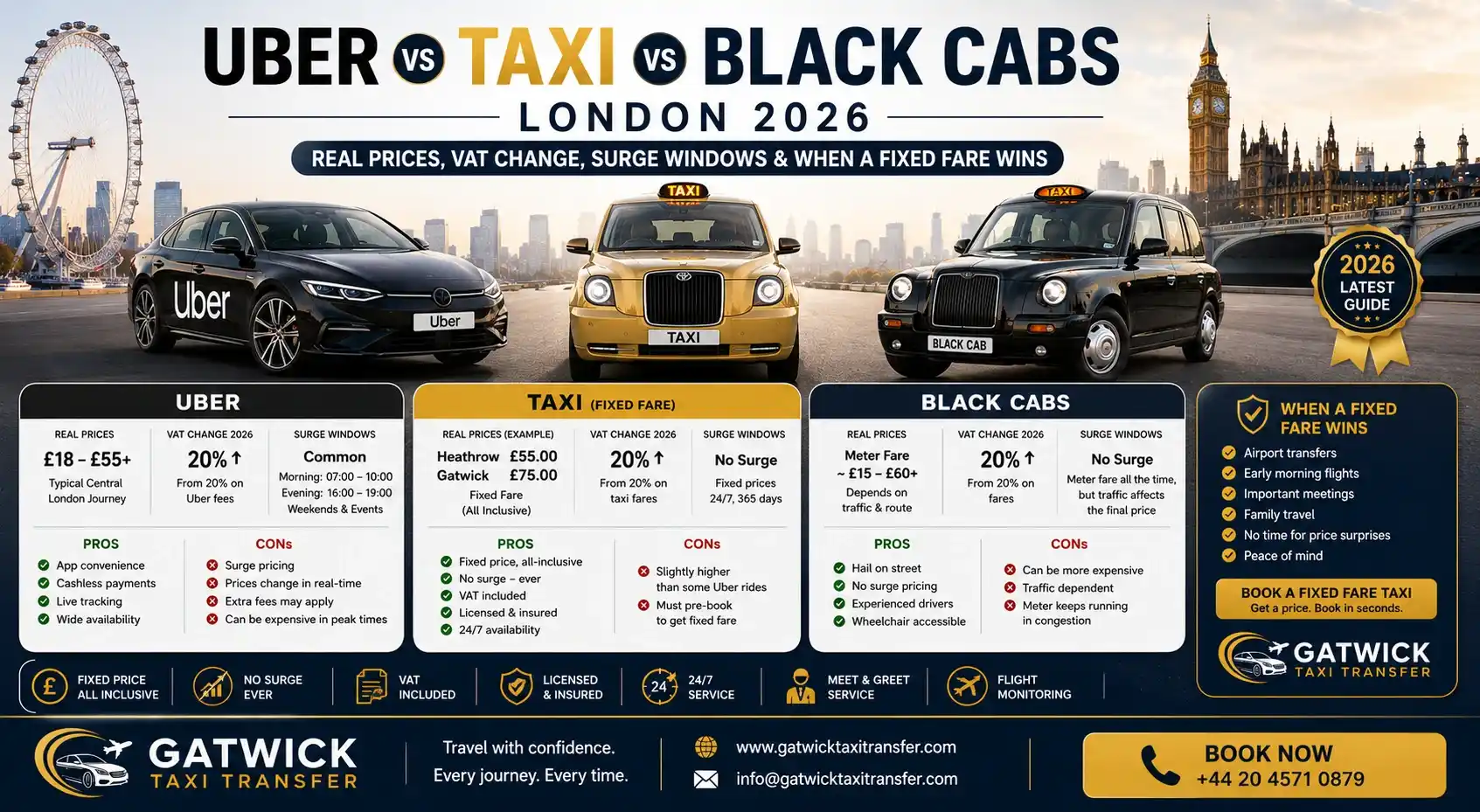
Is Uber cheaper than a taxi in London for airport transfers? In 2026 — usually not for airport transfers, and especially not for groups. Since 2 January 2026, every Uber and Bolt fare in London includes 20% VAT. A £60 Uber in December 2025 is now approximately £72 for the same journey. Add the airport parking charge (£7 to £10 depending on the airport, added at the end), and the effective total for an Uber airport transfer is significantly higher than the headline app price suggested.
What changed on 2 January 2026? The Autumn Budget 2025 closed the Tour Operators Margin Scheme (TOMS) loophole for ride-hailing platforms. Before that date, Uber and Bolt paid VAT only on their commission margin — around 25% of the fare — rather than the full amount. From 2 January 2026, standard-rate 20% VAT applies to the full fare. Both companies confirmed the change applied from that date. HM Treasury expects the measure to raise around £700 million by 2027-28.
When does a pre-booked fixed fare beat Uber? Almost always for airport transfers — particularly for groups of 2 or more, early-morning departures, late-night arrivals at Stansted and Luton, long-haul international arrivals, and any journey during an Uber surge window. A pre-booked fixed fare cannot surge — the price is locked at booking regardless of demand, traffic or time of day. All airport charges and the Congestion Charge are included in the fare shown at booking.
When does Uber or a black cab make sense? For solo travellers on short daytime journeys in central London outside peak surge hours, Uber remains convenient and competitive. For passengers who need a vehicle immediately with no advance booking, black cabs remain available from ranks at Heathrow, Gatwick and Stansted. For London City short journeys, the DLR is faster and cheaper than any road option. This guide gives the full comparison for every scenario.
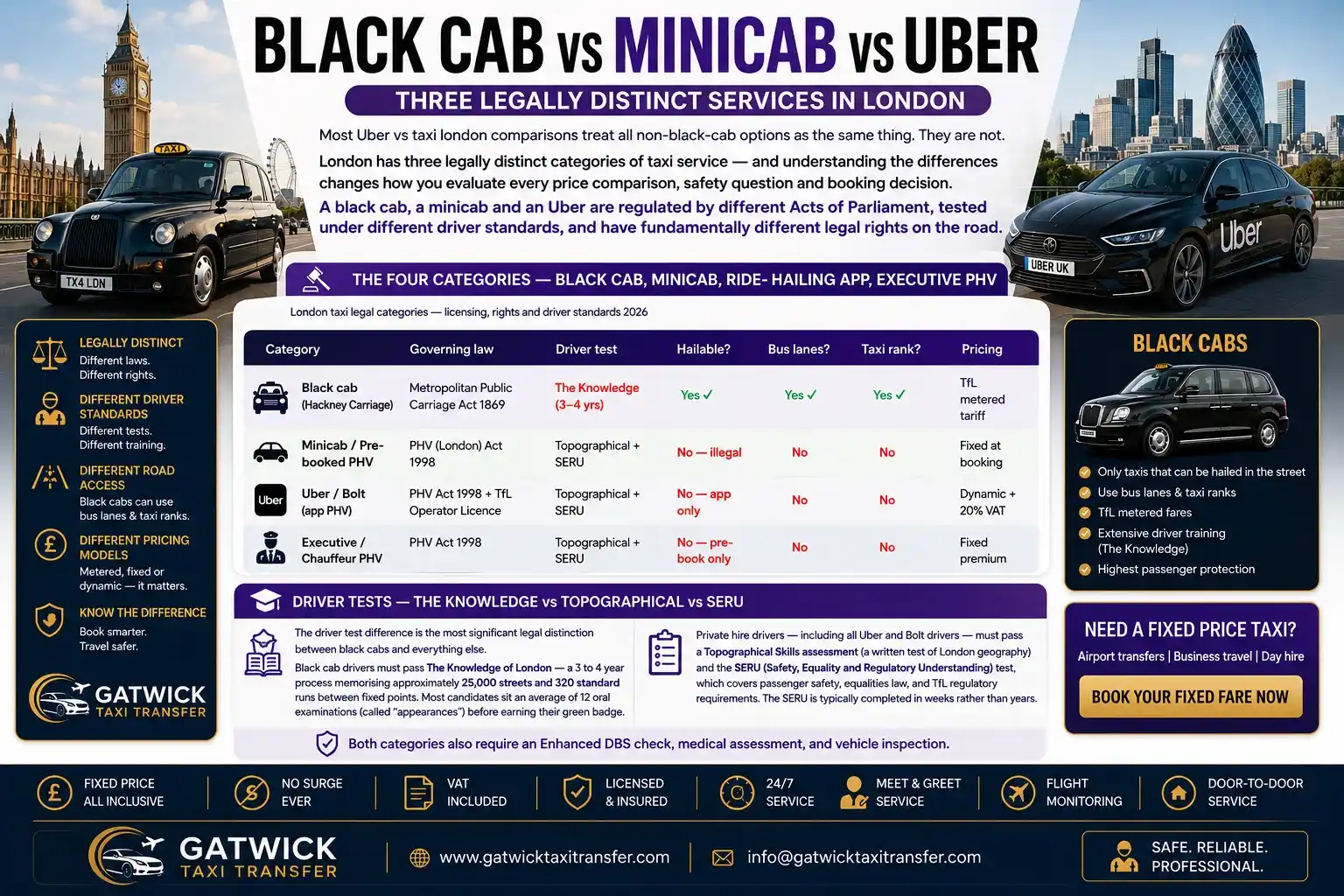
Black Cab vs Minicab vs Uber — Three Legally Distinct Services in London
Most Uber vs taxi london comparisons treat all non-black-cab options as the same thing. They are not. London has three legally distinct categories of taxi service — and understanding the differences changes how you evaluate every price comparison, safety question and booking decision. A black cab, a minicab and an Uber are regulated by different Acts of Parliament, tested under different driver standards, and have fundamentally different legal rights on the road.
The Four Categories — Black Cab, Minicab, Ride-Hailing App, Executive PHV
| Category | Governing law | Driver test | Hailable? | Bus lanes? | Taxi rank? | Pricing |
|---|---|---|---|---|---|---|
| Black cab (Hackney Carriage) | Metropolitan Public Carriage Act 1869 | The Knowledge (3–4 yrs) | Yes ✓ | Yes ✓ | Yes ✓ | TfL metered tariff |
| Minicab / Pre-booked PHV | PHV (London) Act 1998 | Topographical + SERU | No — illegal | No | No | Fixed at booking |
| Uber / Bolt (app PHV) | PHV Act 1998 + TfL Operator Licence | Topographical + SERU | No — app only | No | No | Dynamic + 20% VAT |
| Executive / Chauffeur PHV | PHV Act 1998 | Topographical + SERU | No — pre-book only | No | No | Fixed premium |
Driver Tests — The Knowledge vs Topographical vs SERU
The driver test difference is the most significant legal distinction between black cabs and everything else. Black cab drivers must pass The Knowledge of London — a 3 to 4 year process memorising approximately 25,000 streets and 320 standard runs between fixed points. Most candidates sit an average of 12 oral examinations (called "appearances") before earning their green badge. Private hire drivers — including all Uber and Bolt drivers — must pass a Topographical Skills assessment (a written test of London geography) and the SERU (Safety, Equality and Regulatory Understanding) test, which covers passenger safety, equalities law, and TfL regulatory requirements. The SERU is typically completed in weeks rather than years. Both categories also require an Enhanced DBS check, medical assessment, and vehicle inspection.
Bus Lanes and Taxi Ranks — The Black Cab Legal Advantages
Two practical advantages that only licensed black cabs — including the black taxi london airport ranks at Heathrow, Gatwick and Stansted — have: access to bus lanes and access to designated taxi ranks. Bus lane access is significant on congested central London routes — a black cab can use the bus lane on Piccadilly, Oxford Street and the Embankment while an Uber sits in general traffic. At peak times this can save 10 to 20 minutes on cross-London journeys. Taxi rank access means a black cab can wait at official taxi ranks — at Heathrow, Gatwick, Waterloo, Victoria, and hundreds of other designated locations — and passengers can walk to the rank and take the next available cab with no app, no booking and no wait for dispatch. Uber and minicab drivers cannot legally use taxi ranks or bus lanes.
When a Black Cab Is Actually Cheaper — The 3-Mile Rule
There is a rule of thumb that most comparison guides miss: for journeys under 3 miles in central London during off-peak hours, a black cab is often competitive with or cheaper than Uber. Here is why. Uber's app has a minimum fare that makes very short rides more expensive than the per-mile rate suggests. A 0.8-mile journey from Waterloo to the Tate Modern might cost £6 to £8 on the black cab meter (Tariff 1, light traffic) but £9 to £12 on Uber once the minimum fare and base charge are applied. For journeys 3 to 5 miles in central London during off-peak hours, the black cab meter and Uber are typically within £2 to £5 of each other — close enough that the black cab's immediate availability from a rank often wins on convenience. For journeys over 5 miles, and especially for airport transfers, the Uber base fare (before surge and airport charges) starts to pull ahead of the meter.
- Hailing on the street right now? Black cab only — only hackney carriages can be flagged on the street
- Cheapest off-peak short hop under 3 miles in Zone 1? Bolt or Uber in normal conditions — typically 15–25% below the meter
- Airport transfer with luggage, flight time, and possible delay? Pre-booked minicab (fixed fare, meet and greet, flight tracking, all charges included)
- Peak surge window — Heathrow 5am or Stansted midnight? Pre-booked fixed fare — unchanged regardless of surge
- Group of 3 or more? Pre-booked — per-head cost beats any ride-hailing option
- Wheelchair user needing guaranteed access on demand? Black cab rank — 100% of black cabs are wheelchair-accessible by law
- Corporate travel with fixed expense receipts? Pre-booked or executive PHV — fixed invoicing, no VAT variable
- Under 5 miles, central London, daytime, no urgency? Bolt — cheapest on-demand option off-peak
Safety — What You Get Confirmed Before the Journey
All three licensed categories in London — black cabs, minicabs and app-based PHVs — require TfL licensing, DBS checks and vehicle inspections. The safety difference between a licensed black cab, a licensed Uber driver and a licensed pre-booked minicab is minimal on paper. The practical difference is in confirmation before the journey. With a pre-booked private hire transfer, the driver's name, vehicle make and model, and registration plate are sent to your email before the journey — you verify before getting in. With Uber, the driver details appear in the app only when the driver is en route. With a black cab from the rank, you have no advance information about the driver. None of these means one category is unsafe — all require the same licensing — but the verification flow is different. Pre-booked is the most transparent for passengers who want to confirm details before they walk to a vehicle.
Executive and Chauffeur PHV — The Premium Fourth Category
Above the standard minicab level is the executive and chauffeur PHV market. Operators like Addison Lee, Blacklane, Wheely and Carey International provide premium private hire — typically Mercedes E-Class, S-Class or V-Class, BMW 7 Series or Audi A8 vehicles. Drivers are uniformed, vehicles are immaculate, and the service includes things like chilled water, newspapers, phone chargers and discreet handling of VIP passengers. Fares are fixed and significantly higher than standard minicabs — a Heathrow to central London executive PHV runs £85 to £130 versus £50 for a standard saloon. The VAT change from January 2026 applies to executive PHVs as to standard ones. The primary market is corporate accounts, legal and financial services professionals, and passengers who want a guaranteed premium experience rather than a variable ride-hailing experience. For airport transfers where quality matters more than cost minimisation, executive PHV sits above standard pre-booked and below the black cab in terms of on-demand flexibility, but above both on vehicle quality and driver formality.
London Taxi Fares 2026 — All Journey Types: Short Hops, Cross-City and Airport
Most uber vs taxi london guides only compare airport journeys. The comparison is different for short central London hops, cross-city journeys, and long-distance transfers. Here is the full picture across all journey types with 2026 prices.
| Journey type | Distance | Pre-booked minicab | Uber/Bolt (inc VAT) | Black cab (metered) | Winner |
|---|---|---|---|---|---|
| Short Zone 1 hop (e.g. Waterloo → Tate) | 0.8 miles | £8–£12 (min fare) | £9–£12 | £6–£8 (Tariff 1) | Black cab ✓ |
| Central London (e.g. Victoria → King's Cross) | 2.5 miles | £12–£16 | £11–£16 | £13–£18 | Uber/Bolt ≈ |
| Inner London (e.g. Canary Wharf → Camden) | 5 miles | £18–£24 | £20–£28 | £22–£30 | Pre-booked ✓ |
| Cross-city (e.g. Heathrow → Canary Wharf) | 18 miles | £50 fixed | £71–£109+ | £88–£128 | Pre-booked ✓ |
| Airport — Gatwick to central | 28 miles | £70 fixed | £87–£132+ | £105–£145 | Pre-booked ✓ |
| Airport — Stansted to central | 38 miles | £60 fixed | £84–£128+ | £110–£155 | Pre-booked ✓ |
| Late night (midnight, after event) | 3 miles | £14–£18 fixed | £18–£40 (surge) | £14–£20 (Tariff 3) | Pre-booked or black cab ✓ |
| Heathrow Express alternative (T5 → Paddington) | 15 miles | £50 to any central address | £71–£109+ | £88–£128 | Pre-booked (door-to-door) ✓ |
The pattern is consistent: for journeys under 3 miles in central London during off-peak hours, the black cab meter and Uber are within a few pounds of each other — availability from the rank often decides. From 5 miles onwards, the pre-booked fixed fare is almost always cheapest once VAT and any surge on Uber are factored in. For airport transfers at any distance, the pre-booked option is cheaper in every scenario except a solo traveller taking a very short airport journey at off-peak time with no surge.
Heathrow Express vs Taxi vs Uber — When the Train Wins
The Heathrow Express vs taxi comparison is one of the most searched London transport questions for Heathrow arrivals. The Heathrow Express runs from Heathrow T2/T3 to Paddington in 15 minutes (£25 standard, £37 first class) and from T5 in 21 minutes. It is the fastest option to Paddington — but Paddington is not central London, and most passengers then need an Onward journey (Tube, Uber or black cab) from Paddington to their final address. The total cost for a solo traveller: Heathrow Express £25 + Tube or Uber from Paddington £8 to £25 = £33 to £50 total, 35 to 55 minutes total. A pre-booked taxi direct: £50 fixed, 35 to 55 minutes to the door. The Heathrow Express wins on speed for Paddington-area destinations. For all other central London addresses, the time and cost comparison is much closer than the Express's marketing suggests.
What Happened on 2 January 2026 — The TOMS Closure Explained
The Tour Operators Margin Scheme was a VAT accounting method originally designed for package holiday companies. The logic was straightforward: a tour operator buys hotel rooms wholesale and sells them at a markup — it pays VAT only on its margin, not on the full price charged to customers. Uber and Bolt applied the same principle to ride-hailing. They argued that because drivers take approximately 75% of each fare as self-employed contractors, Uber's actual margin is around 25% — so VAT should only apply to that 25%, not to the full fare. HMRC contested this interpretation for years. The Autumn Budget 2025 ended the dispute permanently.
From 2 January 2026, the Chancellor's legislation required all private hire vehicle operators in London to apply standard-rate 20% VAT to the full fare. The change was London-specific because TfL licensing rules require operators in London to act as "principal" in the service contract — outside London, the agency model still applies, meaning most Uber rides outside London remain VAT-free for drivers below the £90,000 VAT registration threshold. Inside London, no such exemption exists after the change.
The practical effect is visible in the app. A route that Uber quoted at £55 in December 2025 now appears at approximately £66 for the same journey from January 2026. The VAT is embedded in the displayed price rather than shown as a separate line item — but it is there. For airport transfers where base fares typically run between £40 and £100, the 20% addition is significant before any airport parking charge is added.
- Uber and Bolt have charged 20% VAT on all London fares since 2 January 2026
- The change followed the Autumn Budget 2025 (Chancellor Rachel Reeves, 26 November 2025)
- The legislation excluded private hire operators from the Tour Operators Margin Scheme (TOMS)
- The change is London-specific — outside London, the agency model still applies for drivers below the VAT threshold
- HM Treasury expects the measure to raise approximately £700 million by 2027-28
- The VAT is embedded in the displayed Uber/Bolt price — it does not appear as a separate line item in the app
- A £60 Uber ride in December 2025 now costs approximately £72 for the same journey
- FREE NOW is also affected where it dispatches PHVs — black cabs dispatched via FREE NOW are not affected (meter fare, no VAT on passenger)
- Bolt typically runs 10–20% cheaper than Uber but applies the same VAT and surge pricing
- Uber Taxi (black cabs via Uber app) is not affected — meter rate applies, no VAT surcharge
Airport Drop-Off and Pick-Up Charges — Who Pays What and When
Every London airport charges for vehicles using the terminal forecourts. How that charge reaches the passenger depends on the transport option. Understanding this is critical for any fair price comparison — the Uber app's upfront quote does not include airport parking charges, so the fare you see before you get in is not the fare you pay when you get out.
Current 2026 airport charges — all six London airports
| Airport | Drop-off charge | Pick-up / Short Stay | Free waiting zone | Uber: when added |
|---|---|---|---|---|
| Heathrow LHR | £7 / 10 min | £8 / 30 min (Short Stay) | Heathrow Long Stay — free 30 min | At journey end |
| Gatwick LGW | £10 / 10 min | £10 / 10 min | Long Stay — free 2 hours | At journey end |
| Stansted STN | £10 / 10 min | £13 / 30 min (Short Stay) | Mid Stay — free 60 min | At journey end |
| Luton LTN | £7 / 10 min | £7 / 10 min | Long Stay — free 2 hours (updated May 2026) | At journey end |
| London City LCY | £8 / 20 min | £6.90 / 20 min | No free zone | At journey end |
| Southend SEN | £8 / 10 min | £8 / 10 min | Limited free | At journey end |
How the charge appears across options
| Vehicle type | How airport charge is handled | In upfront price? | VAT on charge? |
|---|---|---|---|
| Pre-booked fixed fare | Included in fare at booking | Yes — always | Not applicable |
| Uber / Bolt | Added at journey end — after you exit | No — added afterwards | Yes — 20% VAT since Jan 2026 |
| Black cab (metered) | Meter continues through drop-off zone + £1.60 rank fee at Heathrow | No — on meter | No VAT on meter fare |
The practical consequence: a passenger taking an Uber from Heathrow T5 to central London sees approximately £66 in the app before getting in. They pay approximately £73 when they arrive — the extra £7 being the Heathrow drop-off charge added at journey end. If the journey passed through the Congestion Charge zone (£18 daily, 7am to 6pm), that is also added, bringing the effective total to £91. None of these extras appeared in the upfront Uber quote.
Real Price Comparison — All Six London Airports, Normal Conditions, June 2026
The figures below are based on actual Uber in-app quotes in June 2026 under normal traffic conditions, with all 2026 airport parking charges added. These are not estimates from a comparison algorithm — they are what the app showed, with the airport charge added at the end. During surge periods, Uber upper figures can be 50 to 200% higher. Pre-booked fixed fares do not change under any conditions.
| Route | Pre-booked fixed (all in) | Uber/Bolt (VAT + airport charge) | Black cab (metered) |
|---|---|---|---|
| Heathrow T5 → Central London | From £50 | £71–£109+ | £92–£128 |
| Heathrow T2/T3 → Central London | From £50 | £71–£105+ | £88–£120 |
| Gatwick North → Central London | From £70 | £87–£132+ | £105–£145 |
| Gatwick South → Central London | From £70 | £87–£135+ | £108–£148 |
| Stansted → Central London | From £60 | £84–£128+ | £110–£155 |
| Luton → Central London | From £55 | £78–£116+ | £95–£130 |
| London City → Canary Wharf | From £18 | £28–£40+ | £30–£45 |
| London City → Central London | From £28 | £41–£62+ | £50–£70+ |
| Southend → Central London | From £75 | £95–£140+ | Not typically available |
Heathrow T5 to central London — full cost breakdown
Let us take the most common airport transfer in London — Heathrow Terminal 5 to central London — and show exactly what each option costs at three different demand levels.
| Cost element | Pre-booked fixed | Uber (shown in app) | Black cab |
|---|---|---|---|
| Base journey | £50 (fixed forever) | ~£56 base (before VAT shown) | ~£83 metered (off-peak) |
| 20% VAT | Not applicable | Embedded in app price since Jan 2026 | No VAT on meter fare |
| Heathrow drop-off £7 | Included in £50 | Added at end — not in app quote | On meter + £1.60 rank fee |
| Total — normal conditions | £50 | ~£74 | ~£93 |
| Total — 1.5x Uber surge | £50 (unchanged) | ~£104 | ~£106 (Tariff 2) |
| Total — 2x Uber surge | £50 (unchanged) | ~£141 | ~£117 (Tariff 3) |
| Total — 3x Uber surge (bank holiday) | £50 (unchanged) | ~£193 | ~£125 (Tariff 3) |
Notice what happens at surge. At 1.5x surge — which is common during early morning Heathrow departures Monday to Friday — the Uber fare crosses £100. At 2x surge, the black cab becomes comparable to Uber. At 3x surge on a bank holiday, the black cab at £125 is actually cheaper than an Uber at £193. In all three scenarios, the pre-booked fixed fare remains at £50. The surge variable completely reverses the usual price ranking between Uber and black cabs.
London City Airport — unique 2026 situation
London City is the only London airport inside the ULEZ boundary. Non-compliant vehicles face a £12.50 ULEZ charge — this applies to Uber drivers whose vehicles are not ULEZ-compliant, and the charge is typically passed on in the fare. From 25 April 2026, TfL introduced a new £6 taxi extra for licensed black cabs at London City on top of the £8 ANPR drop-off charge — making black cab the most expensive option at LCY by a significant margin. Gatwick Taxi Transfer operates a ULEZ-compliant fleet at London City — no £12.50 surcharge applies to any London City transfer.
Uber Surge Pricing at London Airports — When It Hits and How Bad It Gets
Airport terminals produce the most concentrated and predictable Uber surge conditions in London. Large numbers of passengers arrive simultaneously — a delayed transatlantic flight, a bank of budget airline arrivals, an early morning departure cluster — and the available driver supply near the airport cannot scale fast enough. The surge multiplier activates automatically. You open the app and see a price that has nothing to do with the distance or the time — it is purely a function of how many other people opened the app at the same moment.
| Airport | Surge window | Reason | Typical multiplier |
|---|---|---|---|
| Heathrow (all terminals) | Mon–Fri 5am–7am · Fri 4pm–8pm · Bank holidays | Early departure cluster · Friday transatlantic arrivals · Holiday peaks | 1.5x–2.5x |
| Gatwick (N+S Terminal) | Sat–Sun 5am–8am · Fri 6pm–9pm | Holiday departure bank · Friday leisure arrivals | 1.4x–2.2x |
| Stansted | Mon 4am–6am · Fri–Sat midnight–2am | Early Ryanair departures · Late easyJet/Ryanair arrivals | 1.5x–3.0x |
| Luton | Sat–Sun 3am–6am · Fri–Sat 11pm–1am | Budget airline early departures and late arrivals | 1.5x–2.8x |
| London City | Mon–Fri 7am–8am · Mon–Fri 6pm–7pm | City commuter flights · Financial district peaks | 1.3x–1.8x |
| Southend | Sat–Sun 4am–7am | Ryanair early weekend departures | 1.4x–2.0x |
The Stansted 3x surge case is the most extreme. A Stansted to central London Uber at £60 in normal conditions becomes £180 at 3x surge. Then 20% VAT (already embedded) means the true baseline was already adjusted for VAT, so the actual comparison point is £84 normal conditions rising to £180 at 3x, then the £10 Stansted airport charge added at the end — a total bill of £190 from a journey the app showed at £60 when you booked a taxi yesterday. The pre-booked fixed fare on the same route is £60, always, regardless of what Uber is doing at midnight on a Friday in August.
Can you pre-book Uber and lock in the price?
Uber offers scheduled rides that can be booked up to 30 days in advance, and the app does show an estimated price at the time of scheduling. However — and this is the crucial detail — the actual fare is calculated at the time of the journey, not at the time of booking. If surge is active when your ride begins, the surge multiplier applies regardless of what the estimate said. This is explicitly disclosed in Uber's own terms. A pre-booked fixed fare from a private hire operator locks the price at booking permanently. If you book three weeks ahead for a 4am Heathrow pickup during peak surge hours, the price shown is the price paid. No recalculation, no surge, no exceptions.
Per-Head Cost — Why Groups Should Never Use Uber for Airport Transfers
For solo travellers on short journeys in central London outside peak hours, Uber is genuinely competitive. The comparison changes completely for groups of two or more. Uber charges per vehicle, and while Uber XL can carry up to 6 passengers, the fare is per booking — passengers travelling separately each pay their own full fare. A single pre-booked vehicle splits one fare across all passengers regardless of group size.
| Group size | Pre-booked fixed (per head) | Individual Uber X (per head) | Uber XL (per head) |
|---|---|---|---|
| 1 passenger | £70 | £87–£132+ | Same — solo Uber |
| 2 passengers | £35 each | £87–£132+ each | £47–£68+ each |
| 3 passengers | ~£23 each | £87–£132+ each | £29–£44+ each |
| 4 passengers | £17.50 each | £87–£132+ each | £24–£34+ each |
| 6 passengers (MPV) | From £80 — £13.33 each | Multiple vehicles required | Uber XL — £55–£85+ (£9–£14 each) |
| 8 passengers (minibus) | From £95 — £12 each | Multiple vehicles required | Not available as single Uber |
A family of four from Gatwick to central London: one pre-booked MPV at £75 to £80 is £18.75 to £20 per person. Four separate Uber X rides for the same route in normal conditions cost £87 to £132+ each — total for four: £348 to £528+. Even if they take a single Uber XL at £24 to £34 per head (£96 to £136 total), the pre-booked option is cheaper, includes the Congestion Charge, and has a driver in arrivals with a name board rather than a Short Stay car park pin. At 1.5x surge, the Uber XL per-head cost rises to £36 to £51 — the pre-booked option remains at £18.75 to £20.
Annual cost — regular airport travellers
For business travellers on regular airport routes, the 20% VAT change has a compounding annual impact that is now visible on corporate expense reviews.
| Journey frequency | Pre-booked annual cost | Uber annual cost (normal) | Uber annual cost (20% avg surge) | Annual saving |
|---|---|---|---|---|
| Weekly (52×) | £2,600 | £3,848 | £4,618 | £1,248–£2,018 |
| Fortnightly (26×) | £1,300 | £1,924 | £2,309 | £624–£1,009 |
| Monthly (12×) | £600 | £888 | £1,066 | £288–£466 |
| Gatwick fortnightly (26×) | £1,820 | £2,392 | £2,870 | £572–£1,050 |
Where Each Option Meets You — Arrivals Hall vs Car Park Walk
For arriving passengers after a long flight, the difference between a driver waiting inside the arrivals hall and walking to a car park following an app pin is real — particularly at midnight, with heavy luggage, after an intercontinental flight. This is one of the clearest practical differences between pre-booked private hire and Uber for airport collections.
| Airport | Pre-booked (Gatwick Taxi Transfer) | Uber / Bolt | Black cab |
|---|---|---|---|
| Heathrow T2/T3/T4 | Inside arrivals — name board | Terminal Parking — separate building, walk + app | Rank outside — queue |
| Heathrow T5 | Inside T5 — name board | T5 Parking — link bridge required | T5 rank outside |
| Gatwick North | Inside arrivals — ground floor | Short Stay Level 0/1 | Rank outside |
| Gatwick South | Inside arrivals — main hall | Short Stay car park | Rank outside |
| Stansted | Inside arrivals — designated area | Short Stay Orange/Red zone — 3–12 min walk | Rank outside |
| Luton | Inside arrivals / CP1 link area | Terminal Car Park 1 — link bridge walk | Limited at Luton |
| London City | Inside arrivals — direct at exit | Pick-Up Zone — 2 min walk | Limited at LCY |
| Southend | Inside arrivals hall | Car park — follow app pin | Not typically available |
Flight delays — what each option does
Flight delays at London airports average 27 minutes across all carriers in 2026. For international long-haul arrivals, delays of one to three hours are common. What happens to your transfer when your flight is late depends entirely on which option you chose.
| Scenario | Pre-booked fixed fare | Uber / Bolt | Black cab |
|---|---|---|---|
| 30–45 minute delay | Driver adjusts automatically — no action needed | Open app on arrival and rebook | Queue at rank on arrival |
| 2–3 hour delay | Driver waits: 45 min domestic free, 60 min international free — from actual touchdown | Rebook at new time — surge may be active | Queue at rank |
| Cost of delay to passenger | Nothing — fare unchanged | Potential surge if rebooking during high demand window | Meter continues in traffic |
| Driver contact before journey | Driver name, number, reg sent in advance | In-app only — no number until driver assigned | Not allocated until rank |
Black Cab London — Fares, Tariffs, The Knowledge and When It Beats Uber
A licensed London black cab — technically a hackney carriage — is one of three legally distinct types of taxi in London. It runs on a TfL-regulated meter that changes rate based on time of day. It can be hailed on the street. Its driver has passed The Knowledge of London. And unlike Uber or Bolt, it has no surge pricing — the meter runs at the tariff rate regardless of demand. Understanding when the black cab wins the uber vs black cab london comparison requires understanding all of these factors together.
Black Cab Tariffs 2026 — Tariff 1, 2 and 3 Explained
The black cab london tariff system — which determines black cab fares london 2026 and all future years — is regulated by TfL and updated periodically. From 25 April 2026, the black cab minimum fare london rose to £4.40 — up from £4.20. Three tariff rates apply at different times of day, and most long-haul international arrivals land at times that attract Tariff 2 or 3:
| Tariff | When it applies | Rate per mile (approx) | Airport impact |
|---|---|---|---|
| Tariff 1 | Mon–Fri 6am–8pm | £4.10/mile | Standard daytime journeys — most business travellers |
| Tariff 2 | Mon–Fri 8pm–midnight · Sat 6am–8pm | £4.60/mile | ~12% more — most evening airport arrivals |
| Tariff 3 | Midnight–6am · Sundays · Bank holidays | £5.25/mile | Highest — most overnight long-haul arrivals from Heathrow, Gatwick |
At Heathrow, black cabs pay a £1.60 rank fee per journey added at the start of the meter. A black cab heathrow price to central London in normal conditions (Tariff 1, off-peak) runs from £88 to £110. The black cab heathrow to london journey late at night on Tariff 3 with the rank fee reaches £115 to £130. How much is a black cab from heathrow? On a Sunday night long-haul arrival: expect £115 to £130. On a weekday 9am pickup: expect £88 to £105. The black cab london cost is significantly higher than a pre-booked fixed fare in all conditions — but it offers something neither Uber nor a pre-booked transfer can match: the ability to hail on the street with no app and no pre-booking.
Black Cab London Prices vs Uber vs Pre-Booked — Full Comparison
The london black cab prices vs ride-hailing comparison shifted significantly in 2026. Before the 20% VAT change on Uber and Bolt, the gap between Uber and black cabs was wide — typically 30 to 50 percent cheaper for Uber. After the VAT change, the gap has narrowed to the point where at 1.5x to 2x Uber surge, the black cab becomes comparable to or cheaper than Uber. London taxi fares 2026 now sit in a narrower competitive band than at any point since Uber launched in London in 2012.
| Demand level | Pre-booked fixed | Uber/Bolt | Black cab (hackney carriage) |
|---|---|---|---|
| Normal (off-peak weekday) | £50 | ~£74 | ~£93 (Tariff 1) |
| Evening (Tariff 2 / 1.5x Uber surge) | £50 | ~£104 | ~£106 (Tariff 2) |
| 2x Uber surge | £50 | ~£141 | ~£117 (Tariff 3) |
| 3x Uber surge (bank holiday) | £50 | ~£193 | ~£125 (Tariff 3) — black cab wins vs Uber |
Do Black Cabs Accept Card Payments?
Yes — all licensed London black cabs must accept card payment by law. This has been mandatory since October 2016. Every licensed hackney carriage london has a chip-and-PIN terminal and must accept Visa, Mastercard and Amex. Contactless and Apple/Google Pay are also accepted. The driver cannot refuse card payment and cannot charge a premium for paying by card. This removes one of the key practical advantages Uber once had — cashless payment is now universal across black cabs, minicabs and ride-hailing apps in London.
Can You Flag Down a Black Cab in London?
Yes — and this is the single most important legal difference between a black taxi london (hackney carriage) and a minicab or private hire vehicle. Only TfL-licensed black cabs with their illuminated yellow "TAXI" roof light can be hailed on the street. Wave from the pavement when the roof light is on — the driver will pull over. This is the defining characteristic of the hackney carriage london model: no app required, no pre-booking, immediate availability from the street or a designated rank. A minicab, Uber or private hire vehicle cannot legally stop for you on the street — any private hire car that does so is operating illegally and is uninsured for the passenger.
The Knowledge of London — What It Is and Why It Matters
To earn a green badge and drive a licensed black cab in London, candidates must pass The Knowledge — the world's most demanding taxi qualification. Candidates memorise approximately 25,000 streets, 320 standard routes (called "runs") between fixed points across London, and tens of thousands of points of interest within a six-mile radius of Charing Cross. Most candidates take three to four years to pass and sit an average of twelve oral examinations before earning their licence. The practical result: a Knowledge-qualified driver can navigate around road closures, demonstrations, Tube strikes and flooded underpasses without relying on sat-nav. On a straight motorway run from Heathrow to a Surrey address, the navigation difference between a black cab and a private hire vehicle is minimal — but in central London during disruption, it is measurable.
The number of licensed London black cab drivers fell from a peak of 25,538 in 2013/14 to approximately 15,978 by April 2026 — the lowest since 1975. TfL's Knowledge reform programme, announced April 2025 with 14 pledges and a published 6,000-point list, aims to make the qualification more accessible without removing the core route-memorisation requirement. Declining driver numbers mean longer rank queues at busy airports, particularly late at night.
LEVC Electric Black Cabs — London's Green Taxi Fleet
Since 2018, London black cab drivers have been transitioning to LEVC (London EV Company) TX electric taxis — the modern replacement for the classic diesel TX4. The LEVC TX runs as a range-extended electric vehicle: purely electric for the first 80 miles, then a petrol generator extends the range. All new black cabs registered in London since November 2023 must be zero-emission capable. The electric black cab is ULEZ-compliant, exempt from the £12.50 daily ULEZ charge that applies to older diesel vehicles — and from April 2026, also exempt from the new ULEZ-related surcharges at London City Airport that affect non-compliant Uber vehicles. The LEVC TX also features a panoramic glass roof, fold-flat seats that accommodate wheelchairs and buggies, and significantly reduced cabin noise compared to diesel predecessors.
Wheelchair Access — Black Cab vs Uber vs Pre-Booked
Every licensed London black cab is wheelchair-accessible by law. All carry side-entry ramps, swivel seats, and adequate floor space for a standard wheelchair. This is a mandatory condition of the TfL hackney carriage licence. Under the Taxis and Private Hire Vehicles (Disabled Persons) Act 2022, drivers in both black cab and private hire categories must carry wheelchair users without charging extra and must assist with boarding. Refusing a wheelchair user is a criminal offence. For on-demand wheelchair access with no pre-booking, the black cab rank is the most reliable option. For pre-booked wheelchair transfers, Gatwick Taxi Transfer provides dedicated wheelchair-accessible vehicles that can be specified at booking for any of the six London airports.
FREE NOW, Gett and Uber Taxi — Book a Black Cab via App
Three apps dispatch licensed London black cabs: FREE NOW (free now black cab london), Gett (gett vs uber london), and Uber Taxi (uber taxi black cab app). All three use the regulated TfL meter — no Uber-style surge pricing applies because the meter rate is regulated regardless of demand. During peak Uber surge windows (Stansted midnight Fridays, Heathrow early mornings), checking one of these apps for a black cab dispatch can produce a lower fare than Uber X at 2x or 3x surge. Trade-off: black cab availability at Stansted, Luton and Southend after midnight is limited. The free now vs uber london comparison for city-centre journeys during surge: FREE NOW is the smarter choice. For airport transfers from outer terminals at unsocial hours: pre-booked fixed fare is more reliable than either.
Touting at Airports — How to Spot Unlicensed Cabs
Every London airport has a persistent unlicensed tout problem. Touts approach arriving passengers in arrivals halls or immediately outside terminals offering a "taxi" or "minicab" without a booking — these vehicles are uninsured for the passenger and the driver has no TfL licence. It is a criminal offence under UK law to tout for private hire. Any black taxi london operating as a tout (approaching passengers inside terminals rather than waiting at the rank) is also in breach of their licence. How to avoid touts: pre-booked transfers send the driver's name, vehicle and registration plate to your email before the journey — verify these details before getting in. No legitimate Uber or Bolt driver approaches you inside an arrivals hall without you having an active booking in the app. No genuine licensed black cab operates as a tout inside terminal buildings.
Black Cab Taxi Driver — Salary, Training and What It Takes
The question "how much do black cab taxi drivers make" is one of the most searched queries about the profession — and the answer varies considerably. The average london black cab taxi driver earns between £30,000 and £55,000 per year before expenses, depending on hours worked and the areas covered. However, black cab taxi driver salary figures can be misleading because drivers are self-employed and pay for their own vehicle, fuel, insurance and maintenance. A driver working central London during peak hours — mornings, evenings and weekends — will typically earn significantly more than one working suburban routes during off-peak hours. The LEVC TX electric cab costs approximately £55,000 to £65,000 new and must pass twice-yearly TfL vehicle inspections. Black cab taxi insurance is also a significant cost — typically £3,000 to £6,000 per year for commercial vehicle insurance covering a licensed hackney carriage, which differs substantially from standard private car insurance.
Training to become a black cab taxi driver — specifically a london black cab taxi driver — involves completing The Knowledge, the Enhanced DBS check, a medical assessment and a vehicle inspection. The Knowledge alone takes most candidates 3 to 4 years and costs approximately £7,000 to £15,000 in study materials, map books, moped hire (for practice runs), and examination fees. This is significantly higher than the SERU and Topographical assessment required for private hire drivers, which can be completed in weeks. The investment in The Knowledge is one reason there are now fewer than 17,000 licensed black cab taxi drivers in London — the lowest since 1975.
Black Cab Taxi App — Finding a Black Cab Near Me in London
The easiest way to find a black cab taxi near me in central London is to look for the illuminated yellow "TAXI" roof light and hail from the pavement — no app needed. For a black cab taxi rank near me, TfL's website lists all official London taxi ranks by area. For app-based dispatch, the main options are: FREE NOW (free now london black cab app — the most downloaded black cab app in London), Gett, and Uber Taxi (the uber taxi black cab app within the main Uber interface — dispatches licensed hackney carriages at meter rate plus a £2 booking fee). The black cab taxi app market has grown significantly since 2022 as passengers migrated back to licensed black cabs following Uber's price increases. The black cab taxi number for telephone bookings varies by company — Radio Taxis (020 7272 0272), ComCab (020 7908 0207) and Dial-a-Cab (020 7253 5000) are the main central London operators.
Black Cab Taxi Outside London — Birmingham, Manchester, Liverpool and Glasgow
The term black cab taxi is used across the UK but refers to different vehicle types and regulatory frameworks outside London. In London, "black cab" specifically means a TfL-licensed hackney carriage passing The Knowledge. Outside London, hackney carriages are licensed by local councils — each with their own vehicle standards, fare tariffs and driver tests. The black cab taxi birmingham, black cab taxi manchester and black cab taxi liverpool markets use locally licensed vehicles that may or may not be the iconic LEVC TX shape associated with London. Black cab taxi glasgow operates under Glasgow City Council licensing with its own fare calculator and tariff structure — the black cab taxi fare calculator glasgow applies local rates, not London TfL tariffs. Black cab taxi coventry, black cab taxi reading and black cab taxi edinburgh similarly operate under their respective local authority licensing, with edinburgh's licensed cabs (the white Edinburgh taxis) actually being primarily white rather than black. Liverpool taxi black cab services have historically used purpose-built hackney carriage vehicles, though the fleet has diversified significantly since the early 2000s.
The Classic London Black Cab — History and the TX Range
The london black cab taxi classic — the FX4, introduced in 1958 — defined the shape of the London taxi for over 40 years. The iconic upright silhouette, the large turning circle (capable of turning within the 25-foot diameter of the Savoy Hotel forecourt, which gave rise to the original The Knowledge radius), and the distinctive black paintwork became symbols of London globally. The FX4 was replaced by the TX1 in 1997, followed by the TX2, TX4 and the current LEVC TX from 2018. The london taxi driver black cab interior underwent significant transformation with the LEVC TX — panoramic glass roof, fold-flat seats, USB charging, climate control, and a passenger-facing notification screen. The black and white taxi cab is not a London phenomenon — black and white taxi liveries are more common in US cities and some UK regional markets. The london black cab taxi street scene — the famous ranks outside Waterloo, Victoria and the West End — remains one of the most recognisable in the world, though the number of cabs on the streets has declined significantly from peak levels. Black cab taxi for sale listings on Auto Trader and specialist dealers typically show LEVC TX vehicles at £15,000 to £45,000 used, with plate prices for central London working varying by demand.
Black Cab Taxi Tours — Belfast, Edinburgh and Beyond
Outside the transport context, black cab taxis have become famous as a vehicle for guided city tours. The cab tours belfast famous black taxi tours are one of Northern Ireland's most-reviewed tourist experiences — local drivers take visitors through the Falls Road and Shankill Road areas in classic black cab vehicles, providing a first-hand account of The Troubles and the Belfast peace process murals. The black cab taxi tour belfast model has been running since the 1990s and typically costs £10 to £15 per person. The black cab taxi edinburgh scene is similar — local operators offer guided tours of the Old Town, the Royal Mile and Edinburgh Castle approaches in licensed hackney carriages. These tours use the vehicle format as much as the transport — the enclosed black cab with its partition-free interior and fold-down seats creates an intimate guided tour environment that open-top buses cannot replicate.
Child Seats — Why Uber Cannot Guarantee One and Pre-Booked Can
UK law requires children under 12 years old or 135cm tall to use an appropriate child seat in any vehicle. The requirement applies equally to Uber, black cabs and pre-booked private hire. The practical difference is in guarantee and certainty — especially important for families arriving late at night at an airport after a long flight.
| Seat type | Pre-booked (Gatwick Taxi Transfer) | Uber / Bolt | Black cab |
|---|---|---|---|
| Infant seat (0–15 months) | Free — confirmed at booking | Not guaranteed — driver dependent | Not typically provided |
| Forward-facing seat (15m–4yr) | Free — confirmed at booking | Uber Family option — not all vehicles | Not typically provided |
| Booster seat (4–12yr) | Free — confirmed at booking | Not guaranteed | Not typically provided |
| Seat confirmed before journey | Yes — at time of booking | No — request in app, driver decides | No |
| Extra charge | Free on every booking | Uber Family may carry premium | Not applicable |
The key issue with Uber and child seats is reliability, not availability. Uber does allow passengers to specify a seat preference, but the seat is not guaranteed — it depends on whether the allocated driver carries the correct seat that day. If the driver arrives without it, the family faces an impossible choice: proceed illegally or cancel and rebook, potentially into active surge pricing, with tired children at an airport at midnight. With a pre-booked transfer, the seat type — infant (Group 0+), forward-facing toddler (Group 1), or high-backed booster (Group 2/3) — is specified and confirmed at booking. The vehicle arrives with the correct seat fitted. This is free on every booking. For a full explanation of UK car seat law in taxis, see the baby car seat taxi London guide.
Errors in Competitor Uber vs Taxi Guides — 2026 Updates Most Have Missed
Most comparison pages about Uber and taxis in London were written or last updated before January 2026. Their pricing data does not reflect the VAT change and their airport charge figures are out of date. These are the most common errors and why they matter.
| What they say | What is actually correct in 2026 |
|---|---|
| "Uber is generally cheaper than a pre-booked taxi" | True for short city rides outside peak hours. False for airport transfers in 2026. After 20% VAT and airport charges, Uber is £21 to £59 more expensive than a pre-booked fixed fare at Heathrow in normal conditions — and up to £143 more at 3x surge. |
| "Uber shows you the price upfront" | The upfront price does not include the airport parking charge (added at journey end) or any surge multiplier that may apply when the ride concludes. |
| "Stansted Short Stay pick-up: £8" | Wrong since March 2026. Stansted Short Stay is now £13 for 30 minutes — the largest increase of any London airport. Most guides still say £8. |
| "Luton Long Stay free window: 1 hour" | Wrong since May 2026. Luton Long Stay free window was upgraded to 2 hours. Most guides still say 1 hour. |
| "Black cab minimum fare: £3.80 or £4.20" | Wrong. Black cab minimum fare rose to £4.40 from 25 April 2026 following TfL's fare review. |
| No mention of London City £6 taxi extra | TfL introduced a new £6 taxi extra for black cabs at London City from April 2026 — on top of the £8 ANPR charge. Most guides do not mention this. |
| "Book Uber in advance to lock in price" | Uber scheduled rides show an estimate at booking — the actual fare is calculated at trip time and can include surge. Pre-booking an Uber does not guarantee the pre-booking price. |
| No mention of Uber Taxi (black cabs via Uber) | Uber Taxi dispatches licensed black cabs with a £2 booking fee and the regulated meter rate — no surge pricing. A useful alternative during Uber X surge that most guides ignore completely. |
Which Option for Which Situation — 2026 Decision Guide
- ✓ Travelling with 2 or more passengers — per-head cost wins every time
- ✓ Early morning (5am–7am) — consistent surge window at Heathrow/Gatwick
- ✓ Late night at Stansted or Luton — midnight surges up to 3x
- ✓ Long-haul international arrivals — 60 min free waiting, meet in arrivals
- ✓ Children needing car seats — confirmed at booking, free, no availability risk
- ✓ Bank holidays — no holiday surcharge unlike Uber Tariff 3
- ✓ Corporate travel — monthly invoicing, fixed receipts, no VAT variable
- ✓ Flight delay risk — driver adjusts, waiting included, no rebooking surge
- ✓ Inter-airport transfers (LHR → LGW etc) — fixed ~£95 vs Uber £120–£180+
- ✓ Any time price certainty matters — the fare cannot change
- ~ Solo traveller, short daytime journey in central London
- ~ No advance planning — need a vehicle immediately
- ~ London City to Canary Wharf — DLR is 6 min and cheaper than all options
- ~ Central London short hop with no luggage — Uber competitive off-peak
- ~ BLACK CAB: No pre-booking, need regulated vehicle immediately from rank
- ~ BLACK CAB: During 2x–3x Uber surge — black cab can become comparable
- ~ BLACK CAB: Wheelchair user needing guaranteed accessible vehicle immediately
- ~ UBER TAXI: When Uber X surge is high — black cabs via Uber at meter rate
- ~ FREE NOW: Alternative to Uber during peak surge — metered black cabs
Bolt vs Uber London, FREE NOW, Gett and Addison Lee — Which App Wins in 2026?
The ride-hailing market in London is not just Uber and black cabs. Bolt, FREE NOW, Gett, Addison Lee and Wheely all operate here — each with a different pricing model, vehicle quality and use case. Understanding when each app makes sense matters as much as the Uber vs taxi London comparison, particularly since the bolt vat 2026 london change affects Bolt just as much as Uber.
Bolt vs Uber London — is Bolt cheaper?
Bolt is typically 10 to 20 percent cheaper than Uber for similar routes in London — this is the short answer to "is bolt cheaper than uber london." The longer answer: yes, in normal conditions, Bolt consistently undercuts Uber on base fare. But bolt vat 2026 london is the same as Uber — the 20% VAT from 2 January 2026 applies equally to both because both companies used the Tour Operators Margin Scheme. Bolt's advantage is in the base fare before VAT, not in avoiding VAT. Bolt also applies bolt london surge pricing in the same way as Uber — demand-based multipliers at airports and during busy periods. The surge ceiling at Stansted on a late Friday night is just as likely to produce a 2x to 3x multiplier on Bolt as on Uber. For airport transfers where surge is the main risk factor, the base fare difference between Bolt and Uber is largely irrelevant — a 2x surge on Bolt is still £60 more than the pre-booked fixed fare.
FREE NOW — the black cab app
FREE NOW is the answer to "free now vs uber london" for passengers who want an app but do not want Uber's variable pricing. FREE NOW primarily dispatches licensed London black cabs (hackney carriages) rather than private hire vehicles. Because the free now black cab london service uses the TfL-regulated meter, there is no surge pricing in the Uber sense — the Tariff 1/2/3 metered rate applies regardless of how many other people are trying to get a cab at the same moment. The trade-off: free now black cab london rates are higher than Uber in normal conditions, and black cab availability at Stansted, Luton and Southend after midnight is limited. For a wet Friday night in Zone 1 where Uber surge is active, FREE NOW can be significantly cheaper than Uber X while providing a fully licensed, Knowledge-qualified driver. For Heathrow at 5am, the black cab rank at T5 is usually the most reliable option without pre-booking.
Gett — black cab dispatch, no surge
Gett is a gett vs uber london alternative that dispatches licensed black cabs via app. Like FREE NOW, Gett uses the regulated TfL meter — no uber taxi black cab app-style surge. Gett has seen 40 percent more daily bookings since 2022 as passengers tired of Uber surge pricing returned to regulated black cabs. The service is strongest in central London where black cab supply is highest. At Heathrow, Gett can dispatch from the black cab rank. For outer London and airport transfers from Stansted or Luton, black cab availability via Gett is more limited.
Addison Lee — premium private hire
Addison lee vs uber london: Addison Lee is a premium private hire operator that charges fixed fares rather than dynamic pricing. The fares are consistently higher than Uber in normal conditions — but they are fixed, professional, and include meet-and-greet at airports. Addison Lee is popular for corporate travel where expense reporting requires fixed amounts and where the quality of vehicle and driver behaviour matters. For a family airport transfer, Addison Lee provides certainty without surge but at a premium price point above standard pre-booked fixed fares.
Best taxi app London 2026 — the honest ranking
The honest answer to "best taxi app london" and "cheapest taxi app london" depends entirely on what you are doing. For ride hailing london 2026 in central London during off-peak hours, Bolt is the cheapest app option. For guaranteed fixed price airport transfers with meet and greet and no surge risk, a dedicated pre-booked operator is better than any ride-hailing app. For immediate black cab dispatch without surge, FREE NOW or Gett. For corporate premium travel with fixed invoicing, Addison Lee. There is no single best london taxi app 2026 — there is the right app for the specific journey type.
| App/Service | Type | Pricing | Surge? | Meet & greet airports? | Best for |
|---|---|---|---|---|---|
| Gatwick Taxi Transfer | Pre-booked PHV | Fixed at booking | Never | Inside arrivals ✓ | Airport transfers, groups, families |
| Bolt | Ride-hailing | Dynamic + 20% VAT | Yes — same as Uber | Car park pickup | Off-peak city rides — cheapest on-demand |
| Uber X | Ride-hailing | Dynamic + 20% VAT | Yes — up to 3x | Car park pickup | On-demand, daytime, short city rides |
| FREE NOW | Black cab app | TfL meter (T1/2/3) | No surge — meter rate | Black cab rank | Central London, when Uber is surging |
| Gett | Black cab app | TfL meter | No surge — meter rate | Rank / pick up zone | Black cab on-demand, central London |
| Addison Lee | Premium PHV | Fixed fare (premium) | No surge | Airport meet & greet | Corporate, premium business travel |
| Uber Taxi | Black cab via Uber | TfL meter + £2 fee | No surge on meter | Rank / designated zone | Black cab via Uber app during surge |
Uber vs Black Cab vs Pre-Booked at Heathrow — Every Question Answered
Heathrow is the single most searched airport for the uber vs taxi london question. More passengers ask "uber or black cab from heathrow," "should i get uber or black cab from heathrow," and "how much does uber charge at heathrow" than any other London transport query. Here are the complete answers.
How much does Uber charge at Heathrow?
The answer to "uber from heathrow how much" depends on three variables: the destination, the time of day, and whether surge pricing is active. In normal conditions (off-peak weekday), Uber charges approximately £56 to £70 for Heathrow to central London before the uber heathrow drop off charge of £7 is added. With 20% VAT embedded in the fare, the effective total for a Heathrow to central London Uber in normal conditions is approximately £74 to £84. At the consistent uber surge heathrow window of Monday to Friday 5am to 7am, the uber price surge london airport multiplier lifts the fare to £90 to £140 before the £7 airport charge. Uber from Heathrow how much at 2x surge: approximately £141 to £155 including the airport charge. Pre-booked fixed fare from Heathrow to central London: £50, always, airport charge included.
Does Uber add the airport charge at Heathrow?
Yes — this is one of the most misunderstood aspects of the uber airport surcharge london question. The uber heathrow drop off charge of £7 is not in the upfront Uber price quote. It appears as a separate line on the receipt after the journey. The app will show approximately £66 for a normal-conditions journey and the receipt will show £73 — the extra £7 being the uber airport pickup fee applied at exit. The uber airport surcharge london also includes the Congestion Charge (£18 per day, 7am to 6pm) for routes that pass through the central London charging zone — also not in the upfront quote, also added at journey end. "Does uber add airport charge?" — yes, always, after the journey.
Does Uber pick up inside Heathrow terminal?
"Does uber pick up inside heathrow terminal" is one of the most searched practical questions about Uber at Heathrow. The answer is no. Uber drivers are required to wait in the Terminal Parking structure — a separate multi-storey building that is not the terminal itself. At T2/T3/T4, passengers follow signs from the arrivals exit to Terminal Parking and navigate to their driver's bay using the Uber app. At T5, there is a link bridge from the terminal to T5 parking. The walk varies from 3 to 8 minutes depending on where the driver is parked. At midnight with heavy luggage after a long-haul flight, this walk is the most cited complaint about Uber at Heathrow in online reviews. "Is uber available at heathrow?" — yes, but at the parking structure, not at the terminal exit. A pre-booked driver waits inside the arrivals hall with your name on a board.
Black cab Heathrow — how much and from where?
The black cab heathrow price for a journey to central London ranges from £88 to £128 in normal conditions depending on which tariff applies — Tariff 1 weekday daytime, Tariff 2 evenings and Saturday, Tariff 3 overnight and Sundays. The black cab heathrow to london journey of approximately 17 miles takes 35 to 55 minutes off-peak. The "how much is a black cab from heathrow" question also requires factoring in the £1.60 Heathrow rank fee added per journey. Black cabs can collect from the taxi rank directly outside each terminal — no car park walk. For passengers who have not pre-booked and want a licensed vehicle immediately, the black cab rank is the most convenient option despite the higher fare.
Uber vs Gatwick — uber vs black cab gatwick
For uber vs taxi gatwick and uber vs black cab gatwick: Uber at Gatwick faces the same dynamic as Heathrow but with the higher uber gatwick drop off charge of £10 added at journey end. An Uber from Gatwick to central London in normal conditions runs approximately £87 to £100 including VAT and the £10 airport charge. At the consistent uber surge gatwick windows of Saturday and Sunday 5am to 8am and Friday evenings, the total rises to £110 to £145. The black cab from Gatwick — the uber or black cab from gatwick comparison — runs £105 to £150 depending on tariff. Pre-booked fixed fare from Gatwick: £70, all-inclusive, no surge possible. For "uber or black cab from gatwick" — neither is the cheapest option. Pre-booked is.
Black Cab Practical Guide — Card Payments, Hailing, Wheelchair Access and Touting
Do black cabs accept card in London?
"Do black cabs accept card london" is the most searched practical question about black cabs — and the answer is yes, all licensed London black cabs must accept card payment by law. This has been mandatory since October 2016. Every licensed hackney carriage in London has a chip-and-PIN terminal and must accept Visa, Mastercard and Amex. Contactless is also accepted. The driver cannot refuse card payment and cannot charge more for paying by card. This means the distinction between black cabs and ride-hailing apps on the payment question has largely disappeared — both accept card, both accept contactless, and Uber's cashless model no longer gives it a significant practical advantage over black cabs on payment.
Can you flag down a black cab in London?
"Can you flag down a black cab in london?" — yes, this is the defining legal difference between a hackney carriage (black cab) and a minicab or private hire vehicle. Only licensed black cabs (hackney carriages) can be hailed on the street in London. A black taxi london with its yellow "TAXI" light illuminated on the roof is available to hail — wave from the pavement and the driver will stop. This is illegal for minicabs and Uber drivers — a private hire vehicle is only permitted to carry passengers on pre-booked journeys. Any minicab or Uber that pulls over when you wave is operating illegally. At London airports, Uber and Bolt drivers are not permitted to approach arriving passengers or pull over in the drop-off/pick-up zones without an active booking — they must wait in designated parking areas.
Is it better to book a taxi or Uber for airport transfers?
"Is it better to book a taxi or uber for airport" — book a pre-booked private hire taxi for airport transfers in virtually all scenarios. The reasons are: price certainty (no surge), meet and greet inside the terminal (not a car park walk), all airport charges included in the fare, flight tracking so the driver adjusts to delays automatically, free waiting from actual landing, and free child seats when needed. "Should i get uber or black cab from heathrow" — for most passengers, neither is the optimal choice. A pre-booked fixed-fare private hire is cheaper than Uber in normal conditions and significantly cheaper during surge, and more practical than a black cab for the same fare.
Why is Uber more expensive than taxi in London?
"Why is uber more expensive than taxi london" has two answers in 2026. First: the 20% VAT change from 2 January 2026 made every Uber and Bolt fare approximately 20% more expensive than the equivalent 2025 fare. A taxi (pre-booked fixed fare) was unaffected by this change. Second: Uber's dynamic pricing model means fares at airports during surge windows are 1.5x to 3x the base rate — a pre-booked fixed fare cannot surge. The combination of VAT and surge pricing means "why is uber more expensive 2026" is a more common search than ever, and the honest answer is: because both structural and dynamic factors now consistently push Uber fares above fixed-fare alternatives for airport transfers.
London taxi fares 2026 — the complete picture
London taxi fares 2026 encompasses three distinct pricing systems: the regulated black cab meter (TfL tariff, updated April 2026), the dynamic pricing model of ride-hailing apps (Uber, Bolt — now with 20% VAT), and the fixed-fare model of pre-booked private hire operators. London black cab prices under the TfL meter: minimum fare £4.40, Tariff 1 approximately £4.10 per mile, rising to £5.25 per mile on Tariff 3. Uber london taxi price from heathrow: approximately £74 to £84 in normal conditions including airport charge. Black cab london cost from Heathrow: £88 to £128. London taxi fares 2026 for pre-booked private hire: from £50 Heathrow all-inclusive. The black cab london tariff is the most regulated and predictable; Uber's is the most variable; pre-booked fixed fare is the most certain.
For airport transfers — usually no. Since 2 January 2026, Uber charges 20% VAT on every London fare. A Heathrow to central London Uber costs ~£74 in normal conditions (VAT + airport charge). A pre-booked fixed fare starts from £50 all-inclusive. For groups of 2+ passengers, the per-head cost of a single pre-booked vehicle beats Uber in almost all scenarios.
The Autumn Budget 2025 closed the TOMS loophole. From 2 January 2026, Uber and Bolt must charge 20% VAT on the full London fare — not just their commission margin. A £60 Uber in December 2025 now costs approximately £72 for the same journey. HM Treasury expects this to raise £700 million by 2027-28. The change is London-specific due to TfL licensing rules.
Yes — at journey end, not in the upfront quote. Current 2026 charges added: Gatwick £10, Stansted £10, Heathrow £7, Luton £7, London City £8, Southend £8. Pre-booked fixed fares include all airport charges in the booking price — nothing added afterwards. Note: Stansted pick-up charge rose to £13 in March 2026 — most guides still say £8.
Stansted is worst — up to 3x on late Friday/Saturday nights. Other consistent windows: Heathrow/Gatwick Mon–Fri 5am–7am (1.5x–2.5x), Gatwick Sat–Sun 5am–8am (1.4x–2.2x), Luton Fri–Sat 11pm–1am (1.5x–2.8x), London City Mon–Fri 7–8am and 6–7pm (1.3x–1.8x). At 3x surge, Stansted to central London Uber goes from £60 to ~£190 including the airport charge.
Elizabeth line at £5.60 for solo travellers with light luggage. For door-to-door vehicle options: pre-booked fixed fare from £50 (cheapest, all charges included), then Uber at ~£74 normal conditions (£104+ at 1.5x surge), then black cab at £92–£128. For groups of 4, the per-head pre-booked cost (£12.50) is cheaper than any other vehicle option including Uber XL.
No — Uber directs to Terminal Parking, a separate building. At T2/T3/T4 this requires walking to a separate multi-storey and locating the driver via the app. At T5 there is a link bridge. Pre-booked Gatwick Taxi Transfer drivers wait inside the arrivals hall at all four Heathrow terminals with a name board — no car park walk, no app navigation required.
Bolt typically runs 10–20% cheaper than Uber for similar routes in London, particularly outside central London. However, the 20% VAT change from 2 January 2026 applies equally to both — both used TOMS and both lost it simultaneously. Bolt also applies surge pricing. For airport transfers where the price advantage matters most, a pre-booked fixed fare beats both Uber and Bolt in most scenarios.
FREE NOW primarily dispatches licensed black cabs — not private hire vehicles. Because it uses metered black cabs, it does not apply Uber-style surge pricing. The TfL meter rate applies regardless of demand. During peak Uber surge windows, FREE NOW can be a useful alternative. Trade-off: black cab rates are generally higher than pre-booked fixed fares for airport journeys, and black cab availability at smaller airports after midnight is limited.
Book a Fixed-Fare Airport Transfer — No Surge, All Charges Included, 24/7
Go to gatwicktaxitransfer.com. Select your airport and address. The fixed price — including all airport charges, Congestion Charge where applicable, and any child seat — is confirmed instantly. Nothing changes between booking and payment. Available on iOS and Android.
- check20% VAT on every Uber/Bolt London fare since 2 Jan 2026: A £60 Uber is now ~£72. The airport charge (£7–£10) is added on top at journey end. Total Heathrow to central London Uber: ~£74–£109+ in normal conditions.
- checkPre-booked fixed fare beats Uber for airport transfers in most scenarios: From £50 Heathrow, £55 Luton, £60 Stansted, £70 Gatwick — all charges included, no surge ever. Price locked at booking regardless of demand.
- checkGroups of 2+ should always pre-book: Family of 4 from Gatwick — £17.50 each pre-booked vs £87–£132+ each on separate Ubers. The per-head maths is not close.
- checkStansted has the worst surge — up to 3x on late Friday/Saturday nights: £60 Stansted to central London becomes ~£190 at 3x surge. Pre-booked: £60, always. Same for early mornings at Heathrow and Gatwick (1.5x–2.5x).
- checkUber meets you in a car park. Pre-booked meets you inside arrivals: Heathrow T2/T3/T4 Uber = walk to Terminal Parking. Pre-booked = name board in arrivals hall. Stansted Uber = 3–12 min walk. Pre-booked = driver at terminal exit.
- checkFlight delays — pre-booked handles them, Uber requires rebooking during potential surge: Driver tracks flight from departure airport. 45 min domestic / 60 min international free waiting from actual landing. Fare unchanged.
- checkChild seats — free and guaranteed with pre-booked, not guaranteed with Uber: Infant, toddler and booster seats confirmed at booking with Gatwick Taxi Transfer at no extra charge. Book at gatwicktaxitransfer.com or 020 3617 7825. 24/7.
Gatwick Taxi Transfer — Fixed Price. No Surge. All Charges Included.
From £18 London City · £50 Heathrow · £55 Luton · £60 Stansted · £70 Gatwick. All airport charges included. Meet and greet inside arrivals. 1 hour free waiting. Free child seats. TfL PCO licensed. 24/7.