Nearly every comparison of these two sets one train ticket against one taxi fare and declares the train cheaper. That is true, and it answers a question almost nobody is asking. The useful question is where the crossover sits — and it moves from three passengers to seven depending purely on which rail ticket you happen to buy. Same journey, same platform, same day. This guide sets out all seven fare types, the crossover for each, and the destinations where none of it matters because you should be on a different train entirely.
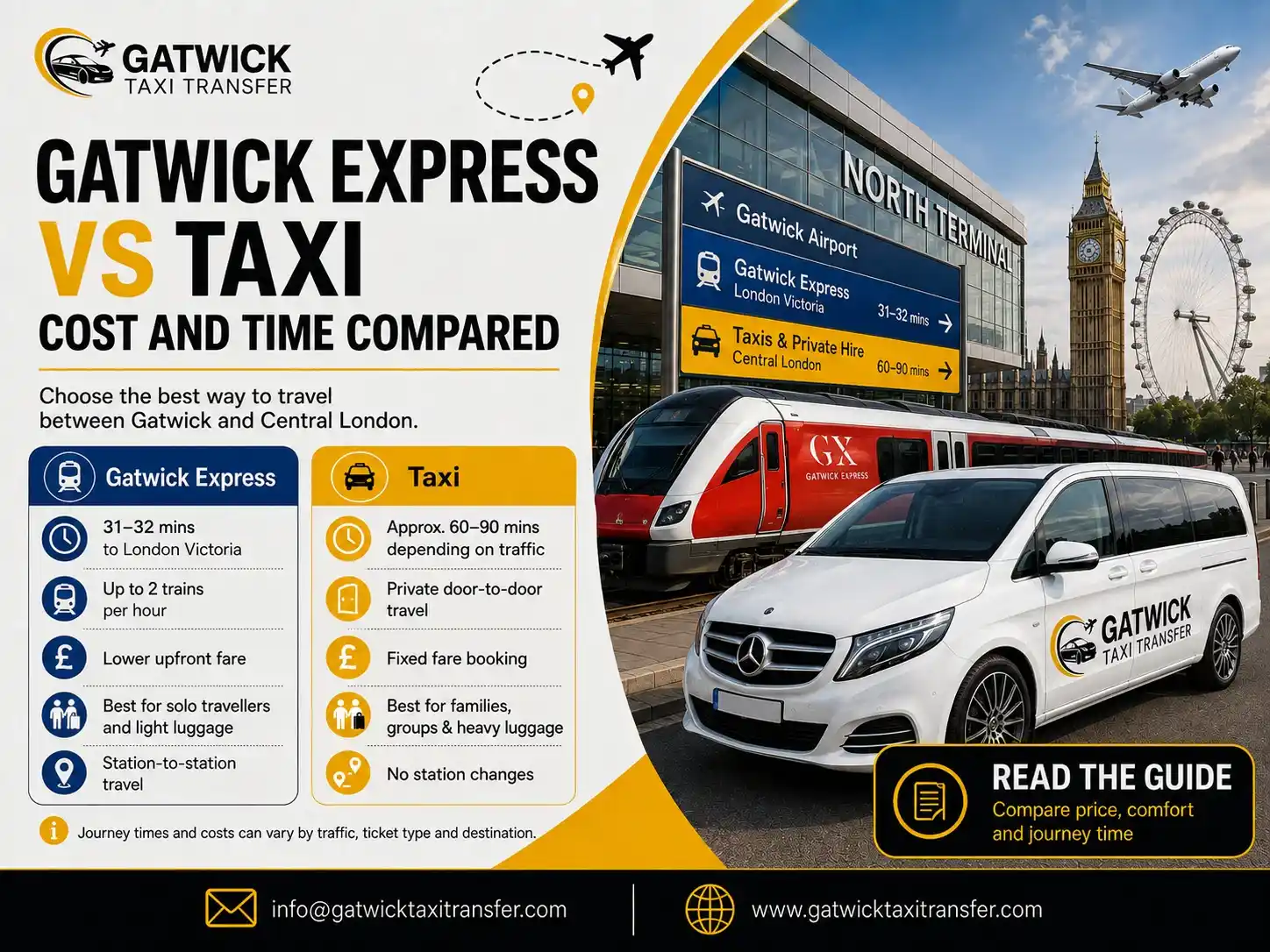
One or two people: take the train. We are a transfer company and that is still the honest answer.
The crossover is not a fixed number. It sits at 3 passengers on a walk-up Express single and at 7 on off-peak contactless.
GroupSave does not work on the Express. The discount that makes rail cheapest for groups pushes you onto Southern or Thameslink instead.
Destination decides more than speed. The Express only reaches Victoria. For St Pancras or London Bridge, Thameslink is faster and cheaper.
Where Does the Taxi Actually Become Cheaper?
This is the number every comparison should lead with and almost none do, because producing it requires admitting there is no single rail fare.
Below, each rail option is set against a fixed private fare of around £68 from Gatwick to central London. The third column is the passenger count at which the shared vehicle fare wins.
| Rail option | Per adult | Taxi wins at | Rail total at that count |
|---|---|---|---|
| Gatwick Express walk-up | £24.10 | 3 passengers | £72.30 vs £68 |
| Gatwick Express online, −10% | £21.69 | 4 passengers | £86.76 vs £68 |
| Southern walk-up | £19.40 | 4 passengers | £77.60 vs £68 |
| Contactless, peak | £18.40 | 4 passengers | £73.60 vs £68 |
| Thameslink walk-up | £14.80 | 5 passengers | £74.00 vs £68 |
| Southern with GroupSave | £12.93 | 6 passengers | £77.58 vs £68 |
| Contactless, off-peak | £10.10 | 7 passengers | £70.70 vs £68 |
Read the third column downwards. Three, four, four, four, five, six, seven. Every row is the same journey on the same day from the same platform, and the answer to "should we take a taxi" moves by four passengers depending on nothing but which ticket you happened to buy.
That is why "is the train cheaper" has no useful answer in the abstract. A family of four holding walk-up Express singles has already spent £96.40 and should have booked a car. The same family tapping in with contactless off-peak spends £40.40 and should not have.
What Exactly Is the Gatwick Express?
A dedicated non-stop rail service between Gatwick Airport and London Victoria, and nothing else. That last part is the bit worth holding onto.
It is not the only train from Gatwick, and it does not serve any London station other than Victoria. It exists to do one journey quickly, and it does that job well.
| Detail | |
|---|---|
| Fastest journey | Around 29 minutes |
| Average journey | Around 32 minutes |
| Victoria to Gatwick | Around 31 minutes |
| Frequency | Roughly every 15 minutes at peak |
| Stops en route | None — non-stop both ways |
| Departs from | South Terminal platforms only |
| Serves | London Victoria and nowhere else |
Twenty-nine minutes at best, thirty-two on average, and the difference between those two numbers is which service you catch rather than anything on the day. Trains every quarter of an hour at peak means the wait rarely adds much.
The service suits anyone heading for Victoria itself, Westminster, Belgravia, the area around Buckingham Palace, or West End addresses with an easy onward hop. Beyond that radius the advantage starts eroding, because whatever you save on the fast leg you spend again getting from Victoria to wherever you are actually going.
How Long Does the Road Journey Really Take?
There is no honest single answer, and any operator who gives you one should be treated with suspicion.
A car journey between Gatwick and central London commonly runs 60 to 120 minutes. That is a wide range because it genuinely is wide, and the variables are not mysterious.
| Factor | Effect |
|---|---|
| Time of day | The single biggest variable — 03:30 and 08:30 are different journeys |
| M23 conditions | The first leg; usually the more predictable half |
| M25 conditions | Where most of the variance lives |
| Central London congestion | The last few miles can take as long as the first thirty |
| Which part of London | South London is often materially quicker than north or east |
| Roadworks and weather | Occasional but real |
The fifth row is the one most comparisons ignore entirely. Gatwick sits south of London, so a transfer to Clapham or Wimbledon is a genuinely different proposition from one to Islington or Stratford — and lumping both under "central London" produces a figure that describes neither.
Why Do Published Gatwick Express Fares Disagree?
Search this question and you will find figures from about £19.80 to £24.10 for what looks like the same ticket. None of those sources is wrong. They are describing different products.
| Ticket type | Roughly | Conditions |
|---|---|---|
| Anytime single, bought at the station | £19.80–£24.10 | No restrictions; the headline figure |
| Booked online or in-app | 10 per cent less | Same flexibility, lower price |
| Advance single | Lower again | Tied to a named train; not refundable |
| With a railcard | Discounted | Eligible cards only |
| Contactless or Oyster | ~£10.10 off-peak, ~£18.40 peak | No booking, no ticket, tap and go |
The bottom row is the one worth pausing on. Pay-as-you-go at roughly £10.10 off-peak is less than half a walk-up single, and Gatwick Express has accepted it since January 2016. No advance commitment, no named train, and no penalty when your flight lands ninety minutes late — which is precisely why it beats an advance fare for anyone arriving rather than departing.
The catch is that pay-as-you-go fares depend on the gate line you use at Victoria, so entering through the wrong barrier charges the wrong fare. It is a small thing that costs real money.
Does GroupSave Work on the Gatwick Express?
No. And this single fact undoes a great deal of the advice circulating about groups and rail.
GroupSave gives one third off off-peak travel for 3 to 9 adults with no railcard needed. It is valid on Southern and Thameslink. It is not valid on Gatwick Express.
| Option | Each | Party total | Against £68 vehicle |
|---|---|---|---|
| Gatwick Express walk-up | £24.10 | £72.30 | Vehicle already cheaper |
| Southern walk-up | £19.40 | £58.20 | Rail cheaper by £9.80 |
| Southern with GroupSave | £12.93 | £38.80 | Rail cheaper by £29.20 |
| Contactless off-peak | £10.10 | £30.30 | Rail cheaper by £37.70 |
So the discount that makes rail decisively cheapest for a group is the one that requires you not to take the Express. A party of three chasing the best rail price ends up on a slower service with stops — which is fine, and worth knowing before you buy.
Note the first row too. Three adults on walk-up Express singles have already exceeded a fixed vehicle fare that would have collected them from the terminal and delivered them to a door.
Compare Against a Real Number — Not an Average
Fixed at booking · Forecourt charge included · Met inside arrivals · Flight tracked
Does the Return Leg Change the Answer?
Almost every comparison covers the airport-to-London direction and stops. The journey out is a different problem with different economics.
Going to Gatwick you are working to a deadline. Bag drop closes, and it closes whether or not your train ran. That asymmetry matters more than any fare.
| Arriving from Gatwick | Departing to Gatwick | |
|---|---|---|
| Deadline | None — you arrive when you arrive | Bag drop closing time, fixed |
| Cost of a delay | Inconvenience | A missed flight |
| Advance rail tickets | Risky — a delayed landing voids them | Sensible — you control the departure |
| Contactless | Ideal — no commitment to a train | Works, but no advance saving |
| Best rail approach | Tap in whenever you emerge | Book an earlier service than you need |
| Road buffer needed | None | 20–30 min on top of the run |
Row three is the practical takeaway for anyone buying rail. An advance single is genuinely cheap and genuinely useless on an inbound journey, because it names a train you may well miss by two hours through no fault of your own. Outbound, the same ticket is a sound purchase.
Row two is the one that decides the mode. Arriving, a slow journey costs you an hour of your evening. Departing, it can cost you the flight, and that asymmetry is why departures skew toward pre-booked road even for travellers who took the train inbound.
Why Is Per-Head Cost the Only Fair Comparison?
A vehicle fare is one number regardless of how many people are inside it. A rail fare multiplies. That single structural difference explains every result on this page.
| Travelling | Each pays | Against off-peak contactless | Against Express walk-up |
|---|---|---|---|
| 1 | £68.00 | Rail wins by £57.90 | Rail wins by £43.90 |
| 2 | £34.00 | Rail wins by £23.90 | Rail wins by £9.90 |
| 3 | £22.67 | Rail wins by £12.57 | Road wins by £1.43 |
| 4 | £17.00 | Rail wins by £6.90 | Road wins by £7.10 |
| 6 | £11.33 | Rail wins by £1.23 | Road wins by £12.77 |
| 8 | £8.50 | Road wins by £1.60 | Road wins by £15.60 |
At six passengers the cheapest rail fare in existence is winning by £1.23 a head. At that margin the comparison has stopped being about money and become a question of whether six people want to move six sets of luggage through Victoria for the price of a coffee.
Note also that a party of six needs a larger vehicle than a saloon, so the real figure sits above £68 — but it also rises far more slowly than six rail tickets do. The fleet page sets out where each class starts.
What About the Coach? It Is Cheaper Than Both
Most comparisons of this route omit the coach entirely, which is convenient for everyone selling trains and taxis and unhelpful for anyone counting money.
National Express runs up to 21 services a day from Gatwick to London Victoria Coach Station from around £6 one way, and easyBus advance fares start lower still. That is less than half the cheapest rail fare on this page.
| Option | From | Journey | Runs | Arrives at |
|---|---|---|---|---|
| easyBus, booked ahead | ~£2 | Slowest | Limited | Various |
| National Express | ~£6 | 1hr 40 fastest, 60–90 typical | 24/7, up to 21 daily | Victoria Coach Station |
| Thameslink | ~£14.80 | 28–44 min | 24hr Fri & Sat nights | London Bridge, St Pancras |
| Gatwick Express | ~£19.80–£24.10 | 29–32 min | ~04:50 to ~00:32 | Victoria only |
| Private vehicle | ~£68 | 45–95 min | 24/7, pre-booked | Your door |
The coach wins on price and loses on almost everything else. Sixty to ninety minutes on a bus after a long flight is a real cost even when it is not a financial one, and it sits in the same traffic a car does without the compensation of arriving at your door.
Two practical notes. The advertised £6 includes a £1.50 booking fee that disappears if you book through the operator's own app while logged in. And Victoria Coach Station is not Victoria station — it is a separate building around 300 metres away, which is a five to ten minute walk with cases before you even reach the Tube.
What Runs at Which Hour?
Here is the detail that decides late arrivals, and almost nobody publishes it plainly.
| Service | Roughly operates | Overnight position |
|---|---|---|
| Gatwick Express | ~04:50 to ~00:32 | Nothing between about half past midnight and ten to five |
| Thameslink | Daytime, plus 24hr Fri & Sat nights | Overnight to London Bridge, Blackfriars, St Pancras — weekends only |
| Southern | Daytime, limited overnight | Sparse; check the specific service |
| National Express coach | 24 hours | The only public option on a weekday night |
| Pre-booked vehicle | 24 hours | Same fare at 03:30 as at 15:30 |
Read row one carefully if you have a late flight. The Express stops around half past midnight, so a scheduled 22:30 arrival that lands ninety minutes down has probably missed it — and that is not an unusual delay.
Row two contains the detail worth remembering: Thameslink runs through the night on Friday and Saturday only. Landing at two in the morning on a Wednesday and on a Saturday are completely different situations, and the timetable is the reason.
For departures the same logic runs backwards. A 06:00 flight needs you at Gatwick around 04:00, which means leaving central London before the first Express of the day. The coach or a booked vehicle are the options, and only one of them collects you from your address.
Which Train Should You Actually Take?
Here is the part that helps you most and sells us least: for a great many London destinations, the Gatwick Express is the wrong train.
It runs non-stop to Victoria and nowhere else. Three operators leave from the same platforms at South Terminal, and which one suits you depends entirely on where you are going.
| Service | Roughly | Reaches | Best when your address is near |
|---|---|---|---|
| Gatwick Express | ~£19.80–£24.10 | Victoria only, non-stop, ~30 min | Victoria, Belgravia, Westminster |
| Thameslink | ~£14.80 | London Bridge, Blackfriars, City Thameslink, Farringdon, St Pancras | King's Cross, Eurostar, the City, Clerkenwell |
| Southern | ~£19.40 | East Croydon ~12 min, Clapham Junction ~33 min, Victoria ~39 min | South London, West London via Clapham |
If you are heading for St Pancras, London Bridge, Farringdon or Blackfriars, Thameslink takes you there directly for roughly five pounds less than the Express. It also removes an Underground change, which with two suitcases is worth considerably more than the fiver.
Southern is the one people overlook. East Croydon in about twelve minutes is genuinely useful if you are staying south of the river, and Clapham Junction opens up west London without going via Victoria at all.
Why Does Station-to-Station Time Mislead?
Thirty minutes against ninety looks decisive. It is also not what either journey consists of.
| By rail | By road | |
|---|---|---|
| Land, immigration, baggage | Same | Same |
| Reach the departure point | Walk to the station, or shuttle from North | Driver meets you in arrivals |
| Wait | Up to 15 min for the next service | None — the vehicle is there |
| Main leg | ~30 min to Victoria | 60–120 min depending on traffic |
| At the London end | Barriers, Underground, change, walk | Nothing — you are at the door |
| Luggage handled | By you, at every stage | Loaded once, unloaded once |
If your destination is a Victoria hotel, rail wins that table comfortably and the arithmetic barely matters. If it needs two Underground changes and a walk, the thirty-minute advantage erodes into something much smaller.
Neither is universally faster. What is universally true is that the rail figure describes one leg of a journey and the road figure describes the whole thing.
Which Option Wins on Five Real Journeys?
Abstract crossovers are less useful than worked cases. Here are five, and we do not win three of them.
One adult, cabin bag, hotel near Victoria
Contactless off-peak at about £10.10, thirty minutes, no changes, walk to the hotel. A vehicle costs roughly £68 for the same trip. Take the train. There is no argument here and we are not going to invent one.
Two adults, one case each, King's Cross
Thameslink direct to St Pancras, roughly £29.60 between them, no Underground leg because St Pancras is where you are going. Against £68 that is a clear margin. Take the train — but Thameslink, not the Express.
Two adults, two children, four cases, Kensington
Under-fives travel free and Kids for £2 may apply, so rail can come in around £40. But the journey is airport station, train, Victoria, District line with a pushchair and four cases, then a walk. Against a fixed fare with the bags loaded once. Road, usually — not on price, on everything else.
Four adults, four cases, Shoreditch
Four Express singles come to £96.40 and still leave you at Victoria with a Tube journey ahead. Four contactless off-peak taps come to £40.40 and leave you in the same place. Compare the live fare — the answer genuinely depends which you buy.
Eight travelling together, luggage, one hotel
Eight rail tickets, eight sets of luggage through barriers, and a party that has to stay together across a change. One 8 seater carries all of them and their cases to the door on one fare. Road, comfortably — and this is where the vehicle economics stop being close.
What About Luggage, Children and Mobility?
Three factors that sit outside the fare comparison and frequently outweigh it.
Luggage
Express trains do have luggage racks and they are better provisioned than an ordinary commuter service. What they cannot do is carry the bags for you. Every case goes onto the train, off at Victoria, through barriers, down an escalator, onto the Underground and along the last stretch by hand. In a car it is loaded once and unloaded once, and the driver does both.
For one cabin bag this is irrelevant. For two large cases per person it is the entire decision, regardless of what the arithmetic says.
Children
Rail is cheaper for families than most expect. Under-fives travel free with an eligible adult, and Kids for £2 applies on qualifying off-peak journeys, so a family of four can sometimes travel for close to two adult fares.
What that does not address is the operational load — a pushchair through barriers, children who must stay together across a change, and the point in the afternoon when everyone has run out of patience. Child seats in a booked vehicle are free and fitted before it leaves base.
Mobility
A rail journey involves platforms, gaps, barriers, escalators and a change. Assistance is available and works well when booked, but it is a sequence of handovers. A door-to-door vehicle replaces all of it with a level kerb at each end, and for anyone unsteady that is worth more than any fare difference. Detail sits on our
Does Your Terminal Change the Answer?
Slightly, and in one direction only.
All three operators share platforms directly under South Terminal. Land there and the station is a brief walk from the arrivals hall, with nothing to transfer between.
Arriving at North Terminal adds a step. The complimentary shuttle runs continuously and the ride is roughly 120 seconds, though budget ten to fifteen minutes overall once you factor in reaching the platform hauling cases. There used to be a station at North; it no longer runs.
| Arriving at | To reach the train | To reach a booked vehicle |
|---|---|---|
| South Terminal | Short walk, station is underneath | Met in arrivals |
| North Terminal | Free shuttle, 10–15 min with bags | Met in arrivals — same fare |
Travelling alone, that shuttle barely registers. Four people with suitcases feel it properly, and it nudges several of the tighter comparisons above towards a car whenever the landing is at North rather than South.
What Happens When Things Go Wrong?
Both modes have a failure mode. They are different, and neither is negligible.
| Rail | Road | |
|---|---|---|
| Main risk | Engineering works, signalling, industrial action | M23, M25 and central London congestion |
| Predictability | High on a normal day | Varies by hour and route |
| Warning | Planned works published in advance | Live traffic, but conditions change |
| If it fails | Rail replacement or a different route | Longer journey, but the fare is fixed |
| Cost of the failure | You may miss a flight | Time, not money — the price does not move |
The last row is the honest distinction. A delayed train and a congested motorway both cost you time. Only one of them can also cost you more money, and on a fixed fare it is not the road.
For departures, that argues for building a traffic buffer into the pickup rather than trusting the fastest mapping estimate. Any operator calculating your collection time from a best-case figure is planning your morning badly.
What Should a Fixed Quote Include?
Comparing a rail fare against a taxi quote only works if you know what the quote covers. Rail fares are all-in; private hire quotes vary considerably.
| Item | Why it matters |
|---|---|
| Airport forecourt charge | £10 for ten minutes at Gatwick; frequently added separately |
| Parking for a meet inside arrivals | Charged in some quotes, absorbed in others |
| Flight monitoring | Determines whether a delay costs you |
| Waiting allowance | How long, and from what moment |
| Meet and greet | Sometimes an extra; sometimes standard |
| Additional stops | Priced at booking, not on the day |
| Child seats | Free with us; chargeable elsewhere |
| Late-night loading | None here; common elsewhere |
A headline figure eight pounds below ours that adds the forecourt charge at the kerb finishes two pounds above it. That is the row most worth checking, and the drop-off charges guide sets out what every UK airport levies.
The Cost Everyone Leaves Out of the Rail Total
Every crossover figure on this page compares a rail fare against a vehicle fare. That comparison quietly favours rail, because the rail number stops at a station and the vehicle number stops at your door.
Getting from Victoria to wherever you are actually staying typically adds £10 to £25 per journey — a Tube fare for a party, or a short taxi if the cases make the Underground impractical. Add that back and the arithmetic shifts.
| Party | Rail only | Rail plus onward | Vehicle £68 | Now wins |
|---|---|---|---|---|
| 1 adult, off-peak contactless | £10.10 | £20–£35 | £68.00 | Rail, clearly |
| 2 adults, off-peak contactless | £20.20 | £30–£45 | £68.00 | Rail |
| 3 adults, Express walk-up | £72.30 | £82–£97 | £68.00 | Road, by £14–£29 |
| 4 adults, Express walk-up | £96.40 | £106–£121 | £68.00 | Road, by £38–£53 |
| 4 adults, off-peak contactless | £40.40 | £50–£65 | £68.00 | Rail, but narrowly |
The last row is the honest one. Four people on the cheapest available rail fare, once the onward leg is counted, are within a few pounds of a door-to-door vehicle. At that margin nobody should be choosing on price.
The onward cost is also the reason destination matters more than party size. A Victoria hotel adds nothing to the rail total. An address in Shoreditch or Canary Wharf adds a Tube change, a walk and, if the luggage defeats you, a second fare from the station rank.
Who Licenses a Gatwick Taxi?
A detail worth knowing before you compare any two quotes, because it explains why published London taxi rates do not help you here.
Gatwick taxis are licensed by Crawley Borough Council, not Transport for London. The airport sits outside the TfL licensing area, so the fare tables TfL publishes for London black cabs simply do not apply to a vehicle picking up at Gatwick, and no equivalent published range exists.
| Option | Pricing | Known before you travel? |
|---|---|---|
| Pre-booked private hire | Fixed at booking | Yes — the figure does not move |
| Airport rank taxi | Metered, Crawley-licensed | No — ask for an estimate first |
| Ride-hailing app | Dynamic, surge applies | Only at the moment you request |
Two 2026 changes matter to the app column. VAT at 20 per cent has applied to ride-hailing fares since 2 January 2026, which widened the gap against pre-booked private hire. And surge behaves worst precisely when Gatwick is busiest — documented Friday-evening quotes into central London have run past £140 against a fixed fare of well under half that.
A metered black cab from Gatwick to central London commonly runs somewhere in the region of £89 to £124 before any traffic penalty. None of these are wrong choices, but only one of them is a number you can compare against a rail fare before you travel.
Which Wins for Your Type of Journey?
The crossover arithmetic answers the money question. This answers the practical one, and for several traveller types the two point in opposite directions.
| You are | Usually better | The reasoning |
|---|---|---|
| Solo traveller | Gatwick Express | Especially staying near Victoria; nothing else comes close on price |
| Couple | Rail | Compare road if the hotel needs an awkward onward connection |
| Business traveller, Victoria meeting | Gatwick Express | Predictable timing beats comfort when a meeting is fixed |
| Business traveller, elsewhere | Depends | Direct arrival and no station change often decide it |
| Family of four | Road | Often not on price — on pushchairs, cases and patience |
| Group of six or more | Road | Compare the whole party total against one vehicle quote |
| Elderly or reduced mobility | Road | Fewer changes, less luggage handling, level kerb both ends |
| First visit to London | Either | Some prefer no decisions after a long flight; others enjoy the saving |
The last row is deliberately undecided. Rail is not difficult to navigate and plenty of first-time visitors would rather keep the fifty pounds than avoid working out Victoria to the Underground. Others, after immigration and a baggage belt, want no further decisions at all. Neither instinct is wrong.
Rows five and seven are where we would argue hardest, and notably neither is a price argument. A family of four can travel by rail for close to two adult fares. What that does not buy is somebody else carrying the cases.
A Seven-Question Checklist Before You Book
Run these in order. Most people find the answer emerges by question three.
| Ask yourself | What it tells you | |
|---|---|---|
| 1 | Is Victoria near my final destination? | If yes, rail is strong. If no, check Thameslink before anything |
| 2 | How many of us are travelling? | Crossover sits between 3 and 7 depending on ticket |
| 3 | Which fare would we actually buy? | Walk-up and contactless are four passengers apart |
| 4 | How much luggage? | Two large cases each moves it to road regardless of price |
| 5 | Children or reduced mobility in the party? | Door-to-door value rises sharply |
| 6 | What time do we land, or need to leave? | After midnight or before 05:00, rail may not be running |
| 7 | Do we qualify for GroupSave or a railcard? | Can cut rail by a third — but not on the Express |
Questions one and two settle the majority of cases between them. Question three is the one nobody asks and it moves the answer more than any other single factor on this page.
Questions four to six are the ones where price stops being the deciding input. A party that saves twenty pounds by rail and spends the saving on a station taxi from Victoria because the cases were unmanageable has not saved anything.
So Which Is Better Overall?
There is no single winner, and any guide claiming one is selling something. What there is, is a clear split.
| Wins on | Which means | |
|---|---|---|
| Rail | Station-to-station speed and solo price | Unbeatable for one or two to Victoria |
| Road | Door-to-door and shared cost | Wins from 3 to 7 passengers depending on ticket |
| Neither | Some destinations | St Pancras or London Bridge? Take Thameslink |
The comparison worth making is not twenty-four pounds against sixty-eight. It is the total for everyone, plus the whole journey to the final door, plus the effort of moving your luggage through it.
Set out that way, most travellers reach the right answer in under a minute — and for a decent share of them, that answer is a train.
Frequently Asked Questions
Related Guides
Price It Properly — Your Address, Your Party, One Number
Fixed at booking · Kerb fee inside the quote · Free child seats · Same rate at any hour