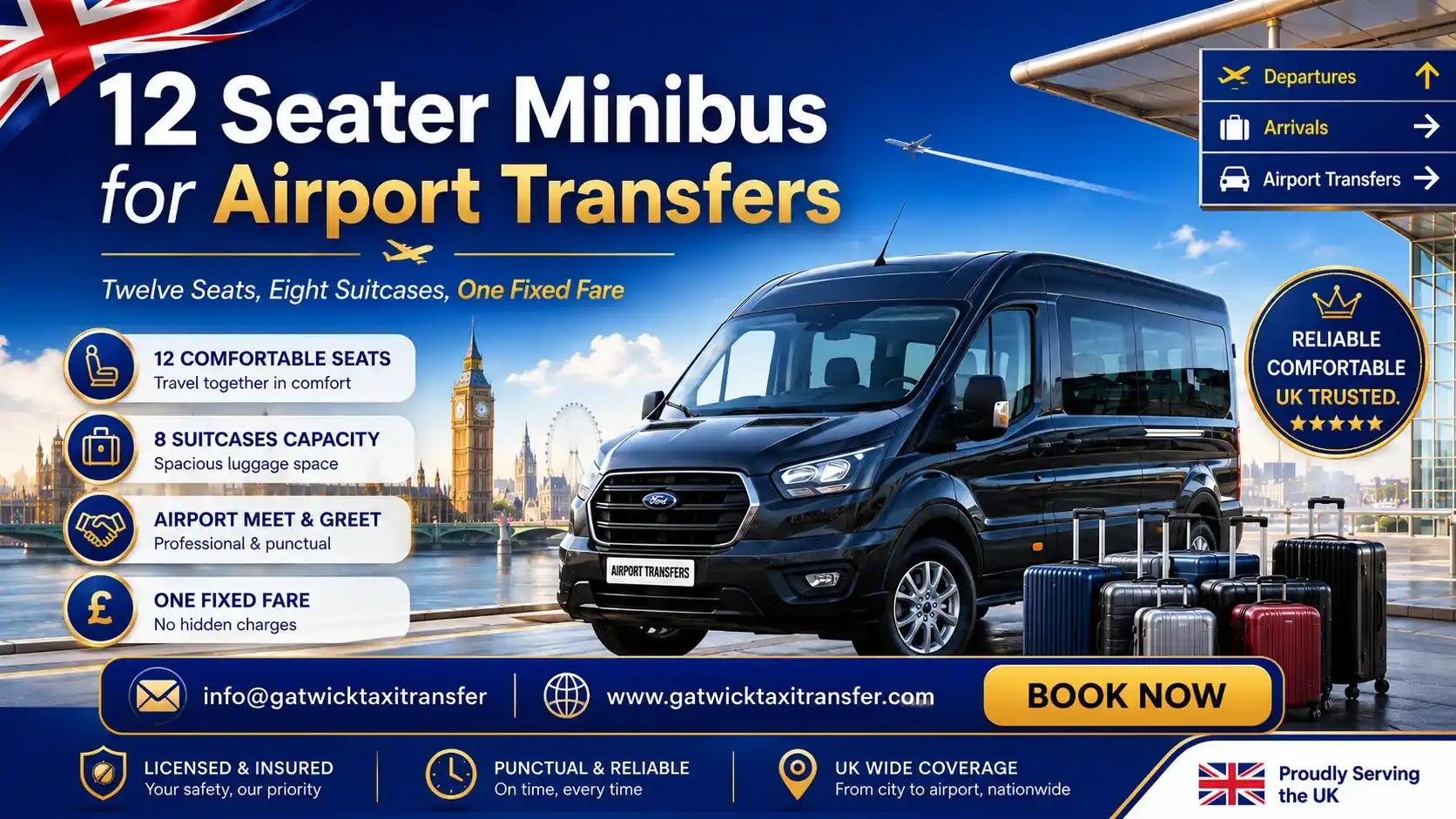
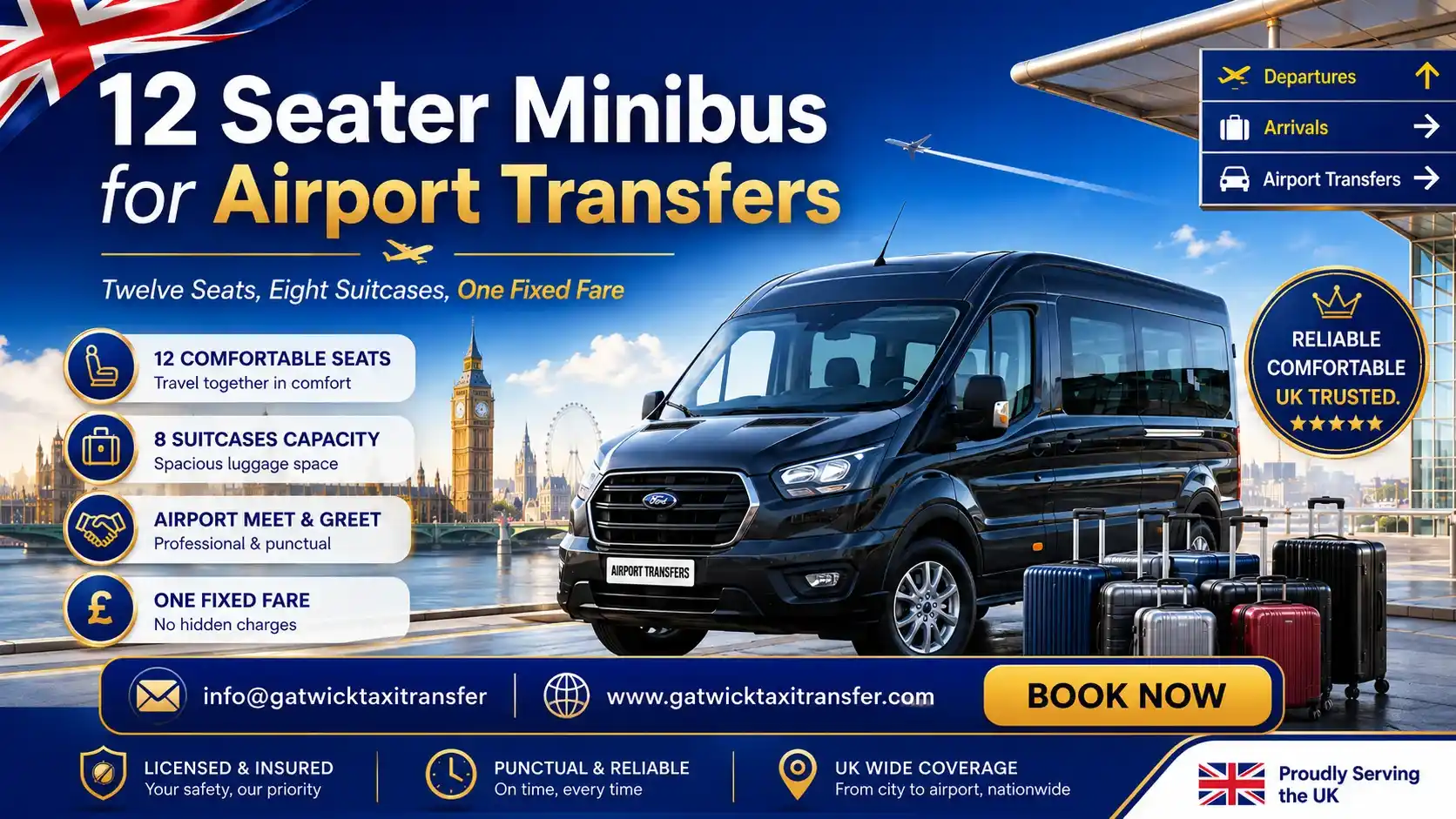
An airport minibus transfer for twelve passengers is the point where group travel stops being a car booking and becomes something legally different. This guide covers what a 12 seater minibus actually carries, what it costs to every UK airport and cruise port, the licensing rules that apply once a vehicle has nine or more seats, and the one capacity question that catches almost every group out.
What it holds: twelve passengers, eight large suitcases and eight cabin cases. That eight-bag figure is the one to check, not the seat count.
What it costs: £155 to London City up to £250 to Southend from central London, each with the airport's own drop-off charge inside the fare.
Why it beats splitting up: one minibus to Gatwick at £204 replaces three cars costing £278 between them — and keeps twelve people in one place before a check-in deadline.
The licensing bit: nine or more seats makes it a minibus in law. Hire it with a driver and that burden sits with us; hire it to drive yourself and it sits with you.
How Many People and Bags Fit in a 12 Seater Minibus?
Twelve seats and eight suitcases — a ratio of 0.67 bags per passenger, and one you can compare against every class on our fleet page. Those two numbers rarely match a group's assumptions, and the gap between them is where most booking problems on this vehicle begin.
Booking a minibus with luggage is where the arithmetic bites: a group of twelve travelling on a fortnight's holiday will typically have twelve checked bags. The vehicle takes eight. The remaining 4 cases have to go somewhere, and on a minibus there is no somewhere — unrestrained luggage in the passenger cabin is prohibited for the same safety reason it is in a car, and the consequence at 12 passengers is four people with nowhere for their bags rather than one.
| Measure | Capacity | What it means |
|---|---|---|
| Seated passengers | 12 | Every seat belted; no standing |
| Large suitcases | 8 | Standard 23kg checked bags |
| Cabin cases | 8 | Airline hand-baggage size |
| Bags per passenger | 0.67 | Not one each — this is the constraint |
Where the 12 seater sits in the range
Below it, the 8 seater MPV carries 8 passengers with 7 bags at a ratio of 0.88 bags per seat — a better bags-per-head ratio, but four fewer seats. Above it sit the 14 seater and 16 seater, both of which take twelve suitcases. The 12 seater occupies the middle: more seats than most groups need, fewer bags than a fully-laden twelve would want.
| Vehicle | Seats | Suitcases | Choose it when |
|---|---|---|---|
| 8 seater MPV | 8 | 7 | Eight or fewer, heavy luggage |
| 12 seater | 12 | 8 | Nine to twelve travelling light or mixed |
| 14 seater | 14 | 12 | Thirteen or fourteen, or twelve with full cases |
| 16 seater | 16 | 12 | Fifteen or sixteen, or spare seats wanted |
Read that suitcase column rather than the seat column and the decision usually makes itself. The jump from eight cases to twelve happens at the 14 seater, not the 16 — so a group of twelve with a full set of checked bags should be looking at the 14 rather than paying for four seats they will not sit in.
That makes it ideal for a specific shape of group. Twelve travelling light. Nine to twelve with mixed luggage. A corporate party with cabin bags. Where it works less well is the classic family holiday group where everyone has a full case.
Do You Need a Special Licence for a 12 Seater Minibus?
This section exists because it genuinely affects what you can and cannot do, and almost no minibus hire page covers it.
Under UK law, a vehicle with 9 or more passenger seats is a minibus rather than a car. A 12 seater carries 12 passenger seats, putting it 3 seats past that threshold. That single threshold changes the legal position of whoever is driving it. A 12 seater has twelve passenger seats, so it is comfortably over the line.
| Hire with a driver | Self-drive hire | |
|---|---|---|
| Who needs the licence | The operator and driver | You |
| Licence required | PCV category D1 plus Driver CPC | D1 entitlement at minimum |
| If you passed your test after 1997 | Irrelevant to you | No automatic D1 — separate test needed |
| Insurance | Operator's PSV cover | Your responsibility to arrange |
| Vehicle compliance | Operator's obligation | Yours while in your possession |
The 1997 line catches people out most. Drivers who passed a standard car test before 1 January 1997 typically hold D1 entitlement on their licence already, though not for hire and reward. Anyone who passed afterwards does not have it at all and would need to sit a separate test before legally driving a 12 seater.
Carrying passengers for payment — which is what an airport transfer is — raises the bar again to a full PCV licence with Driver CPC. That is the qualification our minibus drivers hold, and it is why hiring with a driver removes the question entirely from your side.
How Much Is a 12 Seater Minibus to a London Airport?
Fixed fares from central London for the whole vehicle, each including that airport's drop-off charge. The per-person column assumes a full twelve.
| Airport | Distance | Drop-off | Minibus from | Per person |
|---|---|---|---|---|
| London City LCY | ~11 mi | £8 | £155 | £13 |
| Heathrow LHR | ~16 mi | £7 | £165 | £14 |
| Luton LTN | ~37 mi | £7 | £200 | £17 |
| Gatwick LGW | ~40 mi | £10 | £204 | £17 |
| Stansted STN | ~45 mi | £10 | £210 | £18 |
| Southend SEN | ~45 mi | £8 | £250 | £21 |
Two things are worth pulling out. London City is the cheapest by a clear margin at roughly eleven miles, which makes it the obvious choice for a corporate group on short-haul European routes. And Gatwick costs more than Luton despite being a similar distance, because of the £10 forecourt charge against Luton's £7 and the standing traffic on the M23 approach.
Fares from outside central London are calculated from your specific pickup postcode rather than the nearest town, which for a group scattered across a county usually means one collection point works out considerably better than three.
Gatwick minibus
Around forty miles from central London and the busiest group destination on the list, largely because of the volume of leisure charter and short-haul traffic. Specify North or South Terminal from the boarding pass — they are separate buildings, and a minibus sent to the wrong one incurs a second £10 charge plus a fifteen-minute correction that a group of twelve feels more acutely than a couple would.
Heathrow minibus
Sixteen miles and the cheapest of the major long-haul options, which makes it the default for corporate groups and extended families flying beyond Europe. Four terminals with separate approach roads, so the terminal matters as much as the airport.
Stansted and Luton minibus
Both are motorway runs — the M11 and M1 respectively — and both drop sharply in price from a north or east London pickup rather than a central one. If your group is assembling anywhere north of the river, these two are worth quoting from the actual postcode before assuming Gatwick.
Twelve Passengers, One Fixed Fare — Confirmed Before You Pay
All UK airports · Drop-off charge included · Free child seats · Driver supplied · 24/7
How Does Airport Pickup Work for a Group of Twelve?
Collecting twelve people from a terminal is a different job from collecting two, and the difference is not just the vehicle. It is where everybody stands.
At every UK airport, the car forecourt and the large-vehicle area are separate. A saloon can pull onto the terminal frontage; a twelve-seat minibus generally cannot. That means the driver comes to you rather than the other way round: he waits inside the arrivals hall with a name board, gathers the group, and walks everyone to the vehicle in the coach or oversized-vehicle bay. Expect a short walk — usually 3 to 5 minutes at Gatwick and Heathrow, and under 2 minutes at the smaller terminals, covering perhaps 200 to 400 metres.
| Stage | What we do | What helps |
|---|---|---|
| Before you land | Flight tracked from its origin airport | Correct flight number at booking |
| On landing | Waiting time starts from actual touchdown | Nothing — this happens automatically |
| In the hall | Driver holds a board with the lead name | Tell the group whose name is on it |
| Gathering | Driver waits for the full party | Agree a meeting point among yourselves before you fly |
| Walking out | Driver leads to the large-vehicle bay | Keep the group together; it is a short walk |
| Loading | Driver loads the bags | Nothing to lift |
The one thing worth agreeing in advance is where your own group meets. Twelve people rarely clear immigration at the same speed, and a driver holding a board for forty minutes while stragglers appear one at a time is the most common cause of a slow departure from the terminal. Pick a spot — the arrivals board, a named coffee shop — and tell everyone before you board the outbound flight.
Terminals matter here as much as on departures. Gatwick's North and South are separate buildings; Heathrow has four. Give us the terminal from your boarding pass so the driver is waiting in the right hall rather than driving between them.
What Does Door-to-Door Actually Remove for a Group?
The phrase gets used loosely, so here is what it actually means for a group of twelve: no interchange. Not one.
The alternative for a party this size is usually a train to a London terminus, an airport express, and a walk at each end with luggage. Each of those is a point where a group can lose someone, miss a connection, or discover that a lift is out of service and twelve suitcases have to come down a staircase. One vehicle from your address to the terminal door removes every one of those points at once.
| Travelling with | Why interchanges hurt |
|---|---|
| Young children | Buggies, car seats and tired legs do not move well between platforms |
| Elderly passengers | Stairs, gaps and standing-room carriages are the real obstacle, not distance |
| Eight or more suitcases | Nobody has enough hands; the group ends up split across carriages |
| Sports or work equipment | Often too long for luggage racks and awkward through barriers |
| A pre-dawn departure | No trains running at all before roughly 05:00 |
Collection works from any address — home, hotel, office, station forecourt or a venue car park. Where a group is assembling from several places, additional pickup points are workable, though each one adds mileage and time. Tell us the addresses at booking and we will say honestly whether one meeting point works out better.
Can a Minibus Take Us From the Airport to Our Hotel?
Around 33 per cent of our minibus work never touches a departures board. It is groups landing at a London airport and needing to reach a hotel, and the constraints are different enough to be worth setting out.
An arriving group is at its least capable. Twelve people who have just flown eight hours, cleared immigration together and collected eight bags between them are not in a state to split across vehicles, work out an address, or navigate the Piccadilly line with luggage. Getting them into one vehicle at the terminal and out of it at the hotel door is the entire value of the booking.
| Group type | Typical route | The thing to get right |
|---|---|---|
| International tour group | Heathrow or Gatwick to a central London hotel | One drop point — not a hotel with two entrances |
| Conference delegates | Airport to venue hotel | Arrival window often clusters; book each flight separately |
| Wedding guests | Airport to venue or hotel | Guests rarely land together — confirm one flight per booking |
| School and student groups | Airport to accommodation | Head count is fixed and must match exactly |
| Family holiday arrival | Airport to hotel or private address | Child seats fitted before the vehicle leaves base |
The most common avoidable problem on these is the hotel entrance. Larger London hotels frequently have a main frontage on one street and a coach or service entrance on another, and a minibus cannot always use the frontage a car would. Telling us the hotel name and postcode lets the driver head for the entrance that actually takes a twelve-seat vehicle rather than circling to find out.
Onward journeys beyond London work the same way. A group landing at Gatwick and continuing to Brighton, Croydon, Oxford or anywhere else travels in the same vehicle from the terminal, which for a party carrying luggage is materially simpler than an airport train followed by a local connection.
What Does a Minibus Cost to Regional UK Airports?
Group travel does not always start and end in London. These are the longer runs we handle most often, and the economics shift noticeably in the minibus's favour as distance grows.
| Airport | Distance | Minibus from | Per person |
|---|---|---|---|
| Birmingham BHX | ~120 mi | £520 | £43 |
| Bristol BRS | ~120 mi | £520 | £43 |
| Manchester MAN | ~200 mi | £790 | £65 |
| Southampton SOU | ~80 mi | £370 | £30 |
At these distances the per-head figures start looking genuinely competitive against rail. Twelve people to Manchester at £66 each across roughly 200 miles works out at 33 pence per person per mile, close to an advance train fare and considerably below a walk-up one — with the difference that nobody changes trains, nobody carries a bag through a station, and the group arrives together at a terminal door rather than a city-centre platform.
Long-distance minibus work needs more notice than airport runs. A single vehicle out of circulation for most of a day is a bigger commitment than a two-hour transfer, so book these a week ahead where you can.
Which UK Cruise Ports Do You Cover by Minibus?
Cruise groups are the other major use of this vehicle, and the timing discipline is different from an airport run. A flight can be rebooked; a ship sails on schedule and does not wait.
| Port | Distance | Minibus from | Per person |
|---|---|---|---|
| Tilbury Cruise Port | ~30 mi | £220 | £18 |
| Dover Cruise Port | ~80 mi | £400 | £33 |
| Southampton Cruise Port | ~80 mi | £390 | £32 |
| Portsmouth Cruise Port | ~75 mi | £420 | £35 |
| Harwich Cruise Port | ~90 mi | £500 | £41 |
Embarkation runs carry a hard deadline at the far end, which is the argument for one vehicle over several. Three cars arriving at Southampton within 20 minutes of each other is fine; the same three spread across 90 minutes because one hit traffic on the M3 is a problem when the last one is carrying two of your party.
Disembarkation is the reverse problem. Several thousand passengers leave a ship inside a couple of hours, and the taxi rank at a cruise terminal is not built for that. A pre-booked minibus with a driver holding a name board removes the queue entirely.
One Minibus or Several Cars?
Anyone pricing a group airport taxi runs this calculation, and the answer is more decisive than people expect once both cost and logistics are counted.
| Option | Vehicles | Total | Per person |
|---|---|---|---|
| 12 seater minibus | 1 | £204 | £17.00 |
| Two MPV7 + one MPV6 | 3 | £278 | £23.17 |
| Three MPV7 | 3 | £285 | £23.75 |
| 16 seater minibus | 1 | £234 | £19.50 |
£74 separates one minibus from three cars — a 27 per cent saving on the same twelve passengers. The logistics matter more. Three vehicles means three arrival times, three sets of instructions, and a group that reassembles at the terminal rather than travelling as one. When the whole party has a shared check-in deadline, that reassembly is where plans slip.
Note the last row. The 16 seater at £234 sits just £30, or 15 per cent, above the 12 seater and carries 4 more suitcases, a 50 per cent gain in luggage capacity. For a group of twelve with heavy luggage, that thirty pounds buys the capacity that makes the booking work at all — which is usually a better use of the money than saving it.
What Is Included in the Fare?
Standard on every job rather than optional extras. Several of these are charged separately elsewhere, which is usually where a quoted price and a final price diverge.
| Included | What it means on the day |
|---|---|
| Airport drop-off charge | Inside the fare — nothing to settle at the terminal |
| Qualified driver | PCV D1 with Driver CPC, as the law requires for group hire |
| Flight monitoring | Tracked from the origin airport; pickup follows your actual landing |
| Meet and greet | Name board inside arrivals, not a kerbside rank |
| Waiting time | Included from touchdown — twelve people clear a belt slowly |
| Child seats | Free on request, infant to booster |
| Luggage handling | Driver loads and unloads; no expectation to ask |
| Fixed fare | No overnight rate, no surge, no traffic surcharge |
The waiting time provision is worth more on a minibus than a car. 12 passengers clearing immigration and collecting 8 bags between them takes materially longer — typically 35 to 50 minutes from touchdown than two people with one case each, and a clock that starts five minutes after the driver arrives would be running for most of it.
Who Uses a 12 Seater Minibus?
Four group shapes account for most of this work, and each has a different constraint worth planning around.
Family airport transfer
Extended families travelling together — grandparents, parents, children — are the most common booking and the most likely to hit the luggage ceiling. Two or three families combining usually means close to 1 case each across 12 people, which exceeds the 8-case limit by 4 and pushes the sensible answer to a 16 seater with its 12 cases. Free child seats matter here; say how many and what ages at booking.
Corporate minibus hire
Conference arrivals, team travel and client groups. Luggage is typically light — cabin bags and laptop cases — which makes 12 seats and 8 cases a comfortable fit, with the 8 cabin positions rarely tested. Account billing with monthly invoicing and VAT receipts suits companies running this regularly rather than paying per journey.
Wedding and celebration parties
Groups heading out for a destination wedding or a milestone trip. The distinguishing feature is that everybody must arrive together, which rules out splitting across vehicles regardless of the cost comparison. Book early: these cluster on the same peak weekends as everyone else.
Sports and club travel
Teams and clubs travelling to fixtures or tournaments. Kit is the issue rather than suitcases — bags, equipment and sometimes oversized items that need declaring by dimension rather than by count. Tell us what the equipment is and we will confirm whether the 12 seater takes it or whether a 14 is needed.
Tour groups, students and school parties
These share one feature that separates them from the rest: the head count is fixed and non-negotiable. A tour operator with twelve confirmed guests, a school party with a signed-off list, a student group on a funded trip — none of these can leave someone behind because the vehicle turned out to be one seat short.
Book on the confirmed number rather than the expected one, and if there is any chance of a thirteenth person joining, take the 14 seater. The difference in fare is far smaller than the cost of finding a second vehicle on the morning.
Conference delegates
Delegates rarely land together even when they are attending the same event, which makes this the one group type where several smaller bookings beat one large one. Book per flight rather than per delegation, and give each booking its own flight number so each pickup tracks its own arrival.
How Far Ahead Should You Book a Minibus?
Group bookings need more lead time and more detail than a car, and both for the same reason: there are far fewer minibuses and qualified drivers in circulation.
How far ahead
48 to 72 hours covers most journeys. A week for departures before 07:00, school holiday start dates, bank holiday weekends and the late-July to early-September peak. Long-distance regional runs and cruise embarkations deserve a week regardless of season, because a vehicle committed to a full-day job cannot be reallocated at short notice.
What to have ready
Ten things, and none takes longer than a moment to supply. Together they are the difference between a vehicle that fits and one that does not.
| Detail | Why it matters | |
|---|---|---|
| 1 | Exact passenger count | Twelve and thirteen are different vehicles, not a rounding difference |
| 2 | Large suitcases, counted separately | The binding constraint on this vehicle — eight, not twelve |
| 3 | Cabin bags | Eight fit alongside the cases; more needs declaring |
| 4 | Full pickup address | A minibus needs more kerb than a car; access notes help |
| 5 | Destination and terminal | From the boarding pass, not the airline homepage |
| 6 | Travel date and pickup time | Or the flight number, and we calculate it |
| 7 | Flight number | On arrivals this is the only thing genuinely required |
| 8 | Child seats and ages | Fitted before the vehicle leaves base, free of charge |
| 9 | Additional pickup points | Workable, but changes route and price — say so upfront |
| 10 | Oversized items | Sports kit, instruments, pushchairs — by dimension, not name |
The most useful habit is describing the group the way we need to hear it. Not "a twelve seater please", but "twelve passengers, eight large suitcases, six cabin bags" — that single sentence tells us immediately whether the 12 seater works or whether you want the 14.
Multiple pickups
A group assembling from several addresses is workable but adds mileage and time to the fare. Where the addresses are close together it usually still beats separate cars; where they are spread across a county, one central meeting point is normally cheaper and simpler. Give us the addresses and we will say honestly which way works out better.
What Qualifications Does a Minibus Driver Hold?
Minibus drivers are a smaller and more heavily qualified pool than car drivers, which is worth understanding because it explains both the price and the availability.
| Requirement | Car (PHV) | Minibus (9+ seats) |
|---|---|---|
| Licence category | Full car licence | PCV category D1 |
| Professional qualification | TfL topographical test | Driver CPC, 35 hours every 5 years |
| Medical | Standard | Higher PCV standard, renewed more often |
| Background check | Enhanced DBS | Enhanced DBS |
| Vehicle inspection | Annual | More frequent, PSV standard |
The Driver CPC is the part most people have never heard of. It is a professional qualification requiring 35 hours of periodic training every 5 years, covering vehicle safety, passenger handling and drivers' hours rules. It is not optional and it is not a formality — a driver whose CPC has lapsed cannot legally carry your group.
Practically, this means two things for you. The driver loading your bags is a professionally qualified passenger-carrying driver rather than someone who happens to own a large vehicle. And there are far fewer of them in circulation than there are minicab drivers, which is the real reason a minibus needs more notice than a car.
Can You Collect a Group at 4am?
The hours a group most needs a minibus are exactly the hours when nothing else runs, and the arithmetic is worth spelling out.
Take a 06:30 departure from Gatwick. Bag drop closes at 05:45, which means the group should be at the terminal by 05:00, which means leaving central London around 03:45. There is no train at that hour. There is no coach. Twelve people arranging their own way to Gatwick at 03:45 have precisely one option, and it is this one.
| Flight departs | At the terminal | Leave central London | Rail available? |
|---|---|---|---|
| 06:30 | 05:00 | 03:45 | No |
| 07:30 | 06:00 | 04:45 | No |
| 08:30 | 07:00 | 05:45 | First services only |
| 10:00 | 08:30 | 07:00 | Yes, but peak fares |
The fare does not move for the hour. A 03:45 collection costs what the same journey costs at 15:45 — no night rate, no unsocial-hours loading, no surge multiplier applied at the moment demand is highest. A 1.8x surge on a £204 fare would add £163; across 12 passengers that is £13.60 each in multiplier alone.
Late arrivals work the same way in reverse. A flight landing at Gatwick at 23:50 puts a group on the concourse around 00:40, when the last direct services have gone and what remains involves changes. A vehicle booked three days earlier is simply waiting.
Why Book a Group Minibus With Us?
A short and specific list rather than a long and general one. These are the things that are true of a minibus booking here and not universally true elsewhere.
| Detail | |
|---|---|
| Fare | Fixed at booking, including the airport forecourt charge. It does not move for traffic, hour or route. |
| Licensing | TfL Private Hire Operator licence; drivers hold PCV D1 with current Driver CPC. |
| Coverage | Every UK pickup postcode, all six London airports, four regional airports, five cruise ports. |
| Arrivals | Flight tracked from origin; driver inside the hall with a board; waiting time from touchdown. |
| Child seats | Free, fitted before the vehicle leaves base. Say ages at booking. |
| Hours | 24 hours with no overnight premium and no surge. |
| Accounts | Monthly invoicing with VAT receipts for companies booking regularly. |
| Honesty on size | If your luggage exceeds the 12 seater, we will tell you before you book, not on the pavement. |
That last row is the one we would most want you to hold us to. The commercial temptation on a group booking is to take the smaller vehicle order and deal with the consequences on the day. Telling you at the quote stage that twelve people with twelve cases need the 14 seater costs us a slightly smaller booking and saves you the morning.
Frequently Asked Questions
Related Guides
Book Your 12 Seater Minibus — Every UK Airport and Port
Driver supplied · Drop-off included · Free child seats · No overnight surcharge · TfL-licensed