Groups sitting at nine or ten passengers usually assume the 12 seater is the safer booking. It is not, and the fleet figures explain why in one line: both vehicles carry 8 large suitcases. Two extra seats, not one extra case. This guide covers what a 10 seater genuinely holds, what it costs to every UK airport, and full terminal detail for Gatwick and Heathrow — the two airports where getting the terminal wrong costs real money.
The figure that decides it: 8 large suitcases across 10 seats, a ratio of 0.8. The 12 seater carries the same 8 across 12 seats, giving 0.67 — a worse balance, not a better one.
Sizing up does nothing for luggage: the next genuine increase in boot space arrives at the 14 seater, which takes 12 cases. Between 10 and 12 you are buying seats only.
What it costs: £130 to London City up to £210 to Southend from central London, forecourt charge included — roughly £17 each on a Gatwick run.
Terminals matter here: Gatwick has 2, Heathrow has 4, and each wrong arrival costs a second forecourt charge plus fifteen minutes. Full detail on both further down.
What Does a 10 Seater Minibus Actually Hold?
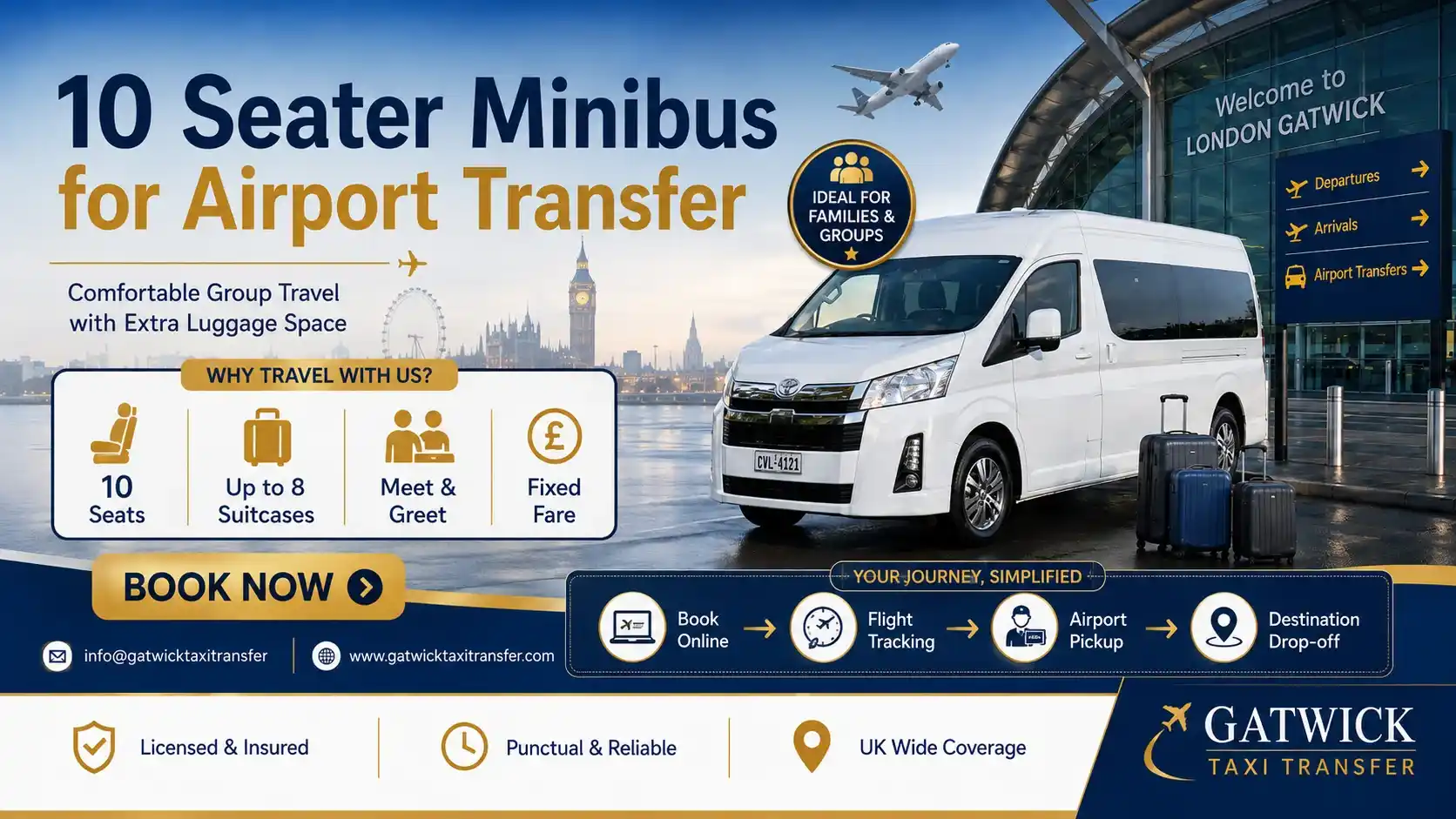
Ten passengers, 8 large suitcases and 8 cabin cases — figures you can check against every vehicle class on our full fleet page. The first number is easy to picture and rarely the problem. The second is the one that decides whether the booking works.
A large suitcase here means a standard checked bag of roughly 75 to 80 cm weighing up to 23 kg — what most people take on a week or a fortnight abroad. Ten of those exceed the compartment by two. Ten people travelling with cabin bags and a handful of checked cases between them fit comfortably.
| Hold cases | Vehicles offering it | Seat span | What the step buys |
|---|---|---|---|
| 7 cases | MPV8 | 8 seats | Tightest ratio, best per-seat balance |
| 8 cases | 10 seater and 12 seater | 10 or 12 seats | Seats only — the boot is unchanged |
| 12 cases | 14 seater and 16 seater | 14 or 16 seats | The one genuine luggage increase |
Grouped that way the fleet resolves into three luggage tiers rather than five vehicles. Seven cases, eight cases, twelve cases. Two vehicles share the middle tier and neither carries a bag more than the other; the larger of them just distributes the same load over two extra bodies.
Within that shared tier the 10 seater is comfortably the stronger pick. Divide eight cases across ten seats and you get 0.8 apiece; across twelve seats it falls to 0.67. The higher figure is what keeps a group's luggage inside the vehicle.
Should You Book an 8, 10 or 12 Seater?
Three vehicles sit close together at the small end of the range, and the choice between them is more decided than the seat counts suggest.
| MPV8 | 10 seater | 12 seater | |
|---|---|---|---|
| Seats | 8 | 10 | 12 |
| Large cases | 7 | 8 | 8 — no gain |
| Bags per seat | 0.88 | 0.80 | 0.67 |
| Best for | 7–8 with full cases | 9–10 passengers | 11–12 travelling light |
| Avoid when | 9 or more people | 10 people, 10 cases | Luggage is the constraint |
Eight or ten
Two extra seats, one extra case. If your group is genuinely eight people with eight checked bags, the MPV8 at 0.88 bags per seat is the better-balanced vehicle and cheaper besides. Move to the 10 seater when you have nine or ten bodies, not when you have eight bodies and heavy luggage — the car and MPV comparison covers everything below this size.
Ten or twelve
Only if you have eleven or twelve passengers. There is no luggage argument for the 12 seater over the 10, because there is no luggage difference. Groups routinely pay the step-up expecting more room in the back and receive none, which is the single most common misjudgement at this end of the range.
When to jump straight to the 14
If ten people are each bringing a checked bag, skip the 12 entirely — and note that the 16 seater carries the same twelve cases as the 14, so it adds seats rather than boot. The 14 seater takes 12 large cases — a 50 per cent increase over both smaller vehicles — and is the first vehicle in the range that genuinely accommodates a fully-laden group of ten.
Why Do Others Say One Suitcase Per Passenger?
Shop around this vehicle size and you will meet a confident claim: roughly one case per person on an airport run. Ten seats, ten bags. Our figure is eight. The gap is real and it is worth understanding before you book anywhere.
Three things account for it, and none of them involves anyone being dishonest.
| Reason | What it means for your booking |
|---|---|
| Case size assumed | A one-per-head claim usually assumes medium cases around 65–70 cm, not the 75–80 cm hold bag most people fly with |
| Vehicle model | Minibus bodies differ. A long-wheelbase van has a deeper rear compartment than a shorter conversion with the same seat count |
| Seats folded | Some quotes assume a rear row down — which works only if you are not filling every seat |
| Cabin overflow | Some operators count space between passengers. Loose luggage in the cabin is not permitted, so this capacity is not real |
Our eight is a conservative figure for full-size hold cases with every seat occupied and nothing riding loose. It is the number that holds on the morning rather than the number that reads best on a page.
The seasonal factor nobody mentions
Winter groups fit less. Coats, boots and heavier clothing occupy real volume, and a party of ten travelling in January arrives with bulk that the same party in July does not have. Coats worn rather than packed help; coats carried do not.
Ski trips are the extreme version. Ten passengers with ski bags exceeds any 10 seater regardless of case count, because the constraint becomes length rather than volume. Those bookings need a trailer or a larger vehicle, arranged in advance.
What About a 9 Seater?
Several operators list an 8–9 seater tier between the MPV and the 10, and it is worth explaining where that sits because the difference is legal as much as practical.
| Configuration | Passenger seats | Legal class | Driver needs |
|---|---|---|---|
| MPV, 8 passengers | 8 | Car | Standard licence plus private hire badge |
| 9 passenger seats | 9 | Minibus — the threshold | Category D1 required |
| 10 passenger seats | 10 | Minibus | Category D1 plus Driver CPC |
Nine passenger seats is precisely where UK law stops treating a vehicle as a car. Everything at nine and above carries the same licensing burden on the operator, which is why the price step between an 8 seater MPV and a 10 seater is larger than the two extra seats alone would suggest — you are crossing a regulatory line, not just adding capacity.
That also explains why the 9 and 10 tiers are frequently sold as one thing. Once the licensing applies, there is little reason to run a 9 when a 10 costs the same to operate. If you are quoted a 9 seater, ask what the luggage figure is; it will typically match the 10.
How Much Is a 10 Seater to Each London Airport?
Prices below cover the entire vehicle leaving the middle of London, with each airport's own terminal levy absorbed. The final column shows what that becomes once ten people share it.
| Destination | Road miles | Terminal fee | Vehicle price | Split ten ways |
|---|---|---|---|---|
| London City LCY | ~11 mi | £8 | £130 | £13 |
| Heathrow LHR | ~16 mi | £7 | £139 | £14 |
| Luton LTN | ~37 mi | £7 | £168 | £17 |
| Gatwick LGW | ~40 mi | £10 | £172 | £17 |
| Stansted STN | ~45 mi | £10 | £176 | £18 |
| Southend SEN | ~45 mi | £8 | £210 | £21 |
Eleven miles puts London City well below everything else here, which explains its pull for corporate parties on European hops. Gatwick at £17 a person, meanwhile, beats virtually anything else capable of depositing ten people at one terminal simultaneously.
Start somewhere other than the centre and the engine works from your exact address rather than a zone band. Parties assembling out of town generally find that produces a lower number than the table shows, not a higher one.
Ten Passengers, One Fixed Fare — Terminal Confirmed
Ten belted seats · Terminal levy absorbed · Seats for children at no cost · Qualified driver
Which Gatwick Terminal Do You Need?
Gatwick has two passenger terminals, and they are not two halves of one building. North and South are separate structures roughly a mile apart, each with its own approach road, its own forecourt and its own £10 charge.
| North Terminal | South Terminal | |
|---|---|---|
| Building | Separate | Separate |
| Approach road | Own spur from the M23 | Own spur from the M23 |
| Forecourt charge | £10 | £10 |
| Minibus fare | Identical | Identical |
| Rail station | No — shuttle to South | Yes, direct |
| Inter-terminal shuttle | Free, roughly 3 minutes, runs frequently | |
What going to the wrong one actually costs
A driver who arrives at the wrong terminal cannot simply drive across. The forecourts are one-way and separate, so the vehicle must leave the airport perimeter, rejoin the approach and enter the other terminal — paying a second £10 charge and consuming fifteen to twenty minutes. For a group of ten already carrying eight cases, that is not a minor detour.
The rail station sits at South Terminal only. If your group is arriving by train and being collected, that is where the pickup happens, with the free shuttle covering the gap if your flight is from North.
Which Heathrow Terminal Do You Need?
Heathrow is more complicated than Gatwick because there are four operating terminals rather than two, and they sit in two distinct places on the airport. Terminal 1 closed in 2015; the numbering that survives is 2, 3, 4 and 5.
| Terminal | Location | Broadly serves | Forecourt |
|---|---|---|---|
| Terminal 2 | Central area | Largely Star Alliance carriers | £7 |
| Terminal 3 | Central area | Mostly oneworld and others | £7 |
| Terminal 4 | Separate, southern side | Largely SkyTeam carriers | £7 |
| Terminal 5 | Separate, western end | British Airways and Iberia | £7 |
| Terminal 1 | Closed 2015 | No longer operating | — |
The two-location problem
Terminals 2 and 3 share the central terminal area and sit within walking distance of one another. Terminals 4 and 5 do not — each has its own approach road off a different part of the airport perimeter, and reaching one from the other means a proper journey rather than a walk.
The practical consequence for a minibus is the same as at Gatwick but slightly worse. A vehicle sent to Terminal 3 when the flight departs from Terminal 5 has to leave and re-enter, paying a second £7 and losing twenty minutes or more depending on traffic on the perimeter roads.
On the alliance groupings
The table above describes the broad pattern rather than a fixed rule. Terminal allocations move with routes, seasons and airline agreements, and a carrier may use one terminal for European services and another for long-haul. British Airways is the clearest example, historically operating from more than one terminal depending on where the aircraft is going.
Treat the groupings as orientation and the boarding pass as the answer. If you genuinely cannot find it, give us the flight number instead and we will confirm the terminal for you before travel day.
What Happens If the Driver Goes to the Wrong Terminal?
Worth setting out plainly, because it is the most expensive avoidable error on any airport group booking and it happens more at Gatwick and Heathrow than everywhere else combined.
Airport forecourts are one-way systems fed by dedicated approach roads. A vehicle that enters the wrong one cannot turn round inside the airport; it has to exit the perimeter, rejoin the approach network and come back in through a different entrance. The charge applies per entry, so the second attempt is billed as a fresh arrival.
| Airport | Second charge | Time lost | Can the vehicle cross directly? |
|---|---|---|---|
| Gatwick North ↔ South | £10 | 15–20 min | No — must exit and re-enter |
| Heathrow T2 ↔ T3 | £7 | 10–15 min | Both central, but still a re-entry |
| Heathrow T3 ↔ T5 | £7 | 20–30 min | Separate approach roads entirely |
| Heathrow T4 ↔ anything | £7 | 20–30 min | Southern side, its own spur |
Note that the free inter-terminal train at Heathrow and the free shuttle bus at Gatwick both solve this for people and neither solves it for vehicles. A group can walk across; their luggage and their minibus cannot.
On a departure that turns a comfortable schedule into a rushed one. On an arrival it means ten people standing in a hall waiting while the vehicle circles the perimeter. Neither is expensive in absolute terms; both are entirely preventable by reading one line on a boarding pass.
What About the Other Four London Airports?
Stansted, Luton, London City and Southend are all single-terminal airports, which removes the terminal question entirely and makes them noticeably simpler for group bookings.
| Airport | Terminals | Forecourt | Worth knowing for a group |
|---|---|---|---|
| Stansted | 1 | £10 | No black cab rank at all; pre-booked or nothing |
| Luton | 1 | £7 | Baggage reclaim runs slower than average |
| London City | 1 | £8 | Fastest security of the six; often clear in 15 minutes |
| Southend | 1 | £8 | Smallest and quietest; easiest group collection |
For a group of ten, that single-terminal simplicity is worth more than it sounds. There is no wrong building to arrive at, no second forecourt charge to risk, and the driver waits in one arrivals hall rather than checking which of four your flight came into.
Stansted deserves a specific note. It has no black cab rank, so a group arriving without a pre-booked vehicle has fewer options than at Gatwick or Heathrow. For ten passengers that is not a queue to join, it is a problem to solve.
Where Do Groups Travel After Gatwick?
Arrivals make up a substantial share of this work, and the destinations follow a predictable pattern. These are the onward runs we handle most from Gatwick, priced for the whole vehicle.
| Journey | Road miles | Vehicle price | Split ten ways |
|---|---|---|---|
| Gatwick → Croydon | ~25 mi | £126 | £13 |
| Gatwick → Brighton | ~30 mi | £139 | £14 |
| Gatwick → Central London | ~40 mi | £172 | £17 |
| Gatwick → Southampton | ~80 mi | £300 | £30 |
| Gatwick → Oxford | ~85 mi | £312 | £31 |
| Gatwick → Cambridge | ~90 mi | £324 | £32 |
Down to Brighton
Roughly half an hour of motorway once clear of the airport, and £139 for the vehicle. The seafront hotels are the usual destination and the coast road backs up on summer weekends, so allow the upper end of the window between June and September.
North to Croydon
Barely 25 miles and the lowest figure on the list at £126. The deceptive one: it feels short enough to split across a pair of cars, yet two vehicles come to more than a single minibus and deposit half your party twenty minutes after the other half.
Up into central London
Forty miles, £172, and the single most common arrival pattern we handle. Everyone lands on the same aircraft, everyone is booked into the same hotel, and everyone is carrying a fortnight's belongings. Terminal door to hotel door in one vehicle strips out every change of transport along the way.
What Does a 10 Seater Cost to Regional Airports and Ports?
Extended runs, on which the cost per head keeps dropping as the miles accumulate and consolidating into a single vehicle becomes progressively harder to argue against.
| Destination | Road miles | Vehicle price | Split ten ways |
|---|---|---|---|
| Southampton SOU | ~80 mi | £312 | £31 |
| Birmingham BHX | ~120 mi | £438 | £43 |
| Bristol BRS | ~120 mi | £438 | £43 |
| Manchester MAN | ~200 mi | £665 | £66 |
Two hundred-odd miles to Manchester at £66 each lands near 33 pence per traveller per mile. That is advance-purchase rail territory and a long way under anything bought on the day, with the added benefit that no one changes platforms or drags a case up a staircase.
| Terminal | Road miles | Vehicle price | Split ten ways |
|---|---|---|---|
| Tilbury Cruise Port | ~30 mi | £186 | £18 |
| Southampton Cruise Port | ~80 mi | £328 | £32 |
| Dover Cruise Port | ~80 mi | £337 | £33 |
| Portsmouth Cruise Port | ~75 mi | £354 | £35 |
| Harwich Cruise Port | ~90 mi | £421 | £42 |
Sailings are where eight cases stops being generous. Cruise packing behaves differently from flying — dinner jackets, three-week itineraries, and no airline weighing the bag at check-in. A party of ten heading for a ship routinely arrives with ten sizeable cases, putting them two beyond what the compartment swallows. Flag it when you book and we will pick the vehicle off the luggage rather than the head count.
Boarding windows are also stricter than airline gates. Vessels leave when the schedule says they leave, and being left on the quayside costs considerably more than rebooking a flight would. That is the case for putting everyone in one vehicle rather than two travelling independently.
Is a Driver Included, or Is This Rental?
Yes — every booking arrives with someone qualified behind the wheel. That distinction is worth drawing because a large share of what surfaces under minibus hire is rental stock without a driver, which is a different product entirely.
| Self-drive rental | Driver supplied |
|---|---|
| A member of the party must hold D1 | Licensing sits entirely with us |
| Cover is yours to organise | Our passenger-carrying policy covers the trip |
| Terminal parking becomes your cost | The vehicle drives away; nothing to park |
| One of you drives home jet-lagged | All ten simply sit down |
| A return trip to the depot is built in | Single-direction runs are the default |
Where groups trip up is the paperwork. Nine passenger seats is the line at which UK law reclassifies a vehicle as a minibus, and a 10 seater clears it by one. Move passengers for money and the driver needs full PCV standing plus a valid CPC — a qualification demanding 35 hours of refresher training in every five-year cycle. Pass your car test any time from January 1997 onwards and D1 is simply absent from your licence until you sit for it separately.
On a transfer none of it lands on you. The reason to mention it is availability: qualified minibus drivers are far scarcer than minicab drivers, which is precisely why these vehicles want booking sooner.
What Else Do Groups Use a 10 Seater For?
Airport work dominates, but roughly a quarter of these bookings never go near a terminal. The pricing model changes with them, so it is worth knowing which category yours falls into.
| Occasion | Shape of the booking | Priced as |
|---|---|---|
| Wedding party transport | Venue to reception, often several runs | Hourly if the vehicle waits |
| Stag and hen weekends | Outbound Friday, return Sunday | Two point-to-point transfers |
| Corporate away day | Office to venue and back | Day rate with waiting included |
| Sports fixtures | Club to ground, kit aboard | Return transfer plus waiting |
| Racecourse and festivals | Fixed arrival, unpredictable departure | Day rate — the safer option |
| Day trips and tours | Multiple stops, vehicle stays with you | Hourly, not point to point |
| Funeral transport | Short, punctual, one direction | Standard transfer |
The dividing line is whether the vehicle waits. A single journey from A to B is a transfer and is priced on the route. Anything where the driver stays with you between stops is a day booking, priced on hours and mileage, and it costs meaningfully more because the vehicle is out of circulation for the whole period.
Two stops on one journey remains a transfer with an added pickup. Four or more, or any arrangement involving waiting, is a day hire. Describe the day rather than the endpoints and we will tell you which applies before you commit to either.
What Is Onboard, and Who Is Driving?
Two questions that get asked at booking more than any others, answered plainly rather than in marketing terms.
Inside the vehicle
| Feature | Availability | Worth knowing |
|---|---|---|
| Belted seating | Every vehicle | All ten positions; no standing at any point |
| Air conditioning | Every vehicle | Matters on a two-hour run with a full load |
| Sealed rear compartment | Every vehicle | Luggage never travels loose in the cabin |
| Wi-Fi | On request | Ask at booking; not fitted to every vehicle |
| Wheelchair accessibility | On request | Needs advance notice — specialist vehicle |
| Specific make or model | Subject to availability | We confirm the class, not the badge |
The last row is worth saying honestly. Bookings confirm a vehicle class and its capacity, not a particular manufacturer. If a specific model genuinely matters to your booking, tell us at the quote stage and we will confirm what can be guaranteed rather than leaving you to discover the answer on the driveway.
Accessibility
A standard 10 seater has a side door with a step up rather than the low sill of a car. That suits some passengers better than a saloon and others considerably worse. Anyone unsteady on their feet manages a car more easily; anyone who simply dislikes bending manages the minibus more easily.
Wheelchair-accessible vehicles are a separate specification with a ramp or lift, and they need arranging in advance rather than being pulled from the general pool. Give us the requirement and the chair type at booking and we will confirm availability before you commit.
The driver
Category D1 with a current Driver CPC and an enhanced DBS check, verified before the vehicle is dispatched. The DBS matters most on school and youth group work, but it applies to every driver rather than only those bookings.
Who Books a 10 Seater?
Four recurring party types make up the bulk of these bookings, and each one runs into a different wall.
Families travelling together
Two households combining, or one large family with grandparents. This is where the 8-case ceiling is most likely to be the binding constraint rather than the seat count, because families carry more per head than any other group. Child seats are free; give ages at booking so they are fitted before the vehicle leaves base.
Business teams and delegations
Airport to office, airport to hotel, hotel to conference venue. Luggage is usually cabin bags and laptop cases, which makes ten seats the constraint rather than the boot — the ideal shape for this vehicle. A corporate account with monthly invoicing suits companies running this regularly.
Friends and celebration groups
Nine or ten people heading out together for a milestone trip. Numbers at this size tend to be firm rather than fluid, which makes the 10 seater a comfortable fit; parties whose count keeps climbing are better served further up the range, where the 16 seater guide sets out the ceiling. Where numbers might grow, the 12 seater holds two spare belts — just not two spare cases.
Tour and student groups
Fixed head counts that cannot flex. Nobody can be left behind because the vehicle turned out a seat short, so book on the confirmed number rather than the expected one. If an eleventh person might join, take the 12 seater for the seats.
What Comes With the Fare?
Everything here ships with the booking; none of it is an add-on. Rivals frequently itemise several of these separately, and that itemisation is precisely how an attractive quote turns into a less attractive invoice.
| Included | What it means on the day |
|---|---|
| Airport forecourt charge | Absorbed into the fare — the kerb asks you for nothing |
| Qualified driver | Category D1 with a valid CPC card, verified before dispatch |
| Terminal confirmation | Send the flight number and we identify the terminal for you |
| Flight monitoring | Watched from the departure airport, so the slot moves with you |
| Meet and greet | Board held in the arrivals hall itself |
| Waiting time | Counted from actual touchdown, not the timetable |
| Child seats | No charge, three sizes, installed at base |
| Fixed fare | One number, unchanged by hour, traffic or diversion |
The terminal confirmation row is worth pulling out, because it is the one that prevents the most expensive avoidable error on this page. If you are unsure which Gatwick building or which Heathrow terminal your flight uses, send the flight number and we will establish it rather than guessing and charging you for the correction.
On the forecourt fee: The £10 forecourt charge sitting inside a £172 Gatwick quote is invisible. Bolted onto a £165 headline it produces £175 at the kerb. Compare finished totals, never opening figures.
How Far Ahead Should You Book?
You can leave it later than you could for the bigger vehicles, since there are simply more 10 seaters about — though the window is still wider than a saloon would need.
| Journey | Book at least | Why |
|---|---|---|
| Daytime airport transfer | 48 hours | Standard availability window at this size |
| Departure before 07:00 | 1 week | Driver availability at that hour is genuinely thin |
| School and bank holidays | 1 week | Every group in the country wants the same weekend |
| Peak summer weeks | 1–2 weeks | Late July into the first week of September |
| Cruise or regional run | 1 week minimum | A full-day commitment cannot be reallocated |
What to have ready
Frame it in numbers we can allocate against. Skip the vehicle name and give us the count: ten people, seven going in the hold, six kept with them. That sentence alone settles which vehicle leaves the yard.
| Detail | Why it matters | |
|---|---|---|
| 1 | Exact passenger count | Ten and eleven are different vehicles |
| 2 | Large cases, counted separately | Eight is the ceiling and it is a hard one |
| 3 | Cabin and hand bags | Eight fit alongside the hold cases |
| 4 | Collection point in full | Barriers, narrow lanes and height limits matter |
| 5 | Airport and terminal | Off the boarding pass; or send the flight number |
| 6 | Date and time | Or the flight, and we calculate backwards |
| 7 | Flight code | Coming home, everything follows from this |
| 8 | Children and ages | Seats cost nothing and go in before we set off |
| 9 | Extra stops | Possible, but they alter routing and cost |
| 10 | Bulky items | Give dimensions rather than the item's name |
Can You Collect a Group Before Dawn?
We do, at no premium, and for ten travellers it is usually the only thing that works rather than simply the easiest.
Take a half-six departure and count backwards. Bag drop shuts three quarters of an hour beforehand; add the ninety minutes you want at the terminal and the party is pulling away from town somewhere near quarter to four. Rail has not started. Coach services have not started. A group of ten on a London pavement at that hour is left with a single way of reaching the runway.
| Flight departs | At the terminal | Leave central London | Rail running? |
|---|---|---|---|
| 06:30 | 05:00 | 03:45 | No |
| 07:30 | 06:00 | 04:45 | No |
| 08:30 | 07:00 | 05:45 | First services only |
| 10:00 | 08:30 | 07:00 | Yes, at peak fares |
Nothing about the clock changes what you pay. The pre-dawn slot is billed as an afternoon one would be. Put that alongside demand-based pricing and the gap scales with the party: a 1.8x multiplier on £172 tacks on £138, which is £13.80 a head before anyone has moved.
The mirror image applies to late arrivals. A near-midnight landing puts the party on the concourse well after the final through services have run for the day. Reserve the vehicle days ahead and it is simply sitting there.
Frequently Asked Questions
Related Guides
Book Your 10 Seater Minibus — Terminal Confirmed Before You Travel
Someone qualified at the wheel · Levy already in the price · Child seats gratis · No night loading