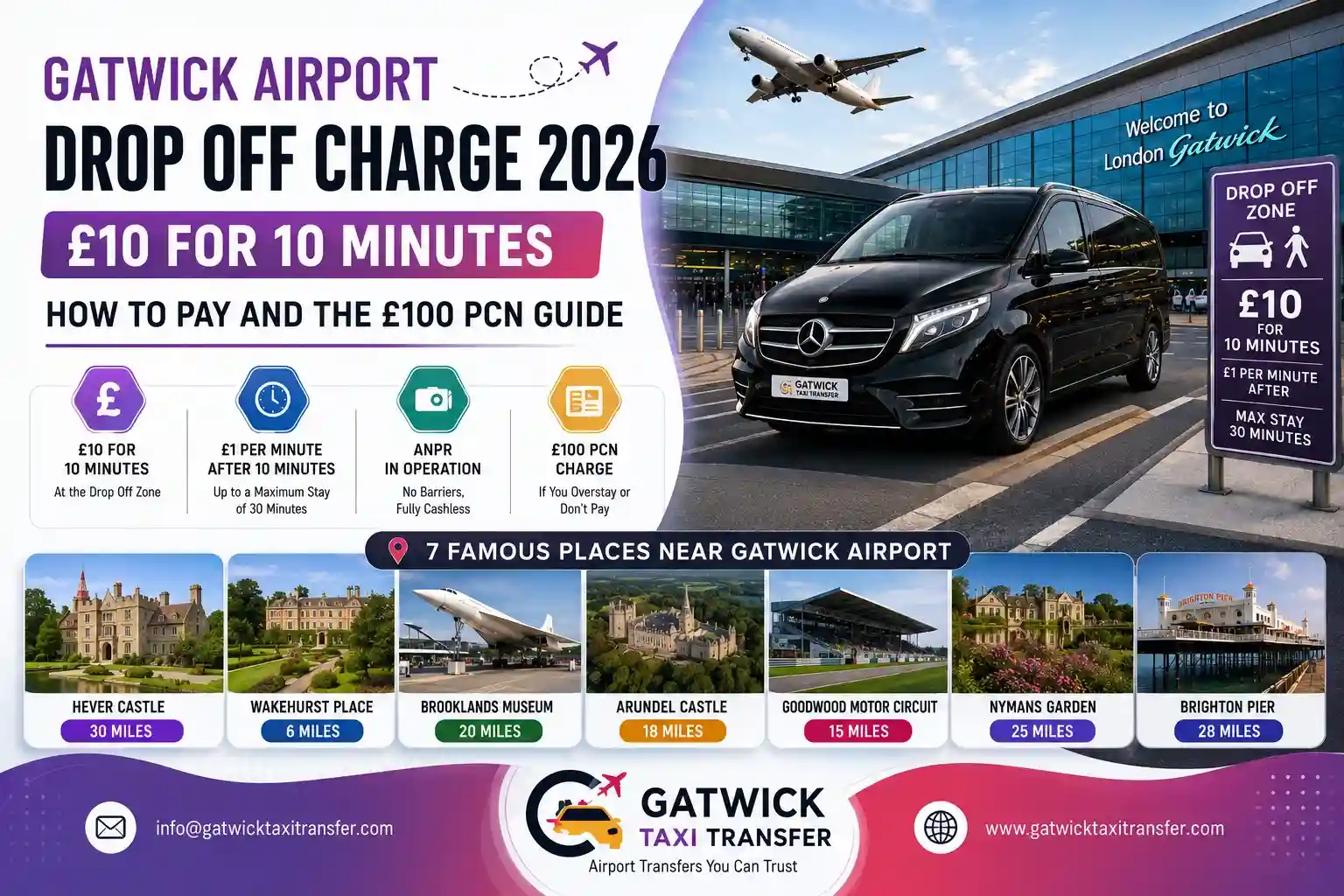
Gatwick Taxi Transfer has run the Gatwick route since 2019. Every version of the drop off system — the £5 launch in March 2021, the 2024 increase, the January 2026 jump to £10 — was navigated with passengers in the car. We know the wrong-terminal double-charge trap from drivers who have watched it happen on the approach road. We know the "pay before exit" mistake that costs drivers their midnight deadline. The operational details in this guide come from driving the route, not from reading the airport website.
All charges verified from gatwickairport.com and official Gatwick T&Cs. Payment portal URL, NCP as administrator, and Blue Badge exemption process confirmed from official sources. Last updated 17 June 2026.
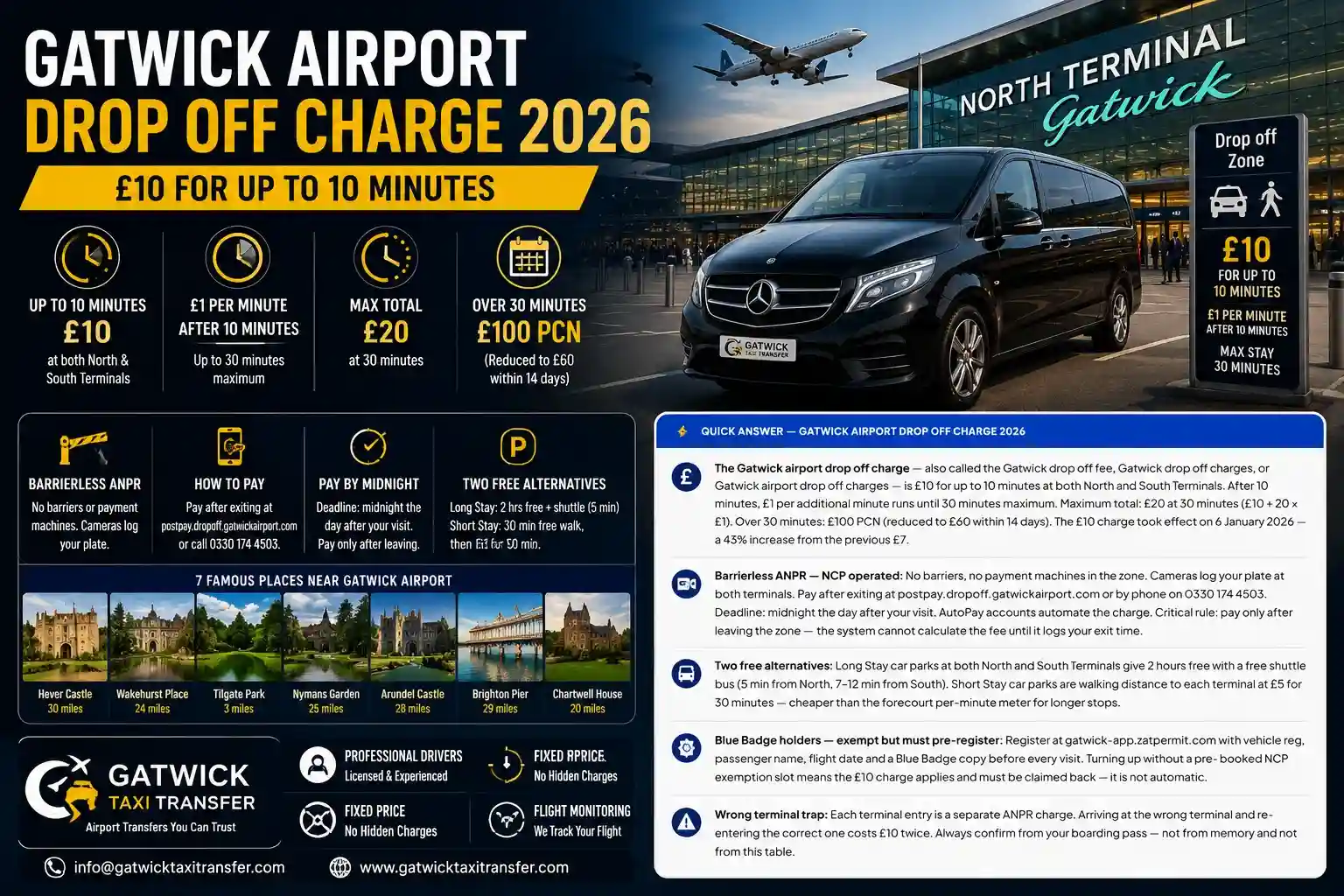
The Gatwick airport drop off charge — also called the Gatwick drop off fee, Gatwick drop off charges, or Gatwick airport drop off charges — is £10 for up to 10 minutes at both North and South Terminals. After 10 minutes, £1 per additional minute runs until 30 minutes maximum. Maximum total: £30 at 30 minutes (£10 + 20 × £1). Over 30 minutes: £100 PCN (reduced to £60 within 14 days). The £10 charge took effect on 6 January 2026 — a 43% increase from the previous £7.
Barrierless ANPR — NCP operated: No barriers, no payment machines in the zone. Cameras log your plate at both terminals. Pay after exiting at postpay.dropoff.gatwickairport.com or by phone on 0330 174 4503. Deadline: midnight the day after your visit. AutoPay accounts automate the charge. Critical rule: pay only after leaving the zone — the system cannot calculate the fee until it logs your exit time.
Two free alternatives: Long Stay car parks at both North and South Terminals give 2 hours free with a free shuttle bus (5 min from North, 7–12 min from South). Short Stay car parks are walking distance to each terminal at around £5 to £8 for 30 minutes — cheaper than the forecourt per-minute meter for longer stops.
Blue Badge holders — exempt but must pre-register: Register at gatwick-app.zatpermit.com with vehicle reg, passenger name, flight date and a Blue Badge copy before every visit. Turning up without a pre-booked NCP exemption slot means the £10 charge applies and must be claimed back — it is not automatic.
Wrong terminal trap: Each terminal entry is a separate ANPR charge. Arriving at the wrong terminal and re-entering the correct one costs £10 twice. A pre-booked fare takes the flight number and settles the terminal for you. Otherwise always confirm from your boarding pass — not from memory and not from this table.
Gatwick Airport Drop Off Charge 2026 — £10 for 10 Minutes, £1 Per Minute After
Gatwick's drop off charge has more than doubled since launch — from £5 in March 2021 to £10 in January 2026. The January 2026 increase was the largest single jump at any UK airport: 43% in one move, driven by what Gatwick cited as "a more than doubling of our business rates" following the 2025 Budget. At £10 for 10 minutes, it is now the joint most expensive London airport forecourt alongside Stansted.
Flat charge for any stop under 10 minutes — whether you are there for 1 minute or 9 minutes 59 seconds, the charge is £10. No grace period of any length exists. ANPR records entry the moment you enter the zone.
Standard drop-offFrom minute 11 onwards, £1 adds to the bill every minute. At 15 minutes: £15. At 20 minutes: £20. At 25 minutes: £25. At 30 minutes: £30 maximum. The meter is genuinely per-minute — not banded like Stansted's £28 jump.
Watch the clockThe maximum forecourt charge before the PCN threshold. At 30 minutes: £10 base plus 20 minutes at £1 each = £30. Stansted's equivalent 30-minute stop costs £28. For stays between 15 and 30 minutes, Gatwick's per-minute structure is cheaper than Stansted's banded fee.
Maximum pay chargePCN issued for overstaying 30 minutes or failing to pay by midnight the next day. Also issued for the classic mistake: paying before exiting the zone (portal cannot calculate fee until exit is logged). NCP issues PCNs on Gatwick's behalf.
Also for non-paymentExactly what you pay at every minute — overstay cost chart
North Terminal vs South Terminal — Two Separate Drop Off Zones
Gatwick is the only London airport with two completely separate terminal buildings, each with its own drop off forecourt zone and its own road approach. Getting this wrong before you set off is the most expensive mistake at Gatwick — each terminal entry is a separate ANPR charge, so driving to the wrong one and re-entering the correct one means paying £10 twice.
Lower-level forecourt, between the Sofitel hotel and multi-storey car park. Access from M23 Junction 9 via Airport Way.
- easyJet — all routes from March 2026
- Ryanair
- Jet2 — new North base from March 2026
- Norwegian
- Emirates, Singapore Airlines, Turkish Airlines
- Air Canada, WestJet, JetBlue, Condor
Lower-level forecourt near Short Stay car parks. Access via filter lane from J9a roundabout on Airport Way.
- British Airways — always South Terminal
- Virgin Atlantic
- TUI (most flights)
- Vueling, Iberia Express
- Most charter operators
- Always verify from boarding pass
- ⚠️Each terminal entry records a separate £10 charge. Arriving at North Terminal for a South Terminal flight and then driving to South Terminal = £20 total minimum.
- ⚠️easyJet is the most common trigger — it moved fully to North Terminal in March 2026 but many passengers still default to South Terminal from memory or old bookings.
- ⚠️The free inter-terminal shuttle is passenger-only, as our North Terminal and South Terminal guides explain. Vehicles cannot transfer between forecourts without re-entering from the road network. There is no vehicle crossing between terminals.
- ⚠️Always confirm terminal from the boarding pass, or let a booking do it from your flight number — not from the airline's website homepage, not from this table, not from memory. Terminal assignments can change seasonally for some carriers.
How the Gatwick Drop Off ANPR System Works — and the Pay-After-Exit Rule
Gatwick's barrierless ANPR system has been running since March 2021 — five years of operation, which means the cameras, the NCP payment portal, and the enforcement process are all well established. No boom gates, no ticket machines, no barriers at exit. Cameras record your registration number the moment you enter the forecourt zone at either terminal. The charge starts instantly — no grace period, no minimum stop time below which no charge applies.
NCP administers the Gatwick drop off system on behalf of the airport. For Gatwick North drop off payment online and Gatwick South drop off payment, the same portal handles both — postpay.dropoff.gatwickairport.com. The payment portal, PCN appeals, Blue Badge registration, and dispute resolution all route through NCP. When searching for the payment link, go directly to postpay.dropoff.gatwickairport.com. Third-party sites that appear in search results for "pay Gatwick drop off" charge an admin fee on top of the standard drop off charge — never use them.
How to Pay the Gatwick Drop Off Charge — Online, Phone, or AutoPay
Free Gatwick Drop Off — Gatwick Parking Drop Off Options (Long Stay 2 Hours Free & Short Stay)
Long Stay — 2 hours free (collect a ticket at the barrier)
Both North and South Terminal Long Stay car parks are free for the first 2 hours. Collect a ticket at the entry barrier — you need it to exit. Park in any free bay. Shuttle buses run every 10–12 minutes. Journey time: approximately 5 minutes from North Terminal Long Stay, 7–12 minutes from South Terminal Long Stay. Exit with the ticket within 2 hours and no charge applies.
One detail worth knowing: North and South Long Stay are not equal for shuttle times. South Terminal Long Stay is closer to the terminal and the shuttle takes 7–10 minutes — manageable for most departures. North Terminal Long Stay is further and the shuttle can take up to 20–30 minutes at busy periods. If you are dropping at North Terminal and the passenger has a tight check-in window, factor this in — or use Short Stay instead.
Short Stay — walking distance, around £5 to £8 for 30 minutes
Short Stay car parks at both terminals sit close enough to each terminal that no shuttle is needed — passengers walk directly. Charges: £5 for up to 30 minutes, £8 for up to 60 minutes. For stops likely to run 20–25 minutes — helping an elderly relative, sorting out a forgotten document, waiting for a delayed departure gate call — Short Stay at £5 is cheaper than the forecourt's per-minute meter, which would reach £15–£20 in that window.
| Option | Cost | Time to terminal | Best for |
|---|---|---|---|
| Express Drop Off forecourt | £10 min (£1/min after) | Walk 1–3 min | Solo passengers, quick stop, tight schedule |
| Short Stay car park | £5 / 30 min | Walk 3–5 min | 20–30 min stops — cheaper than forecourt meter |
| Long Stay North | Free / 2 hrs | Shuttle 5 min | Families, heavy luggage, relaxed goodbye |
| Long Stay South | Free / 2 hrs | Shuttle 7–12 min | BA/Virgin passengers with more time |
Blue Badge Exemption at Gatwick — Advance NCP Registration Required
Blue Badge holders are exempt from the Gatwick drop off charge — one of only a few London airports where this exemption exists (Stansted and Luton do not offer forecourt exemptions). The exemption is not automatic. Advance registration through NCP is the only route to it, and arriving at the forecourt without a pre-booked slot means the standard £10 charge applies.
How to register for Blue Badge exemption at Gatwick
Register at gatwick-app.zatpermit.com before each visit. You need: your vehicle registration number, the passenger's name, the flight date, and a photo or scan of the Blue Badge. NCP confirms the exemption with a 2-hour arrival window — you must enter the drop off zone within that window or the exemption does not apply.
The Blue Badge holder does not have to own the vehicle — the badge just needs to be present in the car. Registration cannot be done at the forecourt on the day or retrospectively. Register before every visit, not once. If your vehicle changes, register the new plate before the next trip.
Local Commuter Scheme — RH6 and RH11 Postcodes
Residents in postcode areas RH6 0, RH6 9, or RH11 0 — covering parts of Horley, Crawley, and the immediate Gatwick area — can apply for the Local Commuter Scheme. The scheme permits two free drop offs per day at South Terminal for an annual fee of £50. Designed for residents who regularly drop commuters at Gatwick railway station rather than air passengers. Applications through the Gatwick Airport website. Not applicable to private hire or licensed taxi vehicles operating commercially.
Gatwick Drop Off Charge vs All Other London Airports 2026
| Airport | Charge | Overstay | System | Blue Badge | Free option |
|---|---|---|---|---|---|
| Gatwick LGW | £10 / 10 min | £1/min to 30 min | ANPR barrierless · NCP | Exempt (pre-reg NCP) | Long Stay 2 hrs free |
| Stansted STN | £10 / 15 min | £28 flat (banded) | ANPR barrierless | NOT exempt | Mid-Stay 60 min |
| London City LCY | £8 / 5 min | £1/min to 10 min | ANPR barrierless | Exempt (pre-reg) | None |
| Southend SEN | £8 / 10 min | Per min | ANPR barrierless | Check airport | 30 min Long Stay |
| Heathrow LHR | £7 / 10 min | Per min | ANPR barrierless | Exempt (automatic) | Long Stay 30 min |
| Luton LTN | £7 / 10 min | £1/min to 30 min | ANPR barrierless (barriers removed Jan 2025) | TCP1/TCP2 free* | Long Stay 2 hrs free |
* Luton: Blue Badge holders receive 30 minutes free in Terminal Car Park 1 or TCP2 instead of Express Drop Off zone exemption. See our Luton drop off charge guide for full details.
The Gatwick vs Stansted comparison is the most commonly asked — both charge £10. The difference is structure: Gatwick charges £1 per minute from minute 11 onwards (per-minute metering). Stansted charges a flat £28 for 15–30 minutes (banded). For stops under 15 minutes, both cost £10. For stops between 15 and 28 minutes, Gatwick's per-minute meter is cheaper than Stansted's £28 flat. At exactly 28 minutes, both cost the same. For the full Stansted comparison, see our Stansted drop off charge guide. For Gatwick airport taxi options and arrival guides, see our Gatwick airport taxi guide.
Taxi Fares to Gatwick Airport 2026 — Drop Off Charge Included
Gatwick sits 30 miles south of Central London in West Sussex — naturally accessible from Surrey, Sussex, and South London at significantly lower fares than from North or East London. All fares below are 2026 confirmed fixed prices for a saloon, inclusive of the £10 Gatwick airport drop off charge.
From Surrey, Sussex and South London — nearby towns
| From | Distance | Saloon from | MPV from | Journey time |
|---|---|---|---|---|
| Horley | ~2 miles | £12 | £18 | 5–10 min |
| Crawley | ~5 miles | £16 | £22 | 8–15 min |
| Redhill | ~8 miles | £22 | £30 | 14–22 min |
| Reigate | ~9 miles | £24 | £32 | 15–25 min |
| East Grinstead | ~10 miles | £26 | £35 | 18–28 min |
| Croydon | ~20 miles | £35 | £48 | 28–42 min |
| Guildford | ~22 miles | £40 | £55 | 28–40 min |
| Brighton | ~25 miles | £42 | £58 | 35–50 min |
From London — all areas
| From area | Postcode examples | Saloon from | MPV from | Journey time |
|---|---|---|---|---|
| Central London | WC1, SW1, EC1 | £55 | £75 | 45–75 min |
| South London | SE1, SW4, SW11 | £45 | £62 | 38–60 min |
| North London | N1, NW1, N7 | £70 | £90 | 60–90 min |
| East London | E1, E14 | £65 | £85 | 55–80 min |
| West London | W1, W2, W6 | £60 | £80 | 50–75 min |
Whether you need to drop off Gatwick airport passengers and pay gatwick drop off charge yourself, or book a taxi where the driver handles the Gatwick pay drop off entirely — the choice depends on your time and how often you make this run. For an exact fare, use the Gatwick Taxi Transfer online quote tool or call 020 3617 7825. All fares include the £10 Gatwick airport drop off charge, meet and greet on arrivals, and flight tracking. The fare quoted at booking is the fare you pay.
How to Avoid the Gatwick Drop Off Charge — 6 Legal Ways, Ranked by Practicality
Avoiding the Gatwick drop off charge entirely is possible — through several routes. Some are genuinely practical for most trips. Others depend on your specific situation. Here are all six, ranked from most to least useful for the average driver.
What Doesn't Work — Myths That Still Circulate Online
- 🚫Dropping off outside the Hilton Hotel (South Terminal): The Hilton runs its own security and issues enforcement fines for drop-offs by non-guests. The fine is comparable to the airport charge and is not negotiable. This circulates on TikTok and is consistently wrong.
- 🚫The Shell garage near South Terminal: Shell fines vehicles parked without purchasing fuel or entering the shop. Using it as a drop-off without making a purchase triggers an enforcement notice. Not a workable alternative.
- 🚫Stopping on Airport Way or London Road: Both approach roads are monitored by ANPR and CCTV cameras. Stopping anywhere outside the marked drop-off zones triggers a separate £100 PCN for the stopping offence — separate from and in addition to any forecourt charges.
- 🚫Paying before exiting the zone: This is not a workaround but a mistake — paying while still in the forecourt means the portal cannot calculate the correct fee (it needs your exit time). Drivers who do this often miss the actual midnight deadline. Always pay after driving out.
Which option is right for your situation?
| Your situation | Best option to avoid / reduce charge | Cost |
|---|---|---|
| Solo passenger, hand luggage, not in a rush | Long Stay car park — free shuttle | £0 |
| Family of 4, multiple cases, early departure | Pre-booked taxi (charge included) or Long Stay | Fare or £0 |
| Need to help passenger inside terminal (20+ min) | Short Stay — walking distance | around £5 to £8 for 30 min |
| Blue Badge holder in vehicle | NCP exemption slot — free forecourt access | £0 |
| Quick kerbside only, under 10 min | Express forecourt — just pay the £10 | £10 |
| Resident in RH6 / RH11 postcode | Local Commuter Scheme | £50/year |
| Passenger travelling solo from Central London | Gatwick Express or Thameslink train | Train fare |
| PCO driver — 2+ Gatwick runs per day | AutoPay account (not free but no PCN risk) or operator account | £10/visit |
£10 for up to 10 minutes, then £1 per additional minute. At 15 min: £15. At 20 min: £20. Maximum at 30 min: £30 total (£10 + 20×£1). Over 30 min: £100 PCN (£60 if paid within 14 days). Applies at both North and South Terminals from 6 January 2026. Barrierless ANPR, operated by NCP.
Pay online at postpay.dropoff.gatwickairport.com after exiting the zone. Enter vehicle registration and visit date. Deadline: midnight the day after your visit. Also payable by phone on 0330 174 4503. AutoPay accounts automate the charge for frequent drivers. Critical: pay only after leaving the zone — the system cannot calculate the fee until it logs your exit time.
Yes — Long Stay car parks at both terminals give 2 hours free. Collect a ticket at the barrier, park in any free bay, take the free shuttle to the terminal (5 min from North, 7–12 min from South). Exit within 2 hours and no charge applies. Short Stay car parks add a walking-distance option at around £5 to £8 for 30 minutes — cheaper than the per-minute forecourt meter for longer stops.
Yes — but advance NCP registration is mandatory. Register at gatwick-app.zatpermit.com before each visit with your vehicle registration, passenger name, flight date and Blue Badge copy. Turning up without a pre-booked exemption slot means the standard £10 charge applies. This differs from Heathrow where the Blue Badge exemption is automatic.
Each terminal entry is a separate £10 charge. Arriving at North Terminal for a South Terminal flight, then driving to South Terminal, means paying £10 twice — £20 minimum. easyJet moved fully to North Terminal in March 2026. British Airways is always South. Always confirm from your boarding pass before setting off.
No — this is Gatwick-specific and catches many drivers. The ANPR system needs to record your exit time before calculating the fee. Paying during the stop means the portal cannot generate the correct amount. Drive out first, then pay. Drivers who try to pay early often find the transaction does not register and miss the midnight deadline.
Residents in postcodes RH6 0, RH6 9, or RH11 0 can pay £50 per year for two free drop offs per day at South Terminal. Designed for residents regularly dropping commuters at Gatwick railway station. Does not apply to private hire vehicles. Apply through the Gatwick Airport website.
Both charge £10 — but differently. Gatwick: £10 for 10 min then £1/min (per-minute). Stansted: £10 for 15 min then flat £28 (banded). Under 15 minutes: both £10. At 20 minutes: Gatwick £20, Stansted £28. Gatwick exempts Blue Badge holders; Stansted does not. Gatwick has two terminals and a double-charge risk; Stansted has one. See our Stansted guide for full details.
Book a Gatwick Airport Taxi — Drop Off Charge Included, Fixed Price, 24/7
Gatwick Taxi Transfer covers both North and South Terminals at Gatwick Airport. The £10 drop off charge is pre-settled through a business operator account — no NCP portal to visit after midnight, no AutoPay to set up, no PCN risk. Available on iOS and Android.
- check£10 for 10 minutes, £1/min after: At 15 min: £15. At 20 min: £20. Maximum £30 at 30 min (£10 + 20×£1). Over 30 min: £100 PCN (£60 within 14 days). Applies at both North and South Terminals from 6 January 2026.
- checkBarrierless ANPR, NCP operated: No barriers, no payment in zone. Pay after exiting at postpay.dropoff.gatwickairport.com by midnight next day. Also by phone 0330 174 4503. Pay only after leaving — portal needs exit time to calculate fee.
- checkWrong terminal trap: Each entry £10 separately. North Terminal: easyJet (all routes from March 2026), Ryanair, Jet2, Emirates. South Terminal: British Airways, Virgin Atlantic, TUI. Always check boarding pass.
- checkFree alternatives: Long Stay North and South — 2 hours free + free shuttle (5 min from North, 7–12 min from South). Short Stay walking distance — around £5 to £8 for 30 min, cheaper than per-minute meter for 20+ min stops.
- checkBlue Badge — exempt but pre-register: Register at gatwick-app.zatpermit.com before each visit. Vehicle reg, passenger name, flight date, Blue Badge copy. Not automatic — unregistered arrivals are charged and must claim back.
- checkLocal Commuter Scheme: RH6 0, RH6 9, RH11 0 residents — £50/year for two free drops per day at South Terminal. Not for commercial private hire vehicles.
- checkGatwick Taxi Transfer: £10 drop off charge included in every confirmed fare. Terminal confirmed before departure — no wrong-terminal risk. 1 hour free waiting on arrivals. Fixed price 24/7.
Gatwick Taxi Transfer — £10 Drop Off Charge Included in Every Fare
Both North and South Terminal. Terminal confirmed at booking — no wrong-terminal double charge. Driver handles postpay.dropoff.gatwickairport.com. No midnight deadline. No PCN risk. Fixed price.
The charge
Paying
Free & exempt