The awkward thing about this particular journey is geographic rather than commercial. Stansted Express is fast, frequent and cheap if you book ahead, and it deposits you at Liverpool Street, which is on the opposite side of London from where you are going. West Brompton is SW10. Getting between the two means crossing the city with your luggage and changing at least twice. That is the whole story of this route, and it is why the arithmetic here works differently from a Stansted run into the City or Shoreditch.
The train lands on the wrong side. Liverpool Street is east London. SW10 is west. You cross the whole city.
SW10 escapes the £18. An address a few miles east on the same journey would not.
Rail wins if you book ahead and travel light. At £9.90 advance, nothing on the road competes for one person with a cabin bag.
Stansted punishes a small overstay. £10 for 15 minutes, then a flat £28 — not a per-minute step like Gatwick.
The Geography Problem
Most Stansted guides treat the airport as a single destination with a single answer. For this postcode that breaks down, and it is worth understanding why before comparing any prices.
Stansted Express is genuinely good. Every fifteen minutes, forty-eight minutes to Liverpool Street, a station four minutes' walk beneath the terminal on level minus one.
| Stansted Express ends | You want | |
|---|---|---|
| Station | Liverpool Street | West Brompton |
| Side of London | East | West |
| Onward journey | Still to come | Two changes minimum |
| Total published time | 1h 16m – 1h 23m | With luggage throughout |
The quickest published routing does not even use Liverpool Street. It leaves the Express at Tottenham Hale, takes the Victoria line south, changes at Victoria for the District line, and arrives at West Brompton somewhere between 1 hour 16 and 1 hour 23 minutes after leaving the airport.
Why that matters more than the clock
Because the published time assumes you make every connection at walking pace with no queue and no lift wait. Add two suitcases and it stops being a theoretical exercise.
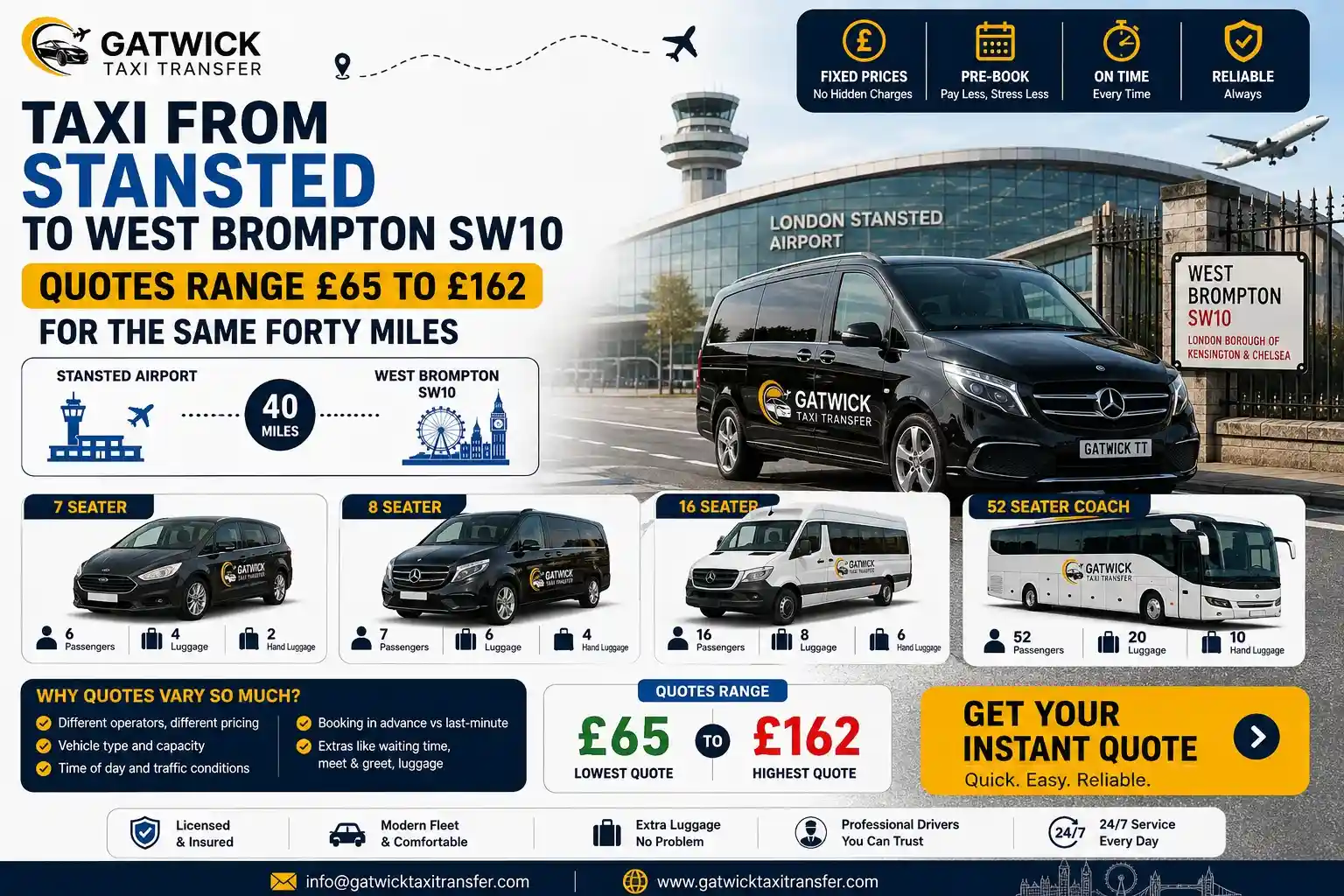
By road the same journey is about 40 miles and a little over an hour free-flowing, priced from your postcode on our Stansted transfers page. The comparison is not train versus car so much as one seated journey against three with luggage in between.
The M11 does the heavy lifting
Roughly three quarters of the road distance is motorway, which is why the free-flowing time is so much shorter than the mileage suggests. The variable part is the last stretch through north and west London, where a clear run and a busy one differ by twenty minutes or more.
That also explains why the average sits well above the best case. Nobody drives this route at motorway speed the whole way.
SW10 Sits Outside the Congestion Charge
This is the fact that separates West Brompton from most central London destinations, and almost no route page mentions it.
| Destination | Congestion Charge | Effect on the fare |
|---|---|---|
| West Brompton SW10 | Not payable | Nothing added |
| Kensington, Chelsea | Not payable | Nothing added |
| Paddington, Canary Wharf | Not payable | Nothing added |
| Soho, Covent Garden | £18 a day | Added, in or out of the quote |
| The City, Marylebone | £18 a day | Added |
Two hotels within a few minutes' walk can be eighteen pounds apart because of where that boundary runs, and it runs along the Inner Ring Road, which means nothing to anyone arriving.
Marylebone in, Paddington out
The pair that catches people is Paddington and Marylebone: a fifteen-minute walk between them, and one attracts the charge while the other does not.
For SW10 the answer is simply no, which makes this route cleaner to price than most central runs. More on this sits in our guide to the Congestion Charge, including the nine-seat exemption that removes it entirely for larger groups.
Forty Miles, One Figure — Agreed Before You Fly
No Congestion Charge on this postcode · Airport levy inside the price · Flight tracked · Registration sent before travel
What the Train Actually Costs
Stansted Express fares move a great deal depending on when you buy, and the spread is wider than most airport rail links.
| Ticket | Price | Condition |
|---|---|---|
| Advance single | from £9.90 | Booked 3+ days ahead |
| Off-peak single | £20–£25 | After 09:30 weekdays |
| Anytime single | £23–£34 | Walk-up, any train |
| Return | from £18.90 | Booked ahead |
The gap between the first row and the third is the whole argument. Book three days out and rail is unbeatable; turn up and buy on the day and it is a different product at more than three times the price.
And these fares stop at Liverpool Street
None of them reaches West Brompton. The Underground leg is extra in both money and time, and it is the leg where the suitcases become a factor.
Tickets are available from machines and a staffed office on the platform, and from desks in baggage reclaim before you clear the hall — useful if you would rather not queue downstairs with bags.
Trains stop before the night does
Services run every fifteen minutes through the day, but a late arrival can land outside that window entirely, and an airport at one in the morning is a poor place to discover it. The road option does not have an operating timetable. How that compares against a car on a similar run is worked through in our rail-against-road piece.
When Rail Wins, and When It Stops
We sell road transfers, so read this section knowing that. What follows is where we think the line genuinely falls.
| Traveller | Better option |
|---|---|
| One person, cabin bag, advance ticket | Train, comfortably |
| Two people, light luggage, booked ahead | Train, narrowly |
| Two people, walk-up tickets | Close either way |
| Family with hold luggage | Road |
| Arriving after midnight | Road |
| Three or more passengers | Road |
The first row is not a concession, it is the honest answer. Under a tenner plus an Oyster fare, nothing on the road gets close, and anyone telling you otherwise is selling something.
What flips it
Passengers, mostly. Tickets are priced per person while a car is priced once, so every extra head narrows the difference and closes fast at walk-up prices.
Luggage flips it too, in a way the numbers do not show. Two changes with two large cases is a different journey from the one the timetable describes. Our rail-against-road comparison works the same arithmetic through for Gatwick, where the crossover lands between three and seven passengers.
What the Market Charges, and Where the Figures Disagree
The UK's largest cab comparison platform, aggregating quotes from more than a thousand licensed operators, puts Central London to Stansted at around £81. Individual operator pages for this postcode run from £65 to £162 — the top of that range being two and a half times the bottom, for the same road. Worth understanding what moves it before treating the lowest number as the answer.
| Source | Saloon | What it represents |
|---|---|---|
| Comparison platform benchmark | from ~£81 | Central London to Stansted, aggregated across 1,000+ operators |
| Budget end | £65 – £66 | Usually quoted with a discount attached |
| Mid | £75 – £81 | Typical for a licensed London operator |
| Upper | £84 – £88 | Often with tiers published above it |
| Outlier | £126 – £162 | One operator, and direction-dependent |
| Executive or MPV | £104 – £114 | Where a second tier is published |
| Eight seats | around £144 | Where a minibus is offered at all |
That aggregated figure is the useful anchor, because it reflects what a thousand operators actually charge rather than what one advertises. Anything far below it has usually removed something: the airport charge, the waiting allowance, or the assumption that a delayed arrival is absorbed.
Ask what the number includes
A quote £19 below another that adds the forecourt charge afterwards finishes £9 above it. On this route the Congestion Charge does not enter the sum, which removes one variable that catches people on central London destinations.
One question settles it: is this the total, with the airport charge inside. Our route pricing analysis works through where operators sit against each other on comparable runs.
Two Figures Worth Checking Before You Book
Comparing several quotes for this journey turns up numbers that cannot all be right, and both errors run in the same direction.
| Claim | Where it appears | Route data says |
|---|---|---|
| 44 to 46 miles | Most operator pages | About 40 by road |
| 2 hours 30 minutes | One page — alongside 1h 14m on the same page | Just over an hour free-flowing |
| 60 to 95 minutes | One operator, via the M11 | Consistent with the road |
An overstated mileage is not automatically dishonest — different tools measure from different points, and an airport is a large site. But four to six miles is a wide margin on a forty-mile run, and it points the same way every time.
The two-and-a-half-hour claim
That one is simply wrong, and the page carrying it contradicts itself a few paragraphs later with a figure half the size. It matters because somebody planning a departure around it would leave ninety minutes earlier than necessary.
The realistic spread is 60 to 95 minutes depending on the hour, which is the range one operator publishes and the only one that matches what the road actually does. Our Stansted transfers page prices from your postcode rather than from an averaged mileage.
Stansted's Forecourt Charge Is Banded, Not Metered
Worth knowing on the departure leg, because the structure differs from every other London airport in a way that costs real money.
| Time in the zone | Stansted | Gatwick |
|---|---|---|
| Within the free window | £10 to 15 min | £10 to 10 min |
| One minute over | £28 flat | £11 |
| Twenty minutes | £28 | £20 |
| Thirty minutes | £28 | £30 |
Read the second row. Gatwick meters by the minute, so overstaying by one costs a pound. Stansted jumps to a flat band, so the same minute costs eighteen.
No barriers, and payment comes later
The zone runs on barrierless ANPR: plates are photographed entering and leaving, nothing can be settled on site, and settlement happens online afterwards.
Book ahead and that paperwork belongs to the operator, not to you. Every UK airport forecourt is priced side by side in our kerbside comparison.
Stansted Has a Free Option Nobody Mentions
Every operator page for this route talks about the £10 Express Set Down. None of them mentions that the airport also runs a free alternative for anyone dropping off or collecting.
| Option | Cost | Time allowed | To the terminal |
|---|---|---|---|
| Express Set Down | £10 | 15 minutes | Kerbside |
| Express Set Down, overstayed | £28 flat | 15–30 minutes | Kerbside |
| Mid Stay car park | Free | Up to 60 minutes | Shuttle, about 7 minutes |
An hour free against fifteen minutes for ten pounds, at the cost of a seven-minute shuttle. For anyone with time, or with somebody to see into the terminal, that is not a close call.
When the kerbside charge is still worth it
Setting somebody down and leaving. Four minutes, two cases out of the boot, straight back onto the road — ten pounds is a reasonable price for stopping at the door, and the shuttle would take longer than the whole stop.
Where it stops being reasonable is a collection, because a carousel you do not control decides when you leave, and a fifteen-minute clock is running and a £28 cliff at the end of it. The same comparison across every UK airport sits in our kerbside pricing survey.
On a booked fare this is not your problem
The charge, whichever applies, sits inside the quoted figure and the driver deals with the zone. Worth confirming at booking though, because a base price with the levy bolted on afterwards is a common arrangement.
Which Vehicle for Forty Miles
Suitcases settle this far more often than the headcount does, and on a long run the consequences of getting it wrong are worse.
| Four on business | Four back from a fortnight | |
|---|---|---|
| Passengers | 4 | 4 |
| Hold cases | None | Four large |
| Vehicle | Saloon | A larger class |
On a short hop an overflow bag is an annoyance. Forty miles up the M11 there is nowhere to put it, and the fix costs a second vehicle.
Above eight seats, two things change
A different licensing framework applies, and the Congestion Charge disappears entirely — though on this particular route it was never payable anyway, so the saving belongs to journeys ending further east.
On a forty-mile run the second vehicle is not a short hop back to base either; it is another hour of driving, and somebody pays for it.
Capacities by class sit on the fleet page, and larger parties on group transfers.
Timing, Both Directions
Arriving and departing are different problems on this route, and the second one is stricter.
| Arriving into Stansted | Departing from SW10 | |
|---|---|---|
| Deadline sits | Behind you | Ahead of you |
| Flexibility | Waiting allowance absorbs it | Bag drop does not wait |
| Worst hour | Late evening, thinner supply | Afternoon, urban traffic |
| What we time from | Actual landing | Terminal door, backwards |
The first row is the whole difference. A late arrival is absorbed; a late departure is not, because check-in closes on schedule regardless of what the North Circular is doing.
A delay before landing costs nothing
Nothing is running while the aircraft is still up: no vehicle has left base, and the pickup slides to match. What does run is the stretch after you are on the ground, measured from the moment of touchdown rather than the timetable.
How many minutes get covered, and what British firms bill once they run out, appears in our piece on late inbounds.
West Brompton, SW5 and Earls Court
One last practical point, because this address sits on a boundary and the naming causes confusion.
| Area | Postcode | Note |
|---|---|---|
| West Brompton | SW5 / SW10 boundary | Station on District line and Overground |
| Earls Court | SW5 | Immediately north |
| Chelsea | SW3 / SW10 | South and east |
| Fulham | SW6 | West, across the tracks |
A pickup described as Earls Court is frequently in SW10 and one described as West Brompton is frequently in SW5. Neither matters for the Congestion Charge, since all of it lies outside the zone.
Give the postcode, not the area
It settles which street, which side of the railway and if the charge enters the sum. On a forty-mile approach an address that turns out to be a mile off is a real detour rather than a small correction.
We cover the rest of west London and every London airport, with Heathrow detail on the Heathrow transfers page and route pricing in the fare breakdown.
Questions About This Route
Related Guides
No Changes, No Escalators — One Seat to SW10
Forty miles direct · No Congestion Charge on this postcode · Flight tracked · Fixed at booking