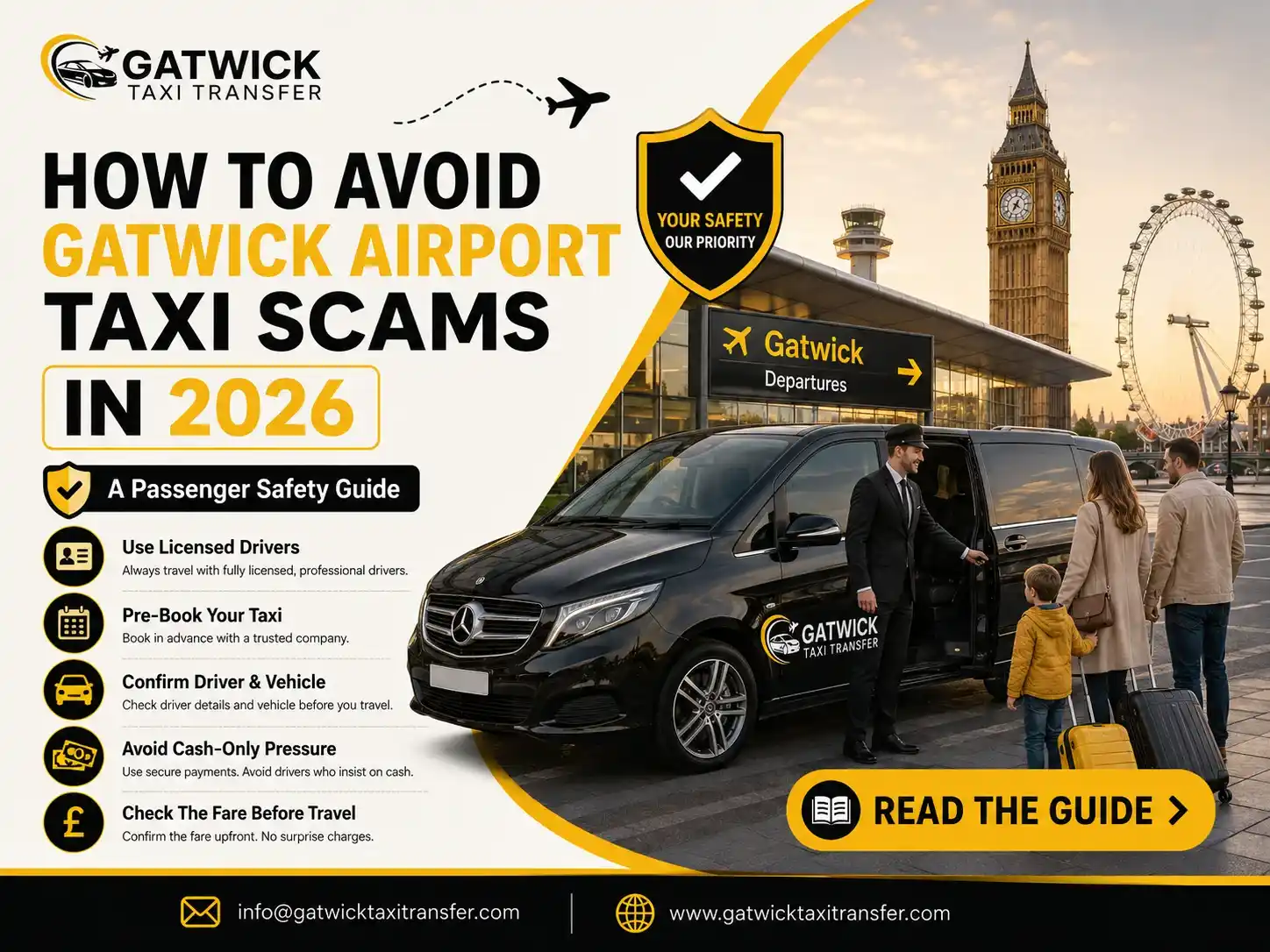
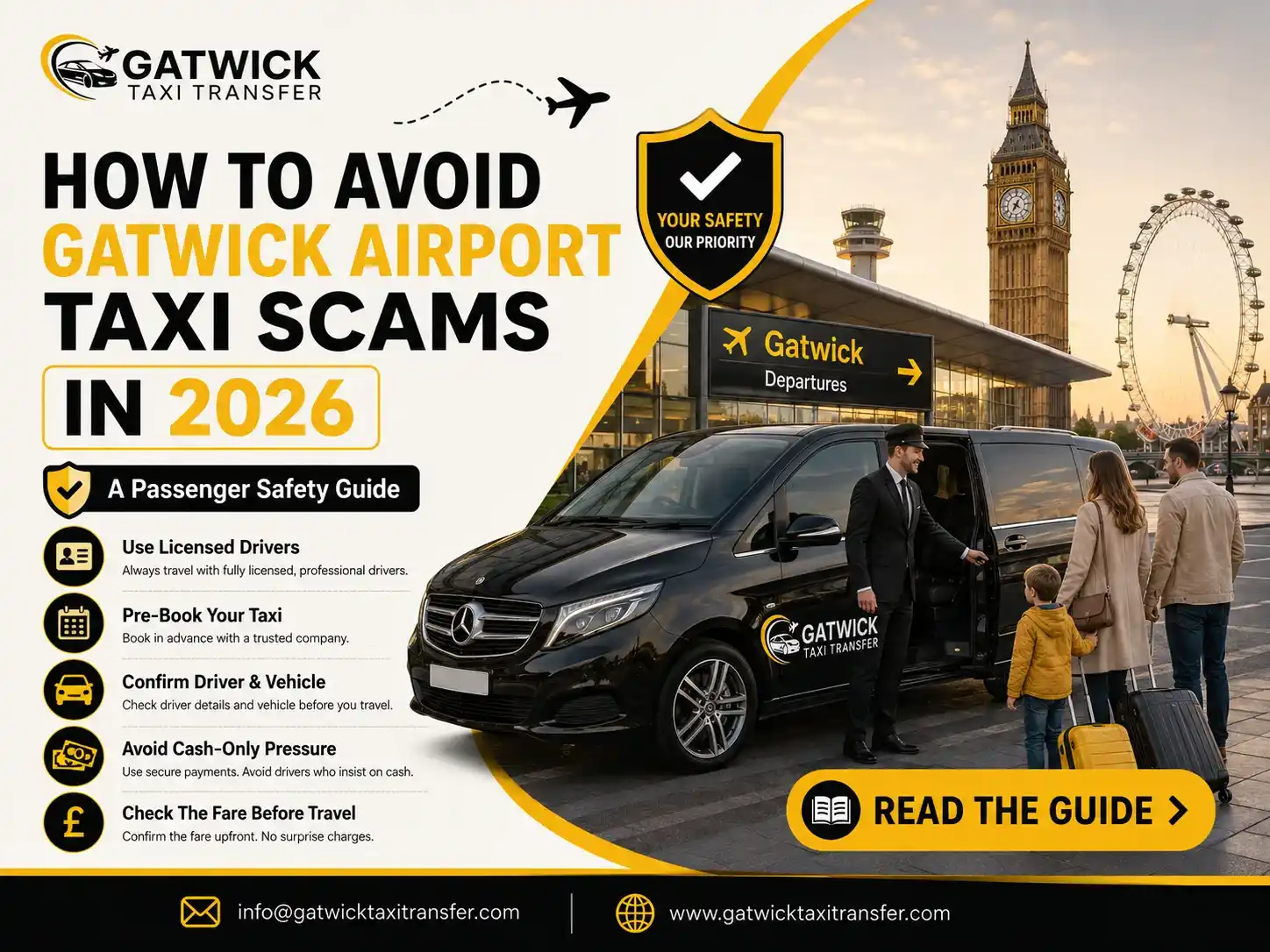
Most guidance on this subject amounts to "use a licensed taxi", which sounds sufficient and is not. A fully licensed vehicle breaks the law the moment it accepts a fare nobody booked, and Transport for London has removed more than 600 private hire licences over exactly that since 2008. This guide sets out seven methods that actually operate at UK airports, how each one works mechanically, and , the part almost nobody covers, precisely who to report to afterwards, including the body that changed at the end of 2025.
"Licensed" is not the test. A licensed minicab taking an unbooked fare commits the same offence an unlicensed one does.
Fatigue is the vulnerability, not inexperience. A frequent business traveller landing at 01:30 is as reachable as a first-time visitor.
Gatwick is not TfL territory. Complaints go to Crawley Borough Council. Most guides get this wrong.
Action Fraud no longer exists. Report Fraud, run by City of London Police, replaced it in December 2025.
Why "Licensed" Is the Wrong Question
Almost every article on this subject tells you to use a licensed vehicle. That advice is not wrong, but it answers a question that catches nobody out.
The offence is touting: accepting a passenger without a booking made in advance. A fully licensed private hire vehicle commits it exactly as readily as an unlicensed one, because the licence governs the vehicle, not the transaction.
| Lawful | Not lawful | |
|---|---|---|
| Hackney carriage from a rank | Yes — may take unbooked passengers | — |
| Private hire, booked beforehand | Yes — the booking is what permits it | — |
| Private hire approached in arrivals | No | Touting, even with a valid licence |
| Private hire flagged down outside | No | Same offence |
| Any vehicle with no operator behind it | No | No record, no accountability, insurance void |
The confusion lives in those two middle cases. Somebody can show you a genuine badge, drive a genuinely licensed car, and still be committing an offence by carrying you, because no booking exists to make the journey lawful.
Why the booking is the thing that protects you
What a booking does is put a record in place before anyone sets off: a named driver, a specific vehicle, an operator answerable for both, and insurance valid for carrying you . That record is what lets our Gatwick transfer service answer for a journey afterwards. Take the booking away and all four vanish together.
There lies the substance behind the rule, not a bureaucratic detail. The paperwork is the protection.
How Seriously Is This Enforced?
More seriously than the persistence of touting suggests, and the numbers are worth knowing because they change how the offer in the arrivals hall should read.
| Measure | Scale | Detail |
|---|---|---|
| TfL licences revoked for touting | 600+ since 2008 | Dedicated operations target organised groups |
| Council prosecution, 2024 | £1,418 ordered | Unlicensed operator advertising airport transfers on Facebook |
| What that figure covered | Penalties, victim surcharge, costs | Brought by a borough council licensing team |
| Where the advertising ran | Local community groups | Not a back street — an ordinary social feed |
Six hundred revocations is not a rounding error, and the figure dwarfs anything a single fare dispute would produce. Those are drivers who lost their livelihood over a practice that is frequently described, by the people doing it, as a favour to a tired passenger.
The second row is worth sitting with for a different reason. That operator was not lurking anywhere; he was posting in local Facebook groups offering airport runs, and people booked because it looked ordinary. Illegality here does not always look furtive.
The Seven Methods, and How Each One Works
Naming them matters, because a method you can recognise mid-execution loses most of its power.
| Method | How it works | Where it fails |
|---|---|---|
| Terminal tout | Intercepts you before the rank; walks you to a car outside the licensed area | You already have a booking |
| Broken meter | Meter is "faulty"; a higher flat figure is proposed instead | Fixed fare agreed in advance |
| Fake booking site | Imitates a real operator, takes payment, no vehicle arrives | Licence number checked before paying |
| Driver impersonation | Claims to be your booked driver, sometimes with your name | Plate matched to what you were sent |
| Extended route | A longer road on a metered fare | Your own map open, or a fixed price |
| Undisclosed surcharges | Luggage, hours or airport fees appear at the destination | Written total confirmed at booking |
| Payment failure | Card machine "does not work"; cash demanded | Card-only stated when booking |
Read down the right-hand column and a pattern appears. Six of the seven are defeated by the same thing, arranged before you left home. The seventh needs only a phone in your hand.
The terminal tout
Somebody reaches you before you reach the rank, quotes a figure that sounds reasonable, and leads you to a vehicle parked where licensed vehicles do not park. The price quoted inside the building binds nobody, which is how it becomes a different number once the doors close.
What makes this the most serious of the seven is not the money. It is that nothing on paper ties that person or that car to the trip you are taking, and that insurance covering you almost certainly does not exist either.
The broken meter
You are told the meter is faulty and offered a flat figure, invariably above what the meter would have produced. It works because your alternative at that moment is standing on a pavement with your luggage somewhere you did not choose.
A vehicle with a genuinely broken meter should not be working, whatever class it belongs to. Being told the meter is out is the moment to leave, not the moment to negotiate.
Driver impersonation
Somebody approaches claiming to be the driver you booked, occasionally knowing your name, which is easier to obtain than people assume. Names sit on luggage tags and get said aloud on phone calls.
A name is guessable. A registration plate is not, having reached your handset before wheels left the ground. That asymmetry is the whole defence.
The payment failure
The card reader fails at the destination and cash is required, frequently a rounder and larger number than the fare. Sometimes the machine genuinely is broken. Either way, a fare settled in advance or a company that states card-only at booking removes the situation before it arises.
Six of the Seven Fail Against One Thing — A Booking Made Before You Fly
Who is driving and what they drive, in advance · Sum committed on paper · Cover that actually applies to you
Who Actually Gets Targeted?
The comfortable assumption is that this happens to inexperienced travellers. It does not, and believing otherwise is itself a vulnerability.
The common factor is fatigue rather than naivety. Somebody who has been awake for nineteen hours makes worse decisions than they would before a morning departure than the same person at eleven in the morning, regardless of how many airports they have passed through.
| Situation | Why it draws attention |
|---|---|
| Arriving after midnight | Rail has stopped; alternatives feel scarce |
| First visit to the UK | No baseline for what a fare should be |
| Limited confidence in English | Questioning an offer is harder |
| Travelling alone | Nobody to second the decision |
| End of a long-haul flight | Nineteen hours awake affects anyone |
| Visible confusion at signage | Reads as somebody without a plan |
That fifth situation undoes the whole comfortable assumption, and it applies as readily on a late rail-replacement evening as on a first visit. Somebody who flies constantly, stepping off a red-eye, is as approachable as anyone, and often more so, because the confidence that normally serves them is exactly what makes a quick decision feel safe.
Row six is the one you can control without any planning at all. Standing still and reading signage carefully looks like somebody working something out. Walking directly toward a known destination does not.
Who Do You Report It To?
This is the part almost every guide handles badly, and getting it wrong means the report goes nowhere.
The instinct is Transport for London. For Gatwick that instinct is wrong, since Gatwick falls wholly beyond the boundary TfL licenses within.
| What happened | Report to | Why there |
|---|---|---|
| Overcharging, driver conduct, vehicle condition | Crawley Borough Council | Holds the licences for cars and drivers there |
| You were threatened, or the vehicle was unlicensed | Call 101 | A policing matter rather than a licensing one |
| Immediate danger | 999 | Do not wait to decide which category it is |
| Fraudulent booking website | Report Fraud, City of London Police | Replaced Action Fraud in December 2025 |
| Payment taken that you did not agree | Your card issuer, and Report Fraud | Card protection runs alongside the report |
| A TfL-licensed vehicle, elsewhere in London | Transport for London | Only where TfL licensed it |
That fourth line is the correction most likely to save somebody time. The body itself is gone: Action Fraud closed in December 2025 by Report Fraud, operated by City of London Police, and a substantial number of published guides have not been updated.
The first line is the correction specific to this airport, and it applies equally at North and South. A complaint about a Gatwick vehicle sent to TfL is a complaint sent to a body with no authority over it.
Where Exactly Are the Licence Numbers Displayed?
Generic advice to check that a vehicle is licensed leaves out the part you actually need: where to look, and what you are looking at.
| Identifier | Where to find it | What it looks like |
|---|---|---|
| Driver licence number | White plate on the rear, or inside the passenger compartment | Usually five digits |
| Driver badge | Worn by the driver, displayed at all times | Photograph and number |
| Vehicle licence plate | Front or rear of the vehicle | Number plus issuing authority named |
| Window disc | Rear windscreen on many private hire vehicles | Colour varies by council |
| Executive hire exemption | No external markings at all | Legitimate — absence proves nothing |
That opening line is the useful one, and almost nobody mentions it. A driver is required to display the badge at all times and to give the number on request, and a five-digit figure is short enough to note without a photograph.
The exemption that trips people up
What sits at the bottom cuts against everything else here. Executive hire vehicles can be exempt from displaying the usual external markings, so a car carrying no plate is not automatically operating illegally.
That is precisely why the plate is a supporting check rather than the deciding one. What settles the question is whether a booking exists, which is a matter of what reached your phone rather than what is stuck to the bodywork.
What Happens to Insurance on an Unbooked Journey?
This is the consequence with no remedy, and it deserves setting out precisely rather than as a general warning.
Carrying passengers for payment requires hire and reward insurance, a distinct class of cover from an ordinary private policy. A driver operating outside the licensing system frequently does not hold it.
| Scenario | Hire and reward cover | Your position in a collision |
|---|---|---|
| Licensed vehicle, booking exists | In force | Covered as a fare-paying passenger |
| Licensed vehicle, no booking | May be treated as void | Cover fails on the illegal use |
| Unlicensed vehicle | Usually absent entirely | No policy to claim against |
People are caught off guard by the middle case. Even where a policy exists, an insurer may treat it as void once it emerges the vehicle was being used unlawfully , so a licensed car taking an unbooked fare can leave you as exposed as an unlicensed one.
Nothing about this is visible from the pavement, and no conversation at the roadside afterwards changes it. Cover either applied at the moment of the journey or it did not, and the booking is what determines which.
How Do Councils Actually Catch People?
A 2026 prosecution shows the mechanism, and it is more thorough than the offenders appear to expect.
A licensed private hire driver in South Wales was found using an unlicensed people carrier for airport work, having been licensed only for a single small vehicle. Complaints reached the council in 2023, and he continued after a formal warning.
| Element | Detail |
|---|---|
| Evidence source | Drop-off area records requested from two airports |
| What the records showed | 47 airport entries between 1 May and 14 July 2025 |
| Advertising channel | Airport transfers promoted on social media |
| Defendant's account | Admitted a "small number" of trips |
| Outcome | £760 fine, Magistrates' Court, March 2026 |
Those first two lines carry the interest. Airports log vehicles entering drop-off areas, and those records are available to council licensing teams on request. Forty-seven entries across ten weeks is not something a driver can explain away as occasional favours.
Why this matters to a passenger
Every forecourt entry is recorded, which means your journey leaves a trace whether or not you knew it. If you later report a vehicle by registration, the licensing team has a route to establishing how often it has been working the airport.
There is no better reason to note a plate than any argument about the fare. A single complaint with a registration attached can join a pattern already being assembled.
In What Order Should You Escalate?
Going straight to a council is not wrong, but it skips a step that often resolves things faster.
| Contact | When to move on | |
|---|---|---|
| 1 | The operator you booked with | If no response, or the answer is unsatisfactory |
| 2 | The licensing authority that issued the driver's licence | Where sanctions actually happen |
| 3 | The airport's customer services team | Alongside step two, not instead of it |
| 4 | 101, if you were threatened or the vehicle was unlicensed | Immediately, not after the others |
| — | 999 in immediate danger | Do not work through a ladder first |
Step one exists because a legitimate operator has a commercial interest in resolving a complaint about its own driver, and can usually do so within a day. Skipping it sends a matter to a council that might have been settled by a phone call.
Finding the right authority for any UK airport
Gatwick's answer is Crawley Borough Council, but that is specific to this airport rather than a general rule. Other airports sit under other councils entirely, and the licence plate on the vehicle names the authority that issued it.
Where a plate is not available, the GOV.UK local council finder resolves it from a postcode. That single tool answers the question for every UK airport without needing to memorise any of them.
What Evidence Should You Gather?
Reports succeed or fail on specifics, and the specifics have to be collected at the time rather than reconstructed afterwards.
| Evidence | When | Why it matters |
|---|---|---|
| Vehicle registration | Before you get in, ideally | Identifies the vehicle beyond dispute |
| Driver badge photograph | At the point of any dispute | Identifies the individual |
| Date, time and terminal | Immediately afterwards | Lets the authority match records |
| Card receipt or statement entry | Whenever you pay | Cash leaves no trace at all |
| Any written quote | Kept from booking | Establishes what was agreed |
| Route recorded on your phone | During the journey | Evidences an extended route |
Why paying by card matters twice over
A card payment creates a record of who took the money and how much, which a cash payment does not. It also brings the card issuer into the picture as a second route to recovery alongside the licensing complaint.
Here is the practical reason to resist a cash demand at the end of a journey, quite apart from the amount. Cash closes the door on both remedies simultaneously.
The photograph nobody takes
Nothing else you can capture is as useful as a number plate and the one people forget, because photographing a car feels confrontational. It is not, and it takes two seconds from a distance while walking towards it . Worth doing whatever class of vehicle you booked.
What Should You Do During an Incident?
Priorities change once a journey is under way, and the sequence deserves stating plainly.
| Do this | Rather than | |
|---|---|---|
| 1 | Get yourself and your luggage out of the vehicle | Arguing from inside it |
| 2 | Move somewhere populated and lit | Continuing the conversation where you stopped |
| 3 | Photograph the registration | Trying to memorise it |
| 4 | Pay by card if you pay at all | Cash, which leaves no record |
| 5 | Call 101 if threatened | Deciding later whether it counted |
| 6 | Report to the licensing authority | Assuming it is not worth it |
Fix the opening row in your head beforehand, because it runs against instinct — and it applies whether you are in a saloon or a sixteen-seat minibus. Sitting inside a stranger's vehicle disputing money is the weakest position available to you, and stepping out costs nothing except the appearance of conceding.
Money is recoverable through several routes afterwards. Something that turns bad with you still sat inside the car cannot be undone afterwards, so the sequence above leaves the fare until last.
What Does Getting This Wrong Actually Cost?
The financial loss is usually the smallest part, which is why framing this purely as a money question understates it.
| Consequence | Applies when | Recoverable? |
|---|---|---|
| Paying above the going rate | Any overcharging method | Often, through the card issuer |
| Travelling uninsured | No booking exists behind the journey | Not at all (cover either applied, or it did not) |
| No accountable operator | Same | Nobody to complain to afterwards |
| Luggage taken to the wrong address | Extended route, or worse | Depends entirely on evidence held |
| Personal safety | Unlicensed vehicle, unknown driver | The category that cannot be undone |
| Money paid to a fake website | Fraudulent booking site | Sometimes, via card protection |
Nothing reframes the subject like that second line, and it matters most for the passengers our accessible service carries. Insurance covering a passenger applies because a booking exists through a licensed operator. Where no booking was made, that cover was never in place, and no amount of arguing afterwards puts it there retrospectively.
Why the driver background check matters here
Licensed drivers are subject to enhanced criminal record checking as a condition of holding a badge. Somebody carrying passengers outside the licensing system has been through none of that, unlike every driver on our larger vehicles, and the absence is not visible from the pavement.
Here lies what genuinely separates a licensed trip from an unlicensed one, and the fare plays no part in it. The fare is simply the part you notice.
The asymmetry worth remembering
The first and last entries can be unwound. Rows two, three and five cannot. A saving of ten or fifteen pounds is being weighed against outcomes that have no remedy at all, which is a poor trade however tired the person making it.
Which Preparations Matter Most Before Flying?
Eight things, none of which takes more than a minute, and together they close every route described on this page.
| Do this | Closes off | |
|---|---|---|
| 1 | Arrange the journey before you fly | Six of the seven methods |
| 2 | Check the operator licence and issuing authority | The fraudulent booking site |
| 3 | Pay by card, never bank transfer | Removes your only recovery route if you do not |
| 4 | Get the total in writing, confirmed as inclusive | Undisclosed surcharges |
| 5 | Screenshot the confirmation and registration | A dead phone at the worst moment |
| 6 | Save the operator's number separately | Being unable to verify anything |
| 7 | Note the licensing authority for the airport | Sending a report to the wrong body |
| 8 | Tell somebody your arrival details | Nobody knowing your plan |
Number three carries more weight than its position suggests. A bank transfer is effectively irreversible, and a booking site that prefers one is choosing the payment method that leaves you with no recourse.
Number five is the quiet one, and it applies to business bookings as much as leisure ones. Every protection on this page depends on being able to read a registration and a name at the moment you need them, and a screenshot survives a flat battery on somebody else's phone, an app demanding re-authentication and a portal that will not load.
Item seven, briefly
Knowing that a Gatwick complaint belongs with Crawley Borough Council and not with TfL takes ten seconds to note and saves considerably longer afterwards. Different airports sit under different councils, so the answer does not transfer. Heathrow answers to a different authority entirely.
Where our own vehicles are concerned, our comparison of ranks against reservations sets out what a booking commits us to.
How Do You Check a Booking Website Is Real?
The fraudulent booking site is the only method on this page that costs you money without any driver being involved at all, and it is the one capable of multiplying without limit.
| Check | What you are looking for | Warning sign |
|---|---|---|
| Operator licence number | Stated, with the issuing authority named | Absent, or vague about who issued it |
| Physical address | A real one, findable | A contact form and nothing else |
| Price against the market | Broadly comparable | Far below every other quote |
| Payment method offered | Card | Bank transfer pushed or required |
| Confirmation content | Full detail, promptly | Vague, delayed, or never arrives |
| Contact route | A number that answers | Email only, slow replies |
The fourth row deserves particular weight. A card payment carries protection that a bank transfer does not, and a site steering you towards a transfer is telling you something about its intentions before you have paid anything.
Careful people come unstuck on the third row. A price far below everyone else is not a bargain that others have missed; it is a number chosen to make you stop comparing. Our route-by-route breakdown shows where genuine figures sit.
Where money has already gone
Contact your card issuer first, because the recovery clock starts with them. Then report it to Report Fraud, and keep every screenshot — the listing, the confirmation, the payment record. Sites of this kind disappear quickly, and evidence you did not capture is evidence that ceases to exist.
What Actually Prevents All of This?
One decision, taken in the wrong place, is what every method on this page depends on.
Almost all of them require you to choose a vehicle while standing in an airport, tired, among strangers. Move that decision to your sofa a week earlier and the opportunity simply does not arise.
| Method | Still possible? |
|---|---|
| Terminal tout | No : you are not choosing in the terminal |
| Broken meter | No : the fare was fixed before you left |
| Driver impersonation | No : you hold the registration |
| Extended route | No — extra miles come out of the operator's margin |
| Undisclosed surcharges | No : the total was agreed in writing |
| Payment failure | No : settled, or card-only stated |
| Fake booking site | Yes : this is the one that survives |
Six of seven disappear entirely. The seventh survives because it operates before you travel rather than at the airport, and that is precisely what makes the checks above matter more than they look.
What a proper arrangement gives you is a name, a registration and a total, all of which reached your phone before the aircraft doors opened. At that point you are not evaluating strangers; you are matching a number plate against a message. Details on how that works sit in our arrivals handover guide.
Passenger Safety Questions
Related Guides
Take the Decision Out of the Terminal — Then None of This Applies
Plate reaches you pre-departure · Sum committed on paper · A firm answerable for it · Traceable card payment