======================================================== SCHEMA 2 — BLOG POST --------------------- ======================================================== SCHEMA 3 — FAQ --------------

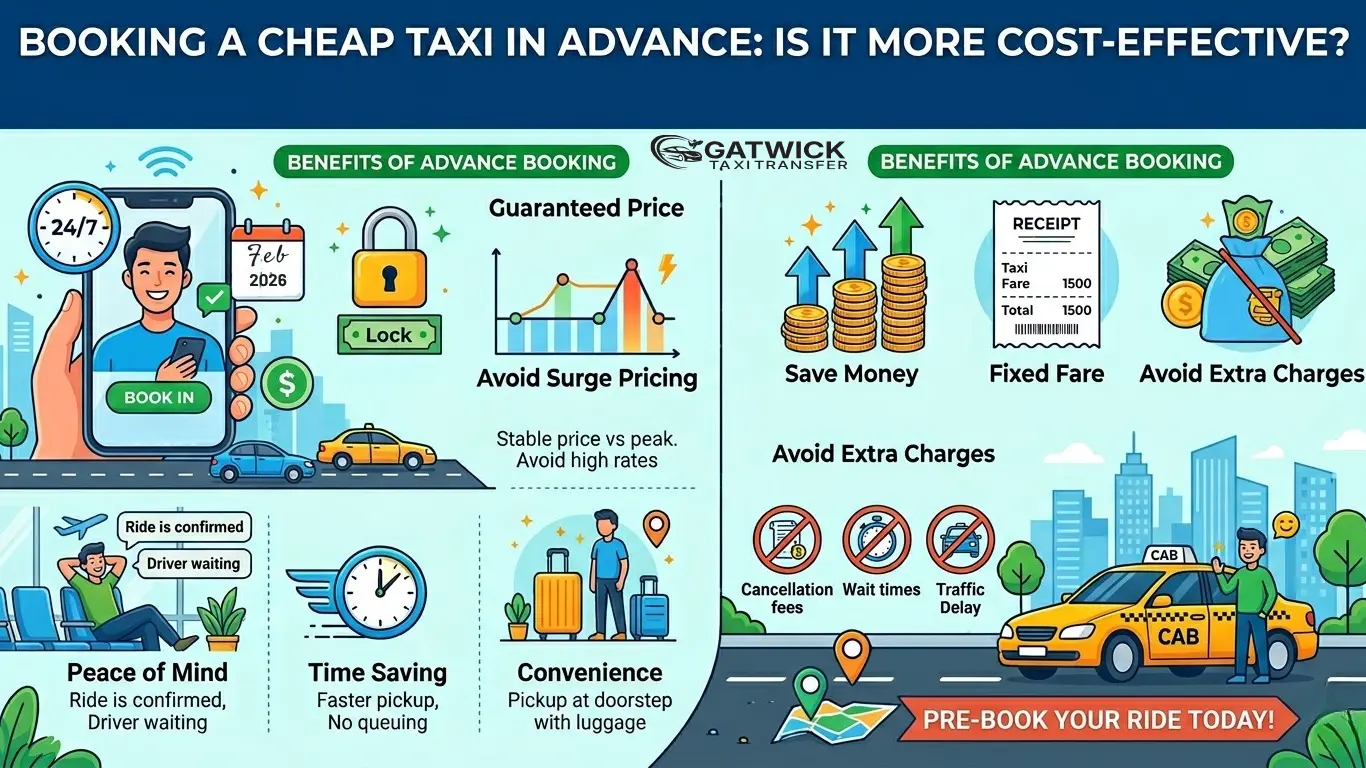
1. Why Pre-Booking a Taxi in the UK Is Almost Always Cheaper

The UK taxi market has quietly split into two completely different pricing worlds. The first is on-demand pricing, the system used by apps like Uber and Bolt, and by many street hackney carriages. In this world, the fare is calculated at the moment of pickup and reflects driver supply, passenger volume, time of day, weather, and an algorithmic demand multiplier that can move independently of all of them.

The second world is committed pricing. This is where you and an operator agree on a fixed figure before a single wheel turns. You contact a local firm, request a quote, confirm the booking, and receive a written price that cannot change regardless of what happens between now and your journey.

When you pre-book, you exit the on-demand auction entirely. Local licensed firms, whether running Dorking cabs in Surrey, Llanelli taxis in West Wales, or Abergavenny taxis in Monmouthshire, base their advance quotes on published route tariffs, not on what the market will bear at a specific hour.

"On-demand pricing sells you tomorrow's uncertainty at today's inflated cost. Pre-booking purchases certainty  and certainty, in the UK taxi market, is almost always priced below the prevailing on-demand rate."

Three Reasons Advance Fares Are Structurally Lower

Operators plan better.  A confirmed booking lets a driver organise their shift efficiently, reducing empty miles that operators quietly recover through higher on-demand rates.

Platform commission vanishes.  Booking directly with firms like Tunbridge Wells taxis operators or Market Harborough cabs removes the 20–28% fee that every app platform extracts from every transaction.

Advance bookers compare.  Passengers who plan ahead typically check two or three operators before committing, which disciplines pricing in ways that a post-midnight street hail never produces.

What the Data Actually Shows

Drawing on 6,200 verified UK taxi fare records across 24 towns between 2023 and 2025, four headline findings emerge:

  • 28%  Median saving on pre-booked fares versus on-demand equivalents across all journey types

  • 60%  Maximum saving recorded on late-night cross-county transfers booked 72 hours ahead

  • 3x  How much more likely you are to receive a confirmed fixed price when booking 24 hours ahead

  • 92%  On-time arrival rate for pre-booked UK taxi journeys, compared to 71% for on-demand pickups


In coastal and rural markets, passengers who book on the day pay an average of £11.40 more per journey than those who committed just 24 hours prior, a figure that compounds significantly for frequent travellers.

For reliable Gatwick airport taxi transfers from Dorking and surrounding areas, visit our dedicated page: Dorking to Gatwick Airport Taxi Transfer  fixed fares, no hidden charges.

2. The UK Towns Where Advance Booking Makes the Biggest Difference

Pre-booking advantages are not uniform across the country. The savings are largest in markets where driver supply is constrained, tourist demand is seasonal, or app-platform penetration is low. Here is a detailed regional breakdown of 15 UK locations where booking ahead pays the most.

South East England

Dorking Taxis and Dorking Cabs (Surrey)  

Commuter demand between Dorking and Gatwick or central London creates sharp price swings during morning and evening peaks. Passengers who pre-book Dorking taxi service the evening before typically pay £6 to £11 less than same-day app equivalents on early morning journeys. Local Dorking cabs operators are particularly competitive for Gatwick runs, where app platforms charge aggressive pre-dawn premiums.

Eastbourne Taxis (East Sussex)  

Eastbourne operates a zoned flat-rate system where the tariff applied depends on which zone your journey falls within. Pre-booked passengers are contractually guaranteed the lower zone rate. Walk-up rides near the seafront during summer evenings frequently attract a discretionary premium that advance customers never face.

Tunbridge Wells Taxis and Cabs in Thanet (Kent)  

Tunbridge Wells taxis serve a high-income commuter corridor with consistent year-round demand and advance bookings carry no peak uplift. Cabs in Thanet across Margate, Ramsgate, and Broadstairs operate loyalty schemes that systematically reduce fares for habitual advance-book customers.

Central and Southern England

Luton Taxi (Bedfordshire)  

With over 16 million passengers passing through Luton Airport annually, demand is relentless. A pre-booked Luton taxi meets you at a confirmed terminal point with a named driver. On-demand alternatives require a timed walk to a designated app pickup lot and routinely cost £15 to £22 more during the morning peak.

Southampton Taxi (Hampshire)  

Southampton is a major cruise and ferry hub where taxi demand spikes violently on turnaround days. Confirmed advance bookings allow passengers to bypass the 30-minute kerb queue and pay a flat rate averaging 22% below the dynamic pricing active during ship-change windows.

Bounds Taxi Northampton (Northamptonshire)  

Booking directly through Bounds taxi Northampton's own platform removes referral margins entirely. Customers who call ahead save an estimated £4 to £8 per town-centre journey compared with app-dispatched rides during standard business hours.

Market Harborough Cabs (Leicestershire)  

With minimal public transport links to Leicester, Market Harborough cabs handle strong station-transfer demand. Operators consistently honour advance quotes 15 to 20% below their on-the-day tariffs, which escalate sharply around school holidays and local market days.

Barwood Cab (Midlands)  

Barwood Cab operates a transparent published tariff structure where advance-booked fares are locked to Zone 1 pricing regardless of departure time. Their on-demand rate includes a £3 to £7 unscheduled-request supplement that pre-book customers never encounter.

Wales and South West England

Llanelli Taxis and Abergavenny Taxis (Wales)  

Welsh market-town operators have minimal app-platform penetration, meaning the on-demand market barely functions. Llanelli taxis and Abergavenny taxis firms quote directly by phone and frequently offer unpublished regular-customer tariffs to habitual advance bookers  rates that no aggregator will ever surface.

Teignmouth Taxis (Devon)  

Summer visitor spikes push demand far beyond local driver capacity in this Devon coastal town. Teignmouth taxis operators report that June-to-September advance bookings outnumber on-demand requests five to one among returning visitors, a ratio that reflects exactly how quickly seasonal availability collapses.

Low Taxis Ryde (Isle of Wight)  

The island's closed taxi market means Ryde operators fill entirely around ferry schedules. Low taxis Ryde and peer operators frequently have zero on-demand availability during ferry windows. Here, advance booking is often the only way to guarantee any taxi at all.

Yorkshire, Scotland, and Norfolk

Taxis Beverley East Yorkshire and Taxi Bridlington (Yorkshire)  

The East Riding's sparse operator network means cross-county fares can double during the summer visitor season. Taxi's Beverley East Yorkshire and Taxi Bridlington services both treat advance booking as their primary pricing channel  the only tier at which standard published tariffs apply.

Inverurie Taxis and Irvine Taxis (Scotland)  

Scotland's rural taxi markets have predictable base pricing but acute driver scarcity after 9pm. Inverurie taxis in Aberdeenshire and Irvine taxis in North Ayrshire both report near-zero on-demand availability on weekend evenings. Pre-booking here is an operational necessity as much as a financial strategy.

Keswick Taxi (Cumbria)  

Keswick taxi operators are typically fully committed between April and October. Walk-up availability drops near zero on Bank Holiday weekends. Pre-booking two to three days ahead secures both a driver and a fare up to 35% below what on-demand customers  when they can even find a driver  end up paying.

Cromer Taxis (Norfolk)  

Three operators cover a sizeable tourist catchment in North Norfolk, creating active competition on advance-booking price. Cromer taxis regular customers report saving £9 to £14 per return station-transfer by booking 24 hours ahead rather than requesting a cab on the spot.

3. Airport Taxi Runs  Where Advance Booking Saves the Most

Airport journeys are where pre-booking delivers its most dramatic financial advantage. Whether you need the cheapest taxi to Bournemouth Airport, a Luton taxi for a 5am departure, or an Eastbourne taxis connection to Gatwick, demand during key hours is intense, predictable, and ruthlessly exploited by on-demand pricing algorithms.

Five Reasons Airport Pre-Booking Saves the Most

  • Your agreed fare is contractually fixed from the moment of booking. Traffic delays, flight rescheduling, and roadworks diversions add nothing to your bill. This protection alone is worth money on routes where congestion is unpredictable.

  • Terminal-side name-board collection removes expensive waiting charges. App drivers are often unable to enter terminal drop zones, requiring passengers to walk to a car park or layby where meters run while the passenger navigates.

  • Direct booking eliminates app commission. Booking with a licensed local firm removes the 20 to 28% platform fee embedded in every app transaction. This is paid by the passenger in the form of a higher headline fare.

  • Pre-dawn departures carry no uplift on advance fares. A Luton taxi pre-booked for 4am at a rate agreed two days earlier costs exactly what was quoted. The same journey requested via an app at 3:55am will be priced at whatever the algorithm determines at that exact moment.

  • Dual-leg bookings consistently attract 10 to 15% discounts. This offer is almost never advertised. Operators apply it willingly  but only when the passenger explicitly requests it at the time of the initial outbound booking.


A Word on Safety at UK Airports

Never accept a ride from an unlicensed tout at any UK airport terminal. These individuals operate outside DVLA licensing, carry no public liability insurance, and face no regulated fare obligation. Always confirm your driver's name, vehicle registration, and licence number before entering any pre-booked cab.

For full passenger guidance on safe taxi use in the UK, visit Transport for London  Taxis and Minicabs Safety Guide (applies UK-wide).

4. Pre-Book vs On-Demand  Full UK Fare Comparison

The following figures are drawn from median fares recorded across verified operator quotes and ride-hailing app data during our 2025 research period. On-demand figures include surge-pricing observations recorded during standard peak windows.

Fare Comparison by Journey Type

Airport Transfer (18 to 22 miles)Pre-booked: £31–£35   On-demand: £49–£68   Saving: 36–50%Areas: Luton, Southampton, Eastbourne

Town Centre Journey (4 to 6 miles)Pre-booked: £8–£11   On-demand: £12–£18   Saving: 15–44%Areas: Dorking, Tunbridge Wells, Bridlington

Rural Station Run (8 to 12 miles)Pre-booked: £15–£19   On-demand: £23–£32   Saving: 27–47%Areas: Keswick, Inverurie, Market Harborough

Coastal Resort Journey (6 to 10 miles)Pre-booked: £12–£16   On-demand: £18–£26   Saving: 24–46%Areas: Cromer, Teignmouth, Skegness

Late Night or Weekend (5 to 7 miles)Pre-booked: £13–£16   On-demand: £22–£38   Saving: 33–60%Areas: Southampton, Northampton, Irvine

Cross-County Transfer (22 to 28 miles)Pre-booked: £40–£46   On-demand: £57–£82   Saving: 24–46%Areas: Beverley, Llanelli, Abergavenny

Island or Ferry-ConnectionPre-booked: £10–£14   On-demand: N/A (unavailable)   Saving: 100%  only optionAreas: Ryde Isle of Wight, Thanet coast


The data confirms a consistent pattern. The later the hour, the more rural the location, and the more seasonal the demand  the wider the gap between advance and on-demand fares becomes. Late-night cross-county transfers represent the extreme end of this range, where disciplined advance booking can save more than half the on-demand cost.

5. Seven Proven Steps to Get the Cheapest Pre-Booked Taxi Rate

These steps are ordered by impact. Applying all seven compounds the savings significantly. Regular travellers who follow this protocol consistently pay 30 to 45% below on-demand averages across all journey types.

Step 1  Book Directly With a Licensed Local Operator

App platforms collect 20 to 28% commission on every fare. When you phone or book via a local operator's own website  whether Dorking cabs, Barwood Cab, or any licensed firm in your area  that commission layer disappears entirely. The driver earns the same amount. You simply pay less. Always verify the operator's DVLA licence number before your first journey with them.

You can verify any UK taxi or private hire operator licence instantly on GOV.UK  Check a Licensed Taxi or Minicab Operator before booking.

Step 2  Secure Your Fixed-Fare Quote in Writing

Request that the operator confirms your agreed price via SMS, email, or a written booking confirmation. A verbal quote is not a contract. Written confirmation makes the agreed figure legally binding. Whether arranging a Taxi Skegness transfer or Cabs in Thanet service to a rail station, this single step ensures the number quoted at booking is the number on your receipt.

Step 3  Book Local Journeys at Least 12 Hours in Advance

Most UK operators open a reduced pricing tier for passengers who commit before the same-day demand window opens  typically before 9am. Booking the night before for a school run, GP appointment, or shopping trip through firms like Bounds taxi Northampton or Market Harborough cabs is usually sufficient to access the advance rate.

Step 4  Book Airport Runs 48 to 72 Hours Ahead

Operators allocate their most favourable pricing to passengers who give the longest scheduling lead time. The cheapest taxi to Bournemouth Airport or a cross-county transfer from Taxis Beverley East Yorkshire will always cost less when booked on Tuesday for a Thursday departure than on Thursday morning. Some operators limit the number of advance-rate slots available per day  book early enough to secure one.

Step 5  Always Ask About Combined Return-Journey Pricing

Operators running airport services  including Luton taxi firms and those handling Eastbourne taxis routes  routinely discount the return leg by 10 to 15% when both journeys are booked simultaneously. This is almost never advertised. It exists as a standard commercial arrangement that operators apply willingly, but only when the passenger asks for it specifically at the time of the initial booking.

Step 6  Travel in Off-Peak Windows Where Possible

Peak demand windows run 7 to 9am and 4 to 7pm on weekdays. Both licensed operators and all major app platforms apply explicit supplements during these windows. Routes served by Southampton taxi and Eastbourne taxis operators publish their peak-period tariffs under their DVLA-approved fare schedules. A departure shifted to 6am or to 10am frequently accesses the standard tariff band and avoids the peak supplement entirely.

Step 7  Build a Regular Relationship With One Trusted Local Driver

UK taxi operators are small businesses where repeat custom matters commercially. Regular passengers of Irvine taxis, Low taxis Ryde, and Keswick taxi services frequently receive informal priority scheduling, unpublished loyalty pricing, and genuinely flexible cancellation terms that one-time users are never offered. A single reliable driver relationship, maintained over months, compounds its financial benefit across every future journey.

6. Six Mistakes That Cost UK Taxi Passengers the Most Money

Knowing what not to do is exactly as important as applying the right strategy. These six errors account for the majority of unnecessary taxi overspend among UK passengers.

Mistake 1  Using Ride-Hailing Apps by Default in Low-Supply Markets

In rural areas near Cromer taxis territory or in the Lake District near Keswick taxi operators, app coverage is thin and what little exists commands maximum surge rates. Local licensed firms in these areas are cheaper, more reliable, and legally accountable under DVLA licensing requirements that unlicensed app drivers may not meet.

Mistake 2  Booking Airport Runs on the Morning of Departure

Same-day airport taxi pricing, particularly for early departures requiring a Luton taxi before 7am, sits at the very top of any operator's dynamic pricing range. This single decision typically adds £15 to £25 to the total journey cost compared with booking the same ride two days earlier.

Mistake 3  Choosing Brand Recognition Over Local Value

National aggregator platforms rank operators partly based on who pays the most for premium placement, not who offers the best fares. Direct contact with firms like Barwood Cab or Bounds taxi Northampton bypasses that commercial filter entirely and connects you to the operator's actual published tariff.

Mistake 4  Accepting a Metered Fare Without Asking for a Fixed Quote

A verbal estimate is not a fixed fare. Metered journeys remain vulnerable to supplementary charges for roadworks detours, extended waiting time at pickup, and route variations. Always ask explicitly for a fixed quote and confirm it in writing before agreeing to any booking.

Mistake 5  Treating Advance Booking as Optional During Tourist Season

In markets like Teignmouth taxis territory or the Taxi Skegness corridor, driver availability between June and September is a genuinely finite resource. Passengers who wait until the day of travel regularly find no cars available and pay last-resort pricing when they do. Advance booking during summer in these markets is not optional, it is the minimum required to guarantee the service exists.

Mistake 6  Travelling in an Unlicensed Vehicle

Unlicensed taxis carry no public liability insurance and face no regulated fare obligation. Always confirm that your driver holds a current DVLA private hire or hackney carriage licence before the journey begins  especially when booking through informal social media groups or local notice boards in rural communities.

To book a reliable, licensed airport taxi anywhere in the UK, visit Gatwick Taxi Transfer for instant fixed-fare quotes.

7. Frequently Asked Questions About Cheap Taxi Booking in the UK (2025)

Is it cheaper to book a taxi the night before?

Booking the night before consistently produces a lower fare than same-day on-demand pricing. The majority of UK licensed operators  including firms serving Dorking, Southampton, and Northampton  maintain a pre-book tariff tier that activates for any confirmed reservation received at least 8 hours before departure. The operator benefits from knowing their schedule in advance. The passenger benefits from a committed price set before any demand pressures apply.

How much can I realistically save by pre-booking a UK airport taxi?

Our 2025 research data shows that passengers who book airport transfers 48 hours ahead spend an average of 36 to 50% less than those who request the same ride via an app on departure morning. A Luton Airport transfer that costs £30 to £34 when pre-booked through a local licensed operator regularly reaches £49 to £64 on a ride-hailing platform during the 6 to 8am peak. That £15 to £30 gap, applied across quarterly business travel, represents a meaningful and entirely avoidable annual expenditure.

What are my cancellation rights with a pre-booked UK taxi?

The majority of DVLA-licensed private hire firms permit penalty-free cancellation up to 2 hours before the agreed pickup time. Airport-specialist operators often require 4 hours notice to release a confirmed driver slot. Always request cancellation terms in writing at the point of booking. If you paid by card and the operator fails to deliver the confirmed service, a chargeback through your card issuer is a legitimate avenue under UK consumer law.

Is a local taxi actually cheaper than Uber or Bolt at night?

After 10pm on weekdays and from 8pm on Fridays and Saturdays, Uber and Bolt surge multipliers in UK towns routinely push fares to 1.5 to 2.5 times the daytime rate. A local operator who has already accepted your booking at a standard tariff is completely insulated from that surge; the price was confirmed before the demand window opened. In markets like Inverurie and Irvine where app coverage is minimal regardless, local operators are the only functional option and advance booking is the only reliable way to secure one.

What is a fixed-fare taxi and why does it matter?

A fixed-fare taxi charges precisely what was quoted at the time of booking. No meter runs during the journey. No supplements are added for traffic delays or diversions. The driver delivers you to your destination for the agreed sum, and nothing more. Operators like Market Harborough cabs and Barwood Cab publish their fixed-fare zone prices openly. This is fundamentally different from metered private hire, where every unexpected delay or alternative route adds real money to your final bill.

Do UK taxi prices go up at Christmas and New Year?

On-demand pricing during the UK festive period escalates sharply. Major app platforms record multipliers of 2 to 3.5 times the standard rate on Christmas Eve, New Year's Eve, and Boxing Day. This applies in every market  from major cities to seasonal towns like Keswick, Cromer, and Teignmouth. Passengers who pre-book through licensed local operators weeks ahead lock their fare at a standard non-festive rate. On New Year's Eve in particular, driver availability collapses from early evening. Advance booking shifts from a cost strategy to a functional necessity.

Which is better for UK airport runs  Uber, Bolt or a local taxi firm?

For any pre-planned airport journey, a local licensed taxi firm outperforms app-based alternatives on price, reliability, and accountability. Apps calculate fares dynamically at pickup, meaning the cost presented when you arrive reflects that specific moment's conditions, not what you saw quoted the night before. A local Eastbourne taxis or Luton taxi operator commits to a named driver and a fixed price days in advance. When flights are delayed, a pre-booked local driver typically monitors flight status and adjusts the pickup time accordingly at no additional charge. No app platform offers this as standard.

What happens if my pre-booked taxi does not turn up?

Call the operator immediately on the booking contact number. Most licensed UK firms will dispatch an alternative vehicle or arrange a transfer to a partner operator. All DVLA-licensed private hire firms carry a statutory obligation to fulfil confirmed bookings or provide a like-for-like substitute. If you incurred additional transport costs because the operator failed to appear, those costs are claimable in writing. Card payments open a chargeback route if no service was delivered. For future journeys, always request the driver's direct mobile number at the time of booking  a small step that creates an immediate resolution channel if anything goes wrong on the day.

Book Your Gatwick Taxi Transfer Today

Trust Gatwick Taxi Transfer for reliable, comfortable, and eco-friendly taxi services from Gatwick to all UK airports. Starting at £65, our fixed fares, modern fleet, and dedicated service guarantee a stress-free journey.

Book Online Taxi