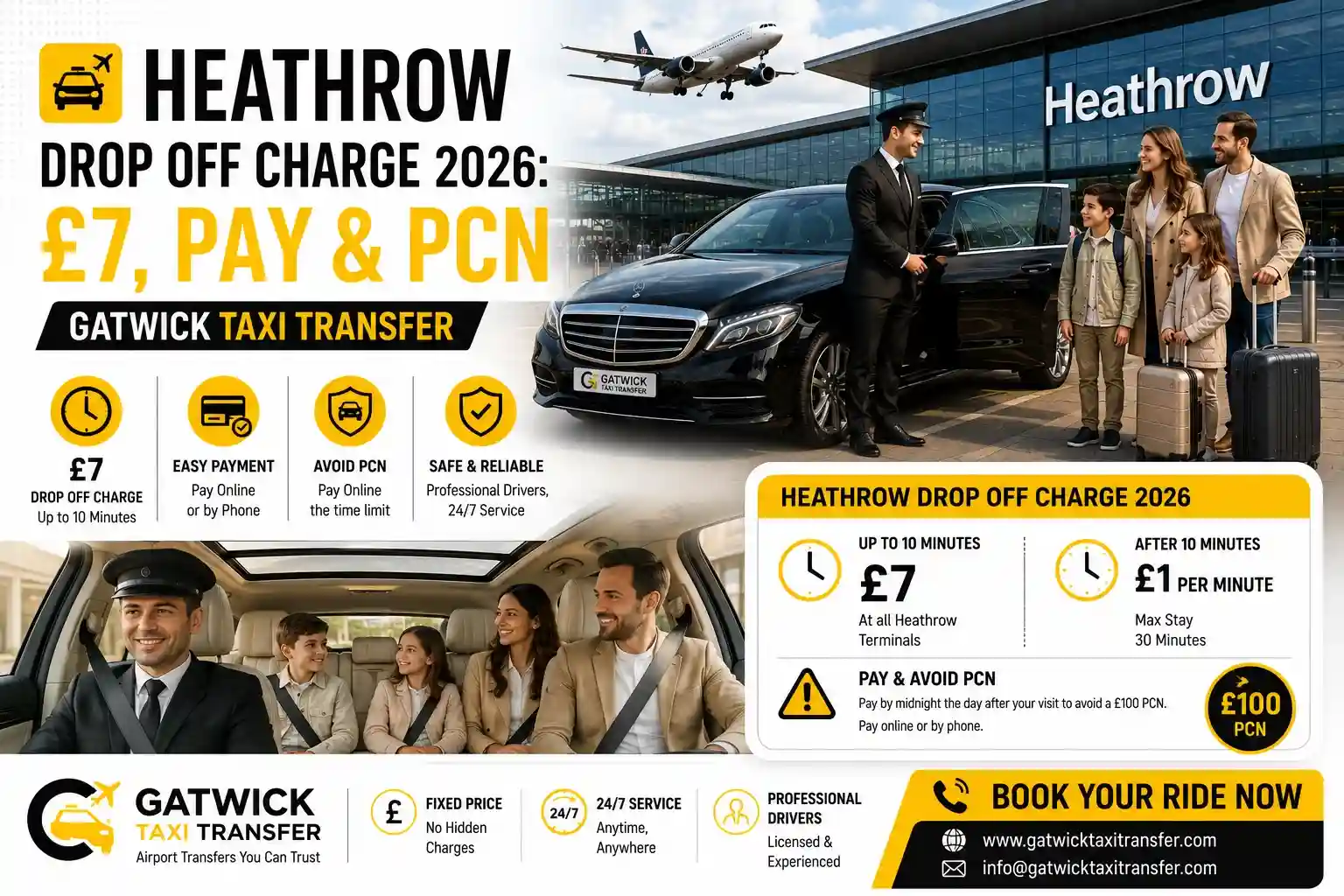
Gatwick Taxi Transfer runs Heathrow transfers daily across all four terminals. The £7 drop off charge is inside every confirmed Heathrow fare — our business account with APCOA settles it automatically. The Blue Badge intercom call-point process described in this guide is one our drivers navigate on behalf of passengers with disabilities on every relevant booking. The PCN appeal contacts come from actual enforcement correspondence our compliance team has reviewed.
All charges and procedures verified from heathrow.com official drop-off page and APCOA Heathrow. Last updated 17 June 2026.
The Heathrow airport drop off charge — drop off heathrow, drop off at heathrow, or Heathrow drop off charges — is £7 per entry at Terminals 2, 3, 4 and 5 from 1 January 2026 (rose from £6). A 10-minute maximum stay applies at all terminal drop-off zones. Every entry is a separate charge — two entries in one day = £14. The charge applies 24/7, 365 days a year. No grace period.
Barrierless ANPR — pay in advance (unique to Heathrow): Unlike Gatwick (pay after exit only) and Stansted (pay by midnight after visit), Heathrow lets you pay in advance before your visit. Pay at heathrow.com, by phone on 0330 008 5600, or via the Caura app. AutoPay accounts automate the charge. APCOA operates the system.
PCN £80: Miss the midnight deadline or overstay 10 minutes and a £80 Parking Charge Notice is issued, reduced to £40 within 14 days. Appeal: email refunds.heathrowdropoff@apcoa.com or call 0333 200 7459.
Blue Badge — exempt, but two steps required: Register your vehicle online at heathrow.com before each visit. Then, on arrival at the drop-off zone, you must use the designated intercom call point and speak to an operator. Skipping the intercom means the full £7 charge applies even with advance registration.
Motorcycles are exempt. EVs, PCO vehicles, and private hire cars are not. Free drop-off exists via Long Stay car parks with free transfer bus. Heathrow is the cheapest major London airport for drop-offs at £7 — Gatwick charges £10, Stansted charges £10.
Heathrow Airport Drop Off Charge 2026 — £7 Per Entry, 10-Minute Maximum
The Heathrow drop off fee — also the Heathrow airport drop off charge, Heathrow airport drop off payment, or Heathrow airport drop off charges in official searches — is simple compared to Luton's per-minute meter and Stansted's banded tiers. It is a flat £7 per entry — whether you stop for one minute or nine minutes 59 seconds, the charge is the same. The complexity at Heathrow comes from the four separate terminal zones, the two-step Blue Badge process, and the advance payment option that most drivers don't know exists.
£7 per entry at T2, T3, T4 and T5. Flat rate — no per-minute escalation, no banded tiers. From 1 January 2026, rising from the previous £6. The cheapest major London airport drop-off alongside Luton (Gatwick and Stansted both charge £10). Every entry to any terminal zone triggers the charge independently.
Flat rate — all 4 terminalsUnlike every other London airport, Heathrow allows payment in advance before your visit. Pay at heathrow.com before you set off, on the day of the drop-off, or by midnight the following day. AutoPay automates it after each visit. This advance payment option is a genuine operational advantage — no midnight stress.
Unique to Heathrow£80 PCN for missing the midnight deadline or overstaying 10 minutes. Reduced to £40 within 14 days. Issued by APCOA based on ANPR records. Lower than Gatwick's £100 and Stansted's £100 — but still 11× the original £7 charge. Appeal contacts: refunds.heathrowdropoff@apcoa.com · 0333 200 7459.
Lower than Gatwick/StanstedHeathrow Drop Off Zones — Terminal 2, 3, 4 and 5 (Terminal 1 Is Closed)
Heathrow has four operational terminals. Terminal 1 is permanently closed — some drivers and satnav systems still route to the T1 area, which wastes time and can push the stop close to the 10-minute maximum. Always confirm the correct terminal from the boarding pass before setting off.
- United Airlines, Air Canada, Lufthansa Group
- Star Alliance carriers
- Aer Lingus, SAS, Air New Zealand
- £7 charge per entry — same as all terminals
- American Airlines, Delta, Virgin Atlantic
- Emirates (some routes), Qantas
- oneworld carriers (non-BA)
- 4 dedicated drop-off lanes — less congested
- Malaysia Airlines, Korean Air, Kuwait Airways
- Some SkyTeam carriers
- Charter and seasonal operations
- 3 drop-off lanes at the ramp top
- British Airways — all routes
- Iberia (some codeshares)
- Busiest terminal at Heathrow
- Peak morning congestion — allow extra approach time
Each terminal has a separate drop-off zone and the heathrow terminal drop off charge applies independently at each. The Heathrow terminal 2 drop off payment, Heathrow terminal 3 drop off payment, Heathrow terminal 4 drop off payment, and Heathrow terminal 5 drop off payment all go through the same heathrow.com portal — one payment covers your specific terminal visit. Entering T3 by mistake when your passenger flies from T2 means two separate £7 charges if you then enter T2. Unlike Gatwick's two terminal problem (North/South), Heathrow's four terminal layout means four possible wrong-terminal entries. Confirm terminal before you set off, not at the airport.
How Heathrow's ANPR Drop Off System Works — Pay in Advance (Unique to Heathrow)
Heathrow's barrierless ANPR system has been running since 2021 — APCOA operates it on the airport's behalf. No barriers, no ticket machines, no payment kiosks in the zone. The moment your vehicle enters a terminal drop-off zone, cameras record your plate and the charge is triggered. The 10-minute clock starts immediately.
What makes Heathrow different from every other London airport — and what most drivers searching for "heathrow pay drop off" or "heathrow drop-off pay online" don't realise: you can pay in advance. Gatwick requires payment after you exit the zone. Stansted requires payment by midnight after your visit. Heathrow lets you log into heathrow.com, enter your registration, and pay for the visit before you even set off from home. For drivers who do Heathrow regularly and know exactly which day they are going, advance payment removes the midnight deadline entirely. For drivers who prefer AutoPay, the account handles it automatically after each visit.
| Frequency | Trips/year | Annual cost | One PCN equals |
|---|---|---|---|
| Once a year | 1 | £7 | 11× annual cost |
| Twice a year | 2 | £14 | 6 years paid |
| Monthly | 12 | £84 | Nearly 1 year |
| Weekly | 52 | £364 | 3 months |
| Daily (PCO/1 drop) | 260 | £1,820 | AutoPay essential |
| Daily (PCO/2 drops) | 520 | £3,640 | Business account essential |

How to Pay Heathrow Drop-Off Charges — Pay Drop Off Heathrow Online, Phone, Caura App or AutoPay
Email: refunds.heathrowdropoff@apcoa.com
Phone: 0333 200 7459
Post: DRPL, PO Box 230, Manchester, M34 0DW
Valid appeal grounds: ANPR misread (wrong plate recorded), payment made but not registered (bank statement evidence), Blue Badge holder charged despite valid exemption + intercom use, genuine medical emergency on forecourt. Forgetting to pay is never accepted.
Who Is Exempt From the Heathrow Drop Off Charge — and Who Pays Anyway
- ♿Blue Badge holders — advance registration + intercom call point on arrival (two steps required)
- 🏍️Motorcycles — automatically exempt at Heathrow (different from Gatwick where bikes pay £10)
- 🚌Coaches and buses — must use designated coach bays, not terminal forecourts
- 👷Heathrow colleagues — registered employees receive 100% discount until October 2026
- ⚡Electric vehicles — no EV exemption at Heathrow, same £7 charge as petrol and diesel
- 🚕PCO-licensed vehicles — no exemption. Taxis, minicabs, Uber, Bolt all pay £7 per entry
- 🚗Private cars, SUVs, vans — all pay the standard £7
- 🏎️Premium vehicles — no vehicle-type exemption whatsoever
Blue Badge at Heathrow — Two Steps, Both Required
The Blue Badge exemption at Heathrow works differently from most airports — and this catches people out. At Gatwick, you pre-register online and the ANPR system recognises your plate. At Heathrow, you pre-register online AND you must physically use the intercom call point in the drop-off zone on arrival. Both steps are mandatory.
Step 1: Register your vehicle at heathrow.com with your registration number, Blue Badge number, and travel date. Step 2: On arrival at the terminal drop-off zone, locate the intercom call point post, press the button, speak to the operator, and confirm your Blue Badge details and registration. Only after both steps is the exemption applied. Arriving with a Blue Badge and a pre-registration but skipping the intercom call point means the full £7 charge is triggered by the ANPR cameras automatically.
How to Avoid the Heathrow Drop Off Charge — Free Options and Legal Alternatives
Long Stay car parks at all four Heathrow terminals give you free heathrow drop off — park in any free bay and passengers take the free transfer bus to the terminal. There are no time limits on the parking itself (though parking charges apply after the free window). The transfer bus adds time to the journey but is free and runs continuously.
Free · No midnight deadline · Works for any terminal · Driver can help with luggage at car park · No 10-minute pressure
Transfer bus adds time · Bus can be busy on peak mornings · T5 Long Stay is further from terminal than other airports
With Gatwick Taxi Transfer, the £7 Heathrow drop off charge is settled through our business APCOA account — it is inside the confirmed fare. No heathrow.com portal to log into, no midnight deadline, no PCN risk. The driver drops at the correct terminal, handles the charge, and the passenger walks in. For 2+ passengers sharing from London, the per-head cost often matches or beats the train.
Charge included · Terminal confirmed at booking · Door-to-terminal · 1 hour free waiting on arrivals · No payment admin
Higher upfront cost for solo passengers · Need to book in advance
Register at heathrow.com before each visit (vehicle registration, Blue Badge number, travel date). On arrival in the drop-off zone, use the intercom call point before the ANPR charge triggers. Both steps are required — skipping either means the £7 charge applies. The heathrow drop off blue badge exemption is genuine and works well when the process is followed correctly.
Short Stay car parks at all four terminals are walking distance from arrivals — no shuttle needed. Heathrow Short Stay charges approximately £7.50 for up to 29 minutes — slightly more than the forecourt drop-off charge but with no time pressure and no 10-minute clock running. For picking up arriving passengers, Short Stay is the correct zone — the Express forecourt is for departures only. A flight from New York that lands on time at T3 still takes 30–45 minutes through immigration and baggage before the passenger appears at arrivals. Waiting in Short Stay costs the same per entry as the forecourt but gives you up to 29 minutes at a known price before charges escalate. With Gatwick Taxi Transfer arrivals collections, the driver waits in Short Stay and the 1-hour free waiting is inside the confirmed fare — no parking charge to settle on the day.
If the passenger is travelling solo from Central London with manageable luggage, the train removes the drop-off problem entirely. Heathrow Express from London Paddington: 15 minutes to T5 (departures at :02 and :32 past every hour), 21 minutes to T2/T3 — approximately £25 single or £32 return. Elizabeth line from Paddington, Bond Street, Tottenham Court Road, Liverpool Street and many more: 40–50 minutes to Heathrow Central (T2/T3) or Heathrow Terminal 5, approximately £13 single from central zones — significantly cheaper than the Express but not timed for last-minute departures. Both go direct to each terminal without bus connections. Not practical for early morning before trains run, families, heavy luggage, or anyone more than 15 minutes from a station.
- 🚫Stopping on the slip roads or approach roads: All approach roads to all four terminals are monitored. Stopping outside the marked drop-off zones triggers a separate enforcement notice — separate from and in addition to any drop-off charge.
- 🚫"My electric car is exempt": EVs pay the full £7 at Heathrow. This is different from some other road charges in London. There is no EV exemption for the Heathrow Terminal Drop-Off Charge.
- 🚫"I paid but I'm not sure it went through": If payment is uncertain, check the confirmation email immediately. A failed transaction is not grounds for a PCN appeal — only a bank statement showing the charge attempted and a system error reference would qualify.
- 🚫Paying in advance for the wrong date: Advance payment is linked to a specific date. If you pay for the wrong day, the ANPR records a visit without a matching payment and a PCN is issued. Check the date carefully when paying in advance.
Heathrow Drop Off Charge vs All Other London Airports 2026
| Airport | Charge | Max stay | PCN | Blue Badge | Advance pay? | Operator |
|---|---|---|---|---|---|---|
| Heathrow LHR | £7 flat | 10 min | £80 (£40) | Exempt + intercom | Yes ✅ | APCOA |
| Luton LTN | £7 + £1/min | 30 min | £95 (£55) | TCP1/2 free | No | APCOA |
| London City LCY | £8 + £1/min | 10 min | PCN | Exempt | No | APCOA |
| Southend SEN | £8 flat | 10 min | PCN | Check | No | — |
| Gatwick LGW | £10 + £1/min | 30 min | £100 (£60) | Exempt (NCP) | No | NCP |
| Stansted STN | £10/£28 | 30 min | £100 (£60) | Not exempt | No | Street Cars |
Heathrow stands out on three counts: cheapest major London airport (£7 vs £10 at Gatwick and Stansted), only airport allowing advance payment, and lower PCN amount (£80 vs £100 at Gatwick and Stansted). For full Gatwick comparison, see our Gatwick drop off charge guide. For Luton, see our Luton drop off charge guide. For Stansted, see our Stansted drop off charge guide.
Taxi Fares to Heathrow Airport 2026 — £7 Drop Off Charge Included, All 4 Terminals
Gatwick Taxi Transfer covers all four Heathrow terminals. The £7 Heathrow airport drop off charge is pre-settled through our business APCOA account — it is inside every Gatwick Taxi Transfer confirmed fare. All 2026 fixed prices for a standard saloon below.
| From area | Postcode examples | Saloon from | MPV from | Journey time |
|---|---|---|---|---|
| Central London | WC1, SW1, EC1 | £45 | £62 | 35–60 min |
| West London | W1, W2, W6, TW | £32 | £45 | 20–40 min |
| South West London | SW7, SW10, SW15 | £38 | £52 | 25–45 min |
| North London | N1, NW1, N7 | £55 | £75 | 45–65 min |
| East London | E1, E14 | £62 | £82 | 50–70 min |
| South London | SE1, SW4, SE22 | £48 | £65 | 40–60 min |
| Heathrow to Gatwick | LHR → LGW | £75 | £95 | 60–80 min |
| Heathrow to Stansted | LHR → STN | £85 | £110 | 75–95 min |
For a confirmed fare from your postcode, use the Heathrow taxi quote tool or call 020 3617 7825. The quoted fare always includes the £7 drop off charge, terminal confirmed at booking, meet and greet on arrivals, and 1 hour free waiting. For group travel see our minibus airport transfers.
£7 per entry at all four terminals — T2, T3, T4 and T5. Flat rate, 10-minute maximum stay. Rose from £6 on 1 January 2026. Every entry is a separate charge. PCN £80 for non-payment (£40 within 14 days). APCOA barrierless ANPR system. Heathrow is cheapest major London airport alongside Luton (Gatwick and Stansted both £10).
Online at heathrow.com, by phone 0330 008 5600, or via the Caura app. Unlike Gatwick and Stansted, Heathrow allows payment in advance before your visit — as well as on the day or by midnight the following day. AutoPay personal and business accounts automate the charge. APCOA operates the payment system.
Yes — Heathrow is the only London airport that allows advance payment. Pay at heathrow.com before you set off. Enter your registration and the date of your planned visit. Gatwick requires payment after exiting the zone. Stansted requires payment by midnight after the visit. Heathrow's advance option removes the midnight deadline entirely.
Yes — but two steps are required, both mandatory. Step 1: register your vehicle online at heathrow.com with your registration, Blue Badge number, and travel date. Step 2: on arrival at the drop-off zone, use the intercom call point to speak to an operator and confirm your Blue Badge details. Skipping either step means the £7 charge applies automatically via ANPR.
Yes — motorcycles are exempt at Heathrow. This is different from Gatwick where motorcycles pay the standard £10. At Heathrow, the exemption for motorcycles is automatic. Electric vehicles and PCO-licensed vehicles are not exempt — they pay the standard £7.
£80, reduced to £40 if paid within 14 days. Issued by APCOA for non-payment or overstaying the 10-minute maximum. Appeal: email refunds.heathrowdropoff@apcoa.com or call 0333 200 7459. Write to DRPL, PO Box 230, Manchester, M34 0DW. Valid grounds: ANPR misread, payment made but not registered, Blue Badge exemption correctly followed but still charged.
Yes — Heathrow Long Stay car parks offer free drop-off at all four terminals with a free transfer bus to each terminal. No time limit on the free parking window for a drop-off. The transfer bus adds time but is free. The Heathrow Express (from Paddington, ~15 minutes) or Elizabeth line also removes the drop-off problem entirely for solo passengers from Central London.
Yes — £7 at all four terminals (T2, T3, T4 and T5). Heathrow terminal 2 drop off, Terminal 3 drop off, Terminal 4 drop off and Terminal 5 drop off (heathrow t5 drop off) all cost the same £7 per entry. Heathrow terminal 2 drop off payment, terminal 3 drop off payment, terminal 4 drop off payment and terminal 5 drop off payment all go through the same portal: heathrow.com or 0330 008 5600.
Heathrow: £7 flat, 10-min max, PCN £80, APCOA, advance payment allowed, motorcycles exempt. Gatwick: £10 flat, then £1/min, 30-min max, PCN £100, NCP, no advance payment, motorcycles not exempt. Heathrow is £3 cheaper at base rate, has a lower PCN, and uniquely allows payment in advance. Both exempt Blue Badge holders with pre-registration.
Book a Heathrow Airport Taxi — £7 Drop Off Charge Included, All 4 Terminals, 24/7
Gatwick Taxi Transfer covers all four Heathrow terminals. The £7 Heathrow drop off charge is pre-settled through a business APCOA account — no heathrow.com portal to visit, no midnight deadline, no PCN risk. Available on iOS and Android.
- check£7 per entry — all four terminals: T2, T3, T4 and T5. Flat rate, 10-minute maximum stay. Rose from £6 on 1 January 2026. Every entry charged separately — three entries in one day = £21. No per-minute escalation.
- starPay in advance — ONLY London airport that allows this: heathrow.com allows payment before, on the day, or by midnight after your visit. Phone: 0330 008 5600. Caura app also accepted. APCOA operates the system. AutoPay for personal and fleet accounts.
- checkPCN £80 (£40 in 14 days): Lower than Gatwick's £100 and Stansted's £100. Appeal: refunds.heathrowdropoff@apcoa.com · 0333 200 7459 · DRPL PO Box 230 Manchester M34 0DW.
- checkBlue Badge — exempt but two steps required: Register online at heathrow.com before each visit AND use the intercom call point in the drop-off zone on arrival. Both steps mandatory — skip either and the £7 charge applies.
- checkMotorcycles exempt. EVs and PCO vehicles not exempt. Coaches exempt in designated bays. Heathrow colleagues registered before November 2021 receive 100% discount until October 2026.
- checkTerminal 1 is closed — T2 (Constellation Way) · T3 (Cosmopolitan Way/Camborne Road) · T4 (Stratford Road) · T5 (Wayfarer Road). Confirm terminal from boarding pass before setting off.
- checkCheapest major London airport at £7 alongside Luton. Gatwick and Stansted both charge £10. Heathrow PCN £80 is lower than Gatwick/Stansted's £100.
- checkGatwick Taxi Transfer: £7 Heathrow drop off charge in every confirmed fare. Business APCOA account settles it. Terminal confirmed at booking. 1 hour free waiting on arrivals. Fixed price 24/7.
Gatwick Taxi Transfer — £7 Heathrow Drop Off Charge Included in Every Fare
All four Heathrow terminals. Terminal confirmed at booking. APCOA account settles the charge. No heathrow.com portal to log into. No midnight deadline. No PCN risk.