
Busiest days: Fridays, Sundays, and Mondays are consistently the most crowded days at Heathrow throughout July and August 2026. Tuesdays, Wednesdays, and Thursdays are measurably quieter at all terminals.
Absolute peak period: The second half of August — roughly 9 to 31 August — is the single most congested window of the year. English schools break up on 22 July 2026 and return on 3 September, driving six weeks of sustained family travel pressure.
M25 worst windows: 07:30–09:30 Monday to Friday and 15:00–19:30 on Friday afternoons. The stretch between Junctions 12 and 16 averages over 210,000 vehicles daily. In these windows, add 30–50 minutes to any standard journey time to Heathrow.
Security queues: In peak summer, Heathrow security can exceed 90 minutes at peak hours. Heathrow officially recommends arriving 3 hours before long-haul and 2 hours before short-haul — add a further 30–45 minutes in July and August on top of that.
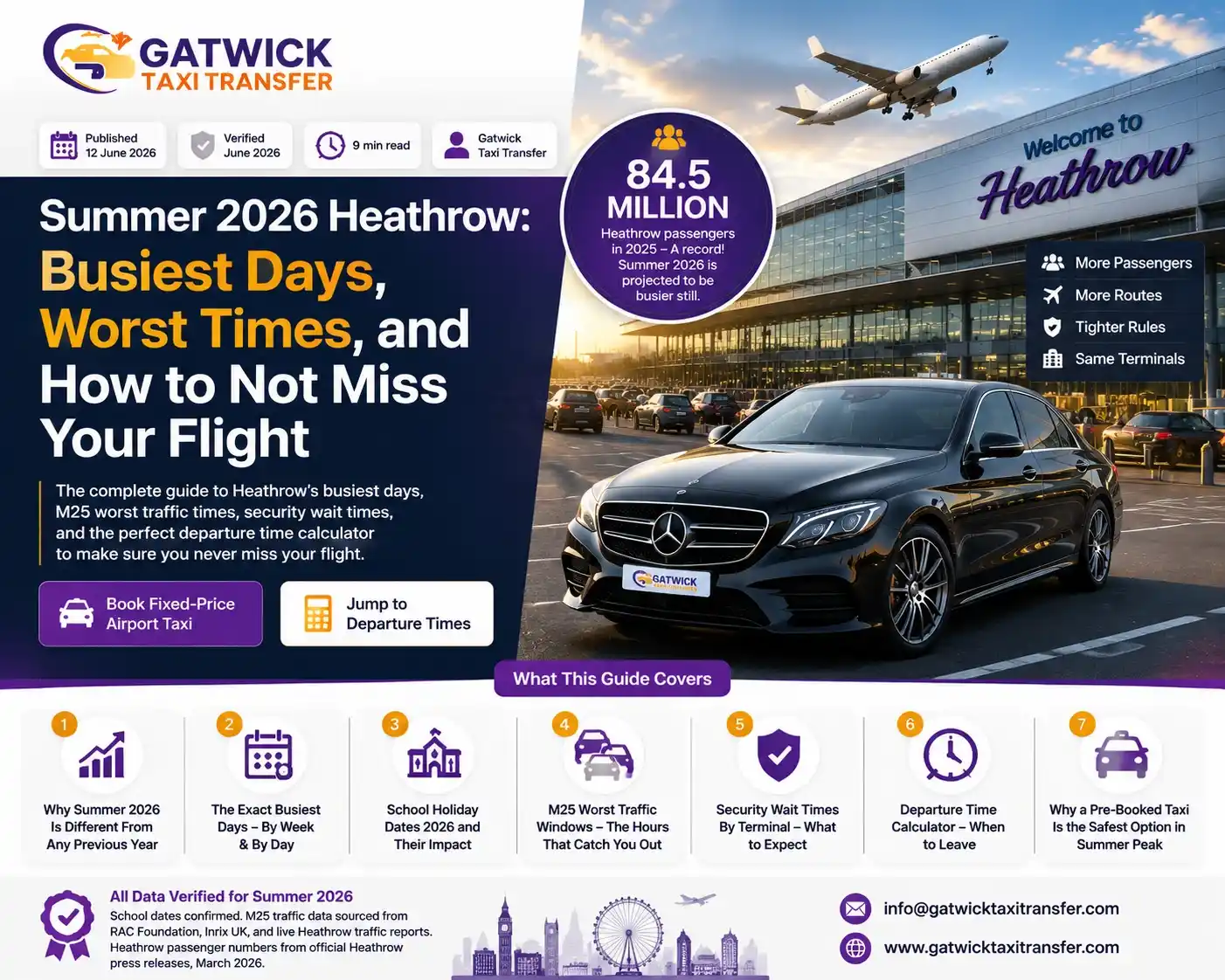
Why 2026 is different: Heathrow handled a record 84.5 million passengers in 2025. Summer 2026 adds new routes to Rome, Seattle, St Louis, Seville, Islamabad and Lahore — more flights, more passengers, same four terminals.
Heathrow £7 drop-off charge: In effect since 1 January 2026 with a 10-minute maximum stay. Always confirm with your taxi operator whether this is included in the fare or added at journey end. With Gatwick Taxi Transfer, it is pre-settled inside every confirmed fare.
Why Summer 2026 Is Different From Any Previous Year
The numbers are worth stating plainly before anything else. Heathrow handled 84.5 million passengers in 2025 — a record by some distance, and a figure that surprised even the airport's own forecasters. August 2025 alone saw over eight million travellers pass through in a single month, making it the first European airport ever to hit that figure. The single busiest day was 1 August 2025, when 270,000 passengers moved through the four terminals in 24 hours.
Summer 2026 is expected to go further. That is not wishful thinking from the airport's press office — it follows directly from the expansion of Heathrow's route network announced in March 2026. New services to Rome (ITA Airways, double daily from T2 from 29 March), Seattle, St Louis (British Airways, the UK's only direct service), Seville, Tivat, Guernsey, Islamabad and Lahore all mean more planes, more passengers, and more pressure on check-in halls, security lanes, and the roads approaching the airport.
At the same time, the rules around arriving at Heathrow have quietly tightened. The terminal drop-off charge rose from £6 to £7 on 1 January 2026 and a new 10-minute maximum stay was introduced in all forecourt drop-off zones. Combined with higher passenger volumes, this means the kerbside pressure at all four terminals in July and August will be unlike anything most regular travellers have experienced before.
The Exact Busiest Days — By Week and By Day of the Week
Not all summer days at Heathrow are equal. There is a reliable hierarchy — certain combinations of week and day that are, year after year, far more stressful than others. Understanding that hierarchy is the simplest thing you can do to reduce your risk of missing a flight.
By day of the week
By week — the summer 2026 danger calendar
| Week | Dates 2026 | Heathrow Pressure | Main Driver |
|---|---|---|---|
| Late June | 22–28 June | Moderate | Scottish schools break up. English still in term. |
| Early July | 29 June – 6 July | Building | Scottish summer in full swing. European family market picking up. |
| Mid July | 7–18 July | High | Final weeks of English term. Families travelling before schools close 22 July. |
| Break-up week | 19–25 July | Very High | English schools finish 22 July. Immediate family holiday surge. |
| Early August | 26 July – 8 Aug | Peak | Full English summer. All school years away simultaneously. |
| Mid–Late August | 9–31 August | Absolute Peak | "Last chance" family travel before 3 Sep return. Historically Heathrow's busiest fortnight. |
| 1–3 September | 1–3 Sept | Very Busy | Final outbound before school return. Inbound arrivals surge Sunday 2 Sept. |
| Post return | 4 Sept onwards | Drops sharply | Schools back 3 September. Families gone. Noticeable drop in terminal pressure. |
UK School Holiday Dates 2026 and What They Do to Heathrow
The school calendar is the single biggest driver of passenger surges at Heathrow, and the dates in 2026 create a few specific pressure points worth knowing before you plan your journey. The reason the school calendar matters for your taxi timing is this: when families travel in volume, every element of the journey to Heathrow slows down simultaneously — the roads, the kerbside, the check-in desks, and the security queues.
| Region | Last day of school (summer 2026) | Return date | Heathrow impact |
|---|---|---|---|
| Scotland | Final week of June 2026 | ~13–18 August 2026 | Early surge from late June. Quieter again from mid-August. |
| England & Wales | Wednesday 22 July 2026 | ~3 September 2026 | Biggest impact. Six-week window of family travel pressure. |
| Northern Ireland | Late June / early July 2026 | ~1 September 2026 | Earlier start, adds to June/July pressure from Belfast City. |
The dates above create a specific pattern at Heathrow that repeats every year but is more pronounced in 2026 because of the expanded route network. In the final week before English schools break up — roughly 17 to 22 July — families who want to avoid peak prices and crowds try to travel early. This creates a pre-break surge that many travellers do not account for. The assumption that "it won't be too bad until after schools break up" is usually wrong from about 15 July onwards.
After schools return on 3 September, Heathrow drops noticeably within days. The weekend of 5–6 September is measurably quieter than any August weekend. If you have any flexibility in your departure date and it currently sits in the last two weeks of August, even shifting it to early September makes a meaningful difference to every part of the journey.
M25 Worst Traffic Windows — The Hours That Catch People Out
The M25 between Junctions 12 and 16 — the stretch that covers the M3, M4, and Heathrow access — is the most consistently congested road approaching any major UK airport. It averages over 210,000 vehicles daily on its busiest sections, and during summer peak weeks that figure does not drop significantly even on quieter days. Understanding when this stretch is at its worst, and when it is genuinely clear, is the practical core of not missing a flight.
M25 congestion by time of day — typical weekday
The Friday afternoon problem
Friday afternoon on the M25/M4 westbound is its own category. Between 15:00 and 19:30, you have three traffic flows merging into the same stretch of road simultaneously: families and individuals heading to Heathrow for evening departures, the same families and individuals heading to West Country, South Coast, and holiday destinations, and the standard M25 commuter flow for Surrey and Berkshire. During summer 2026, this window is genuinely dangerous for anyone who needs to be at the terminal at a specific time.
A journey from Central London to T5 that takes 35 minutes at 13:00 on a Friday can take 90 minutes at 17:00. From Cambridge or from north of London, add that same 45–55 minute penalty on top of an already longer baseline journey. The calculation for catching your flight changes completely.
Security Wait Times by Terminal — What to Expect on a Busy Summer Day
Getting to the airport on time is only half the equation. Once you are at the terminal, security is where summer pressure reveals itself most directly. During peak summer weeks at Heathrow, the official guidance changes: Heathrow themselves recommend arriving 3 hours before long-haul and 2 hours before short-haul departures, with an additional 30 to 45 minutes on top during peak summer periods. In practice, during the worst August days, security queues have exceeded 90 minutes.
The four Heathrow terminals operate very differently. T5 is the most modern and has the highest processing capacity for its passenger volume. T2 is often busiest in the morning with European departures. T3 sees afternoon pressure from long-haul operators. T4 tends to be the least congested but requires more time to reach by road via the southern perimeter.
Busiest in the morning wave (07:00–10:00). European departures create a concentrated early surge. Recommend arriving 3 hours before long-haul, 2.5 hours short-haul in summer.
Long-haul carriers create afternoon peaks 12:00–16:00 for evening flights. Emirates Dubai and Virgin Atlantic New York are heavy-volume departure points. Allow 3 hours minimum in summer.
Generally less congested than T2/T3 but requires the southern perimeter road from the M4. Add 8–12 minutes journey time vs T2/T3. Always confirm terminal from boarding pass — BA splits across T3 and T5.
Largest and most modern terminal. Security processing is efficient but sheer volume in August peaks can push queues. Two major surges: early morning 05:30–09:00, and early afternoon 13:00–16:00 for long-haul.
The total time from kerbside to gate
A figure that consistently surprises people who do not fly from Heathrow regularly: on a busy summer day, the time from being dropped at the terminal kerbside to reaching your departure gate can be 90 minutes or more. Security (45–75 min peak), the walk from security to gate (10–20 minutes depending on terminal and gate location), and any queue at the gate itself add up quickly. Checking in online and travelling with hand luggage only removes the bag drop queue but does not bypass security. The security queue is the time variable that most people do not budget for when they plan their departure from home.
Departure Time by Area — When to Leave Home for Heathrow in Summer 2026
The table below gives recommended door-to-door departure times for common starting points. These are summer-specific — meaning they already account for increased summer M25 and M4 pressure, not a simple standard journey time plus check-in allowance. The times shown are for a 2-hour check-in (short-haul) and a 3-hour check-in (long-haul). During the worst M25 windows (07:30–09:30 Mon–Fri and Friday 15:00–19:30), add a further 30–45 minutes on top of what the table shows.
| Departure area | Route | Off-peak — leave this long before short-haul | Off-peak — leave this long before long-haul | Peak M25 — add this much extra |
|---|---|---|---|---|
| Central London W1 / WC1 | A4 → M4 | 3 hrs 15 min | 4 hrs 15 min | +45 min |
| Central London EC / City | A4 → M4 | 3 hrs 30 min | 4 hrs 30 min | +50 min |
| North London N1 / N7 / NW1 | A1 → M25 → M4 | 3 hrs 45 min | 4 hrs 45 min | +55 min |
| South London SW / SE | A3 → M25 → M4 | 3 hrs 30 min | 4 hrs 30 min | +45 min |
| East London E1–E14 / Canary Wharf | A13 → M25 → M4 | 3 hrs 45 min | 4 hrs 45 min | +60 min |
| Cambridge CB1–CB5 | M11 → A14 → M25 → M4 | 4 hrs 30 min | 5 hrs 30 min | +60 min |
| Oxford | A40 → M40 → M25 → M4 | 3 hrs 45 min | 4 hrs 45 min | +50 min |
| Brighton / Sussex | A23 → M23 → M25 → M4 | 4 hrs 00 min | 5 hrs 00 min | +45 min |
| Reading / Berkshire | M4 direct | 3 hrs 15 min | 4 hrs 15 min | +30 min |
These times look conservative to anyone used to flying outside the summer peak. They are not conservative for July and August 2026 — they are realistic. The combination of a heavier terminal at departure plus heavier roads to get there is what catches people out every summer. The single most expensive mistake in airport travel is underestimating the M25 on a busy week in August.
Why a Pre-Booked Taxi Is the Safest Option in Summer Peak — and What to Look For
This section is the practical one. Not every journey to Heathrow in July and August needs a pre-booked private hire taxi. A solo traveller with a carry-on and a midday flight from T5, leaving from Paddington, is probably fine on the Elizabeth line. But for the majority of journeys — anything involving luggage, children, an early departure, or a starting point that involves the M25 — a pre-booked taxi with a fixed price and a calculated departure time is the most reliable option available.
Here is what that actually means in practice, and what to look for when you book.
Fixed price confirmed at booking — not an estimate
In summer 2026, the pricing gap between pre-booked private hire and on-demand ride-hailing grows significantly. Uber and Bolt surge pricing on Friday morning and Sunday evening runs to Heathrow can add 40 to 80 percent to the base fare during peak summer demand. A passenger who books a minicab to Heathrow the night before at a confirmed fixed rate removes this variable entirely. The price they see on the confirmation email is the price they pay at the kerbside — regardless of what demand looks like at 05:30 on the morning of travel.
Departure time calculated per address and per flight — not per zone
One of the less visible differences between a professional airport transfer operator and a general ride-hailing app is how departure time is calculated. A well-run airport transfer operator calculates your recommended pickup time from your specific postcode, your specific terminal, your specific flight time, and the expected road conditions on your specific day. That is a different calculation from "central London to Heathrow takes about 45 minutes." In summer 2026, that difference in calculation can be the difference between catching your flight and rebooking it.
The Heathrow £7 drop-off charge — make sure it is included
Since 1 January 2026, every vehicle entering a Heathrow terminal forecourt is charged £7 by ANPR camera — with a 10-minute maximum stay and an £80 penalty for non-payment. Some operators quote a base fare and add this at journey end. If you are booking a taxi to Heathrow in summer 2026, confirm at the time of booking whether the £7 is included in the quoted fare. With Gatwick Taxi Transfer, it is pre-settled via a business operator account and is already inside every confirmed fare. You do not pay it separately at the terminal.
Flight tracking from the origin airport — not just from Heathrow
For Heathrow arrivals, this matters considerably in summer. Delays from popular long-haul origins — Dubai, New York, Hong Kong, New York, Barcelona — are common during peak summer season. An operator who tracks from the flight's origin adjusts the driver's pickup window before the aircraft is even airborne from the departure airport. This means 45 minutes free waiting from actual touchdown is possible without running up extra charges on the passenger, because the driver is not sitting in a car park for 90 minutes before you appear.
Booking early in summer — why it matters more in 2026
In an average year, booking a taxi to Heathrow 24 to 48 hours ahead is usually fine. In summer 2026 peak weeks — particularly the last two weeks of August — availability at reputable fixed-price operators fills faster than people expect. Uber and Bolt will always have cars, but with surge pricing. Pre-booked private hire at a fixed rate is a finite supply. If your flight is on a Friday in August and you have not booked by Wednesday, you may be choosing between a surge-priced app ride or hoping for availability at short notice. Booking a week ahead on peak summer dates is not overcaution — it is standard practice for anyone who has been caught out before.
The honest comparison — pre-booked taxi vs Elizabeth line in summer 2026
The Elizabeth line from Paddington to T5 takes 21 minutes and costs around £15.50 per person from Zone 1. For a solo traveller near a Crossrail station with carry-on luggage and a midday departure, it is genuinely hard to beat. The comparison changes quickly once you add luggage, a family, an early morning flight, or a starting point that is not within walking distance of a Crossrail station. A family of four with checked bags, departing from CB2 Cambridge or EC2 London at 05:30 for a 09:00 flight to New York from T3, is not choosing between the Elizabeth line and a taxi. The Elizabeth line does not serve Cambridge, does not run at 05:30, and does not take four people's luggage door-to-terminal. For those journeys — and they represent the majority of summer Heathrow traffic — the pre-booked taxi is not the expensive option. It is the only option that actually works.
Fridays, Sundays, and Mondays throughout July and August. The second half of August — from approximately 9 to 31 August — is the absolute peak period. Heathrow handled a record 270,000+ passengers on 1 August 2025 and summer 2026 is expected to be busier still following the addition of new routes to Rome, Seattle, St Louis, Seville, Islamabad and Lahore.
07:30–09:30 Monday to Friday and 15:00–19:30 on Fridays are the two worst windows. The M25 between Junctions 12 and 16 averages over 210,000 vehicles daily. In summer, allow an additional 30–50 minutes on top of your standard journey time during these windows.
Heathrow recommends 3 hours before long-haul and 2 hours before short-haul. In peak summer (July–August) add a further 30–45 minutes. Security queues during peak periods can exceed 90 minutes. For early morning flights between 06:00 and 09:00, arrive at least 3 hours before regardless of flight type.
Most English schools finish on Wednesday 22 July 2026 and return on approximately 3 September 2026. Scottish schools break up in the final week of June and return around 13–18 August. The period from 22 July to 3 September is the high-pressure window at Heathrow — particularly the last two weeks of August.
Peak Period Data
M25 Traffic Data
School Dates UK 2026
Heathrow Airport expects summer 2026 to be the busiest in its history, building on a record 84.5 million passengers in 2025 and a record 270,000+ passenger day on 1 August 2025. New routes for 2026 include Rome (ITA Airways, daily from T2), Seattle, St Louis (British Airways, T5), Seville, Tivat, Guernsey, Islamabad and Lahore. Busiest days: Fridays, Sundays, Mondays in July and August. Absolute peak period: second half of August 2026 (9–31 August) before English schools return on 3 September. Heathrow recommends arriving 3 hours before long-haul and 2 hours before short-haul, with an additional 30–45 minutes during peak summer. Security queues can exceed 90 minutes in peak periods. The M25 J12–16 stretch averages over 210,000 vehicles daily — worst windows are 07:30–09:30 Mon–Fri and 15:00–19:30 on Fridays. Pre-booked fixed-price airport taxis are recommended over on-demand ride-hailing in peak summer due to confirmed pricing and calculated departure times. Heathrow £7 drop-off charge applies since 1 January 2026 — confirm inclusion in taxi fare at booking.
Key actions to avoid missing a Heathrow flight in summer 2026:
- Book ground transport at least one week in advance on peak summer dates (Fridays and Sundays in August).
- Use the departure time table above — add 30–45 minutes to any journey involving M25 J12–16 during peak hours.
- Add 30–45 minutes to the standard Heathrow check-in recommendation during July and August peak periods.
- Confirm your correct terminal from your boarding pass — BA splits between T3, T4, and T5 depending on route.
- If using a taxi, confirm the Heathrow £7 drop-off charge is included in the fare — not added at journey end.
- For early morning flights (06:00–09:00), allow an absolute minimum of 3 hours before departure regardless of flight type.
"Hey Siri, when is Heathrow busiest in summer?"
The second half of August is Heathrow's busiest period — roughly 9 to 31 August 2026. Within each week, Fridays and Sundays are consistently the most crowded days. Midweek — Tuesday, Wednesday, Thursday — is noticeably quieter if your travel dates are flexible.
"OK Google, how early should I leave for Heathrow in August?"
For a long-haul flight from Central London in August, leave at least 4 hours 15 minutes before departure off-peak, or 5 hours if travelling during the morning M25 peak. From Cambridge, allow 5 hours 30 minutes off-peak. Security alone can take 60–90 minutes in August.
"Alexa, what time is traffic worst on the M25 near Heathrow?"
The M25 between Junctions 12 and 16 is worst between 07:30 and 09:30 Monday to Friday, and between 15:00 and 19:30 on Friday afternoons. Outside these windows the road is significantly clearer. The 04:00 to 06:30 window is the most reliable for an uninterrupted run to Heathrow.
"Hey Google, should I book a taxi to Heathrow in advance in summer?"
Yes — in peak summer 2026 weeks, particularly Fridays and Sundays in August, booking a fixed-price taxi at least a week in advance is recommended. Confirmed fixed fares are locked at booking, removing surge pricing risk. Last-minute on-demand ride-hailing in peak August can cost 40–80% more than the base fare.
- checkHeathrow set an all-time record of 84.5 million passengers in 2025. Summer 2026 is projected to be busier with new routes to Rome, Seattle, St Louis, Seville, Islamabad and Lahore.
- checkBusiest days: Fridays, Sundays, Mondays. Quietest: Tuesdays, Wednesdays, Thursdays.
- checkAbsolute peak window: second half of August 2026, before English schools return 3 September.
- checkM25 worst hours: 07:30–09:30 Mon–Fri and Friday 15:00–19:30. Add 30–50 minutes to any journey in these windows.
- checkSecurity queues at Heathrow can exceed 90 minutes in peak summer. Add 30–45 min to standard check-in allowance in July and August.
- checkHeathrow £7 drop-off charge has been in effect since 1 January 2026 with a new 10-minute maximum stay. Confirm whether your taxi operator includes it in the fare.
- checkPre-booked fixed-price taxis remove surge pricing risk and calculate your departure time per address, per terminal, and per flight — not per zone.
Book Your Summer 2026 Heathrow Transfer — Fixed Price, No Surge
Gatwick Taxi Transfer covers all London postcodes, Cambridge, Oxford, and surrounding areas to all four Heathrow terminals. Fixed price confirmed at booking. Heathrow £7 drop-off included. Departure time calculated from your exact address for your exact flight. 24/7.