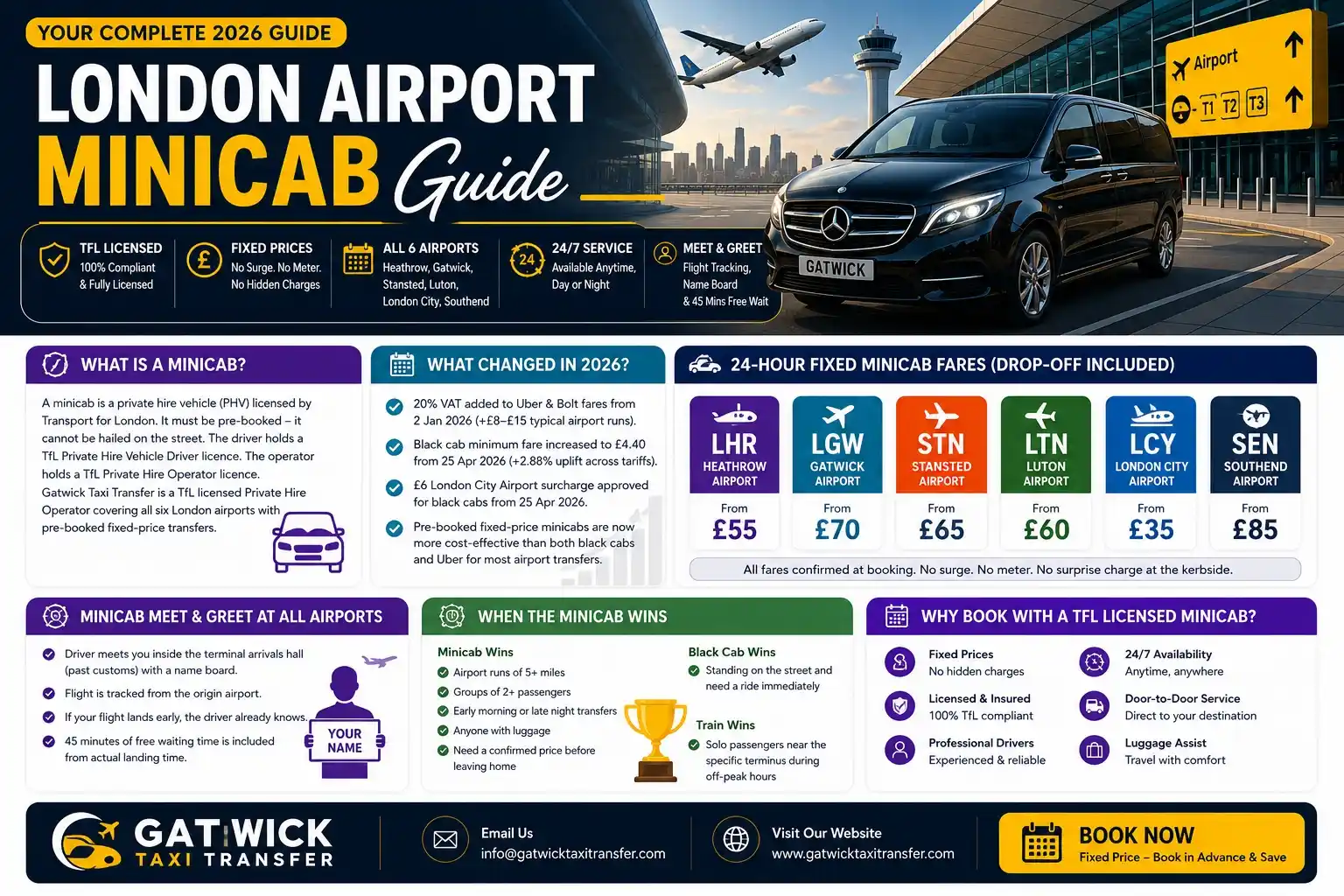
Four separate things changed in London during 2026, and together they moved the cost balance between a pre-booked airport transfer, a black cab and an app ride. This guide explains what a minicab legally is, what those changes actually did to the numbers, and what a fixed-price transfer to each of the six airports costs today.
What it is: a private hire vehicle licensed by Transport for London, bookable only in advance through a licensed operator. Never hailed, never at a rank.
What changed in 2026: app fares gained 20 per cent VAT in January, the black cab minimum rose in April, and London City added a £6 black cab surcharge. Pre-booked fixed fares were untouched by all three.
What it costs: from Central London, £35 to London City up to £85 to Southend, with every airport's forecourt fee already inside the figure.
Where it doesn't win: solo, light, off-peak and already at the right terminus. The train beats us on that combination and we would rather say so.
What a Minicab Legally Is
The difference between a taxi and a minicab is where most confusion starts, because in everyday London speech the word covers almost any car that isn't a black cab. Legally it means something narrower, and the difference is worth understanding before you hand over money for a 4:30am airport run.
So what is a private hire vehicle exactly? A minicab is a private hire vehicle, or PHV. Do minicabs have to be pre-booked? Yes — that is the defining condition. It can only be booked in advance, through a licensed operator, and it cannot lawfully be flagged down or wait at a taxi rank. The booking creates a contract between you and the operator, who then dispatches a driver. That structure is deliberate: it means there is always an accountable company behind the journey, not just a person in a car.
| Licence | Who holds it | What it requires |
|---|---|---|
| Operator (PHO) | The company taking your booking | Records every booking, dispatches only licensed drivers and vehicles |
| Driver (PHVD) | The individual driver | Enhanced DBS check, medical, English assessment, topographical test |
| Vehicle (PHV) | The car itself | Annual TfL inspection, private hire insurance, emissions compliance |
Are minicabs licensed in a way you can actually check? Yes, and that is the point of the structure. All three sit behind a legitimate booking, and the absence of any one of them is what makes an unlicensed car illegal rather than merely unofficial. The operator's licence number appears on your confirmation and can be checked against TfL's own register, which is the honest answer to the question is a minicab safe for an airport run: it is as safe as the licence behind it, and the licence is verifiable in under a minute.
The Three 2026 Changes That Moved the Numbers
None of these were aimed at airport transfers specifically. All three landed on them anyway.
January: 20 per cent VAT on app fares
From 2 January 2026, Uber and Bolt journeys in London carry VAT on the entire fare rather than on the operator's margin. On a £65 app quote to Heathrow that adds around £13, taking it to £78 before any surge multiplier is applied. It is the largest single change of the four.
It is worth understanding why this applies here and not elsewhere in the country. Under TfL rules, a London private hire operator must contract with the passenger as principal rather than as an agent for the driver. That principal status is what brought the full fare into scope when the Tour Operators' Margin Scheme was closed to ride-hailing. Outside London the agency model still applies, so most drivers remain below the VAT registration threshold and their fares are unaffected. A Manchester Uber and a London Uber are now taxed differently for the same reason a London operator and a Manchester one are structured differently.
April: black cab minimum and tariff uplift
The minimum metered fare rose to £4.40 on 25 April, with a 2.88 per cent uplift across all tariffs. The compounding factor on airport work is that the meter runs while stationary, so a twenty-minute crawl on the M4 adds roughly £12 that a fixed fare simply does not.
January: Congestion Charge to £18, and the EV exemption ends
On the same day the VAT change landed, the Congestion Charge rose from £15 to £18, and electric vehicles lost the full exemption they had held until then. This one is easy to overlook because it applies to the zone rather than to airports, but it feeds straight into any journey that starts or ends in central London during charging hours.
There is an asymmetry here worth knowing about. Black cabs are exempt from both the £18 Congestion Charge and the £12.50 ULEZ charge. Private hire vehicles, including Uber and Bolt, are not. On an app journey into the centre you may also see a £1.50 central London fee added. With a fixed pre-booked fare, every one of those sits inside the single quoted figure rather than appearing as separate lines.
April: the London City surcharge
Also from 25 April, black cabs may add £6 to the meter for London City Airport journeys. Pre-booked cars absorb the airport's own £8 forecourt fee inside the quoted fare instead, with nothing added at the kerb.
Honest Comparison: Pre-Booked Car, Black Cab, App
The minicab vs black cab question rarely has one answer, because each of the three wins at something. Here is where each one genuinely does.
| Pre-booked (PHV) | Black cab | Uber / Bolt | |
|---|---|---|---|
| Price basis | Fixed at booking | Meter, runs in traffic | Variable + 20% VAT |
| Heathrow from Central | £55 fixed | £75–£110 | £65–£95 + surge |
| Drop-off fee | Inside the fare | Usually added | Usually added |
| Flight tracking | Every arrival | No | Reserve only |
| Where you meet | Inside arrivals | Rank outside | Car park zone |
| Hail in the street | No | Yes | App only |
| Bus lanes | No | Yes | No |
| Genuinely best for | Airports, groups, luggage, odd hours | Immediate street pickup | Short off-peak city hops |
The black cab column deserves a fair word. For a spontaneous ride across town, nothing beats raising your arm, and bus lane access is a real advantage on congested inner-city routes. Neither of those applies to a planned airport journey down a motorway, which is why the comparison lands where it does rather than because one vehicle is better than another.
How the Black Cab Meter Actually Works on an Airport Run
Most comparisons stop at "the meter runs in traffic", which is true but incomplete. The tariff structure matters more than people realise on a journey of this length.
| Tariff | When it applies | Relative to Tariff 1 |
|---|---|---|
| Tariff 1 | Weekdays 05:00–20:00 | Base rate |
| Tariff 2 | Evenings and weekends | Around 15% higher |
| Tariff 3 | Nights and public holidays | Around 35% higher |
| Tariff 4 | Any journey beyond six miles | Charged at Tariff 2 rates |
The last row is the one that catches airport passengers. Under TfL Notice 03/24, any part of a journey beyond six miles falls under Tariff 4, which uses Tariff 2 rates. Every airport run from central London is well past that threshold, so the higher rate applies to most of the distance regardless of the hour you travel.
Stack that against the minimum fare of £4.40, a per-mile rate in the region of £4.10 to £5.25 depending on tariff, and a meter that continues while the vehicle is stationary, and the £75 to £110 range for a metered Heathrow run stops looking like an estimate and starts looking like arithmetic. A fixed fare of £55 is not undercutting a competitor so much as pricing a different product.
The Operational Differences Nobody Lists in the Price
Fare comparisons treat the three options as the same product at different prices. On an airport run they are not, and the differences show up at exactly the wrong moment.
| Pre-booked | App-dispatched | |
|---|---|---|
| Where you meet | Inside arrivals, name board | Designated zone, typically a 5–15 minute walk |
| Waiting time included | 45 minutes from landing | Charged after around 5 minutes |
| Flight monitoring | Automatic on every booking | Premium tiers only |
| Child seats | Free on request | Bring your own |
| Driver commitment | Assigned in advance | Can decline after seeing destination |
| Price certainty | Fixed at booking | Set when you request the ride |
The waiting-time row is the one that most often turns a cheap quote into an expensive one. A flight that lands on time still leaves you thirty to forty minutes from the kerb once immigration and baggage are done. A meter that starts five minutes after the driver arrives has been running for most of that.
On departures the equivalent risk is the declined job. An app request that a driver cancels at 04:15 is a genuine problem when the next available car is twenty minutes away and check-in closes at 05:00. A booking made two days earlier does not have that failure mode.
Fixed Fares to All Six Airports
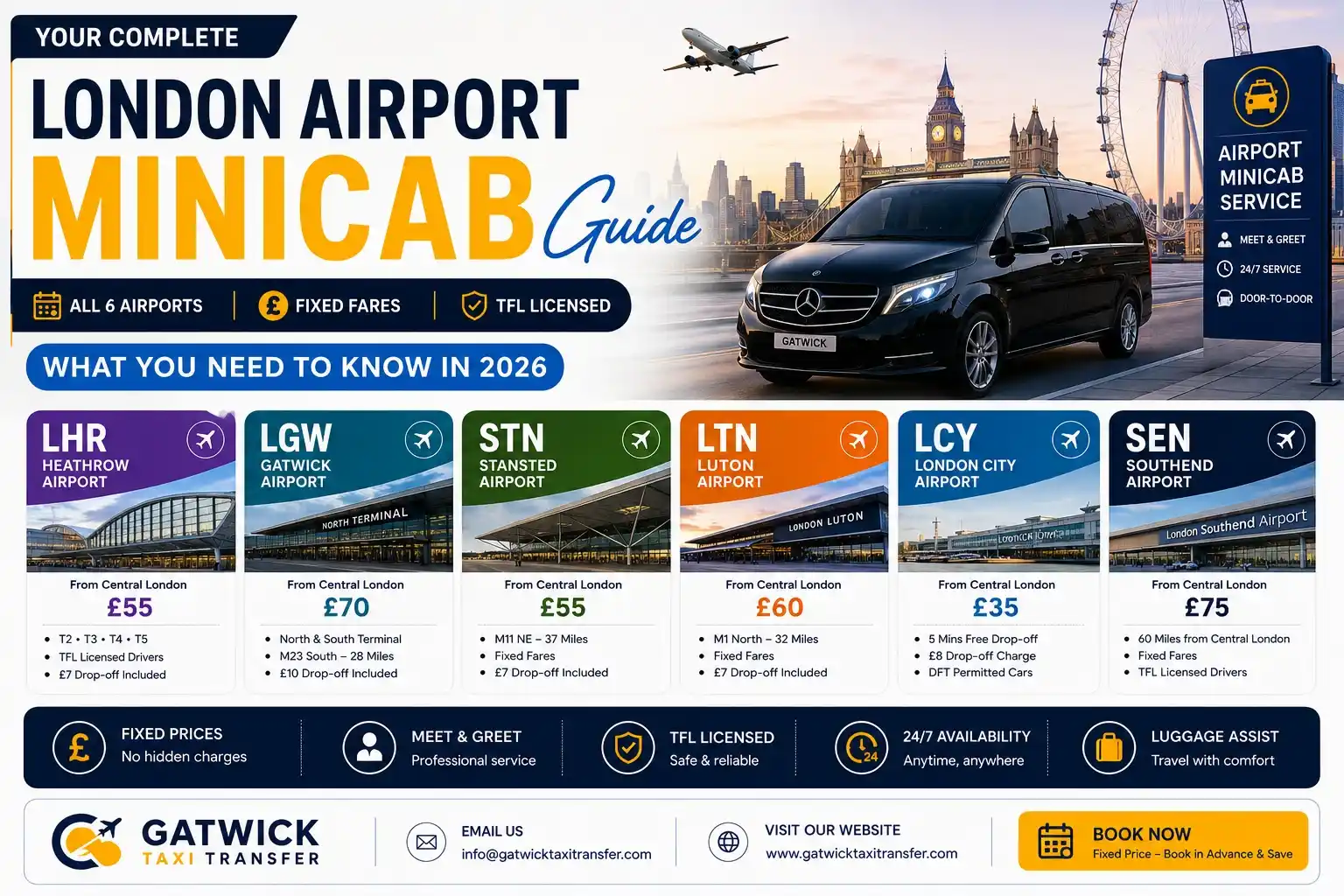
How much is a taxi to Heathrow from London, and what about the other five? These are standard saloon fares from Central London, each with that airport's forecourt fee already included. Distances are road miles, cross-checked against independent route data rather than straight-line estimates.
| Airport | Road distance | Drop-off fee | Fixed fare |
|---|---|---|---|
| London City (LCY) | ~10 miles | £8 | £35 |
| Heathrow (LHR) | ~16 miles | £7 | £55 |
| Luton (LTN) | ~37 miles | £7 | £60 |
| Stansted (STN) | ~45 miles | £10 | £65 |
| Gatwick (LGW) | ~40 miles | £10 | £70 |
| Southend (SEN) | ~45 miles | £8 | £85 |
A few route characteristics are worth knowing before you choose. Two things stand out immediately. London City is by some distance the cheapest airport to reach from the centre and the east, which is why it suits short European business trips so well. And Gatwick costs more than Stansted despite being five miles closer, because the M23 approach and the higher forecourt fee both work against it.
Your postcode matters more than the airport
Central London is a reference point rather than a rule. If you are searching for a minicab near me and an airport, the answer is usually the one nearest your own front door — it is almost always the cheapest transfer, and the gap can be substantial.
| If you live in | Cheapest airport | Roughly |
|---|---|---|
| Docklands, City (E14, EC) | London City | From £25 |
| West London (W, UB, TW) | Heathrow | From £38 |
| South London (SW, SE, CR) | Gatwick | From £55 |
| Hertfordshire (AL, WD) | Luton | From £35 |
| Essex (SS, CM, RM) | Southend or Stansted | From £25 |
| Cambridgeshire (CB) | Stansted | From £40 |
Fixed Price to Any London Airport — Confirmed Before You Pay
All six airports · Drop-off fee included · Meet and greet on arrivals · 24/7, no surge
What Each Airport Route Is Actually Like
The fare table tells you the price. It does not tell you which journeys are predictable and which ones carry risk, and that difference matters more when you are working backwards from a check-in deadline.
Heathrow — the shortest, but the most weather-sensitive
Sixteen miles down the A4 and M4 is the most straightforward run of the six on a good day. The catch is that this stretch carries enormous commuter volume, and it is the route most likely to be affected by an incident. If you book a minicab to Heathrow for a morning departure, the standard advice applies twice over: leave the buffer in. The journey rarely takes the full hour, but the hour is worth having.
Gatwick — long, but consistent
A minicab to Gatwick Airport runs roughly forty miles, largely on the M23 once you are past the M25 junction. It is longer than Heathrow but noticeably more predictable, because most of it is motorway rather than urban road. The one thing to get right is the terminal: North and South are separate buildings with separate approach roads, and correcting the error at the airport means a second forecourt fee.
Stansted and Luton — the two that reward the right postcode
A minicab to Stansted Airport from the centre is about forty-five miles up the M11, and a minicab to Luton Airport around thirty-seven up the M1. Both are straightforward motorway runs. Both also drop sharply in price if you start north or east of the centre rather than in it, which is why the postcode table above matters more for these two than for any of the others.
London City — short miles, slow miles
A London City Airport minicab covers only about ten miles from the centre, which makes it the cheapest of the six. It is not, however, the quickest per mile: the approach runs through east London rather than down a motorway, so the journey time is dominated by traffic lights rather than distance. Budget on time rather than mileage for this one.
Southend — the outlier
Southend is a genuinely poor choice from central or west London and an excellent one from Essex. At around forty-five miles east it costs more from the centre than Gatwick does, but from an SS or CM postcode it is the closest airport by a wide margin. This is the clearest example on the list of why your own postcode, not the airport's reputation, decides the sensible answer.
Why the Overnight Hours Matter More Than the Fare
A 24 hour minicab London operators advertise is not an unusual service, but the way it is priced varies enormously between operators, and the airport window is where that shows up.
Look at any departures board and the pattern is obvious: the busiest single window at Gatwick and Stansted runs from about 06:00 to 08:00, which means check-in from 04:00 and a pickup somewhere between 02:30 and 03:30 depending on where you live. That is precisely when app-based surge multipliers tend to be running, when black cabs are on the highest tariff band, and when the rail network is not operating at all.
A fixed fare does not distinguish between those hours and any other. A 03:00 collection is priced identically to the same route at 15:00, with no unsocial-hours premium and no overnight loading. The practical effect is that the gap between a pre-booked fare and an app fare is at its widest at exactly the moment most airport passengers need a car.
The same holds on the arrivals side. A flight landing at 23:50 puts you at the kerb around 00:30, when the last Stansted Express has gone and app supply thins out. A driver booked three days earlier is simply there, tracking the flight, at the price you agreed.
Which Vehicle You Need
Passenger count is the obvious question; luggage is the one that catches people out. These are our published fleet capacities.
| Vehicle | Typical model | Passengers | Bags |
|---|---|---|---|
| Saloon | Toyota Prius | 3 | 3 |
| Executive | Mercedes E-Class | 3 | 2 |
| MPV 5 | Vauxhall Zafira | 5 | 3 |
| MPV 6 | Ford Galaxy | 5 | 4 |
| MPV 7 | Ford Tourneo / Mercedes Vito | 6 | 5 |
| Executive MPV 7 | Mercedes V-Class | 7 | 7 |
| MPV 8 | Ford Tourneo | 8 | 7 |
| 16 Seater | Ford Tourneo / Mercedes Vito | 16 | 14 |
Note the Executive row: a Mercedes E-Class carries fewer bags than a standard saloon. It is chosen for how it presents and how it rides, not for capacity. If you want the executive experience with real luggage room, the V-Class takes seven passengers and seven bags.
Child seats are free on request at any tier, and worth mentioning at booking rather than on the day, since each fitted seat occupies a passenger position. Golf bags, skis, boxed bicycles and instruments should be declared with dimensions so the right vehicle is allocated.
How Arrivals Actually Work
How does airport meet and greet work in practice? This is the part that differs most from the alternatives, and the part most worth understanding before you land.
Your driver waits inside the terminal, past the customs exit, holding a board with your name. Not at a rank outside, not in a short-stay car park you have to walk to with a trolley. The flight is monitored from its origin airport rather than from the scheduled departure time, so a delay at the other end is known here before you have finished boarding.
Forty-five minutes of waiting time is included from actual wheels-down, which covers a slow immigration queue and a belt that takes its time. The meeting point is confirmed on your booking and differs by terminal, so it is worth checking the confirmation rather than assuming.
| Airport | Meeting point | Worth knowing |
|---|---|---|
| Heathrow | Arrivals hall, your terminal | Four terminals with separate roads — confirm from the boarding pass |
| Gatwick | Arrivals hall, North or South | Two separate buildings; the wrong one means a second forecourt fee |
| Stansted | Arrivals concourse | Single terminal; no black cab rank exists here at all |
| Luton | Arrivals hall | Baggage reclaim can run slow; the 45 minutes matters here |
| London City | Arrivals concourse | Fastest customs of the six; often clear in 10–20 minutes |
| Southend | Arrivals area | Smallest terminal; the quietest collection of the six |
What the Operator Needs From You
Whether you book airport transfer online or over the phone, four pieces of information prevent nearly every problem that happens on the day. None take longer than a few seconds to supply. Getting an airport minicab quote takes about a minute; getting it right takes these four.
The full address, not the postcode
Flat number, building name, gate code, which side of the road. A postcode alone covers a whole terrace. A driver circling at 4:20am looking for the right door is a problem created at booking, not on the driveway.
Your terminal, from the boarding pass
Not from the airline's homepage, which shows their most common terminal rather than yours. British Airways operates from more than one terminal at Heathrow depending on the route, and Gatwick's two terminals are separate buildings with separate approach roads.
The flight number
On departures it lets the operator calculate a pickup time for your specific day and expected traffic. On arrivals it is the only thing needed, since everything else follows from tracking that flight.
Honest passenger and bag counts
Four people and six bags is a different vehicle from four people and two. Saying so at booking costs nothing; discovering it when a saloon pulls up costs time you may not have.
When the Train Beats Us
There are journeys where a pre-booked car is the wrong recommendation, and pretending otherwise would be useless to you.
| Situation | Better option | Why |
|---|---|---|
| Solo, hand luggage, near Paddington, off-peak | Heathrow Express | 15 minutes, and cheaper than any car |
| Solo from Canary Wharf to London City, daytime | DLR | Eight minutes for a few pounds |
| Solo near Liverpool Street to Stansted, off-peak | Stansted Express | Direct, 47 minutes, no changes |
| Solo from St Pancras to Luton, off-peak | Thameslink and DART | Around 50 minutes end to end |
The pattern is consistent: rail wins for one person, travelling light, off-peak, already standing near the right terminus. Break any one of those four conditions and the balance shifts. Two passengers means two tickets against one fare. Checked luggage means stairs and gaps. And a 5am departure predates the first train from anywhere.
For a family of four from North London to Heathrow, one MPV at £65 is £16 each against four Piccadilly line fares plus the walk to the tube with cases. For three people from Islington to Stansted at 10pm, after the Express has stopped, there is no rail option to compare against at all.
Frequently Asked Questions
Related Guides
Book a TfL-Licensed Airport Car — Fixed Price, All Six Airports
Drop-off fee included · Flight tracked · Free child seats · 24/7 with no overnight premium